
The 2021 Big Ten season kicks off this Saturday with Nebraska vs. Illinois at 1 p.m. Eastern. This will be the first Big 10 game of the year, and the first game in over a year that will resemble what we are used to imagining Big 10 football to look like as the Big 10 did not allow fans last season.
(more…)General
-
Clifford the Big Red Question Mark
I would like to start this off by saying I am aware this does not sound reasonable by any means, but in my mind, the entire 2021 Penn State Football season (on the offensive side of the ball) comes down to how well Sean Clifford plays against Wisconsin in week 1.
Why Wisconsin?
If the Nittany Lions can win the season opener against the Badgers that could provide enough momentum and confidence for the team for the start of the year. The first half of the season goes as follows: @Wisconsin, Ball State, Auburn, Villanova, Indiana, and @Iowa. Despite coming off of a miserable 4-5 2020 campaign (that started 0-5), a win IN Madison could reintroduce the Nittany Lions as the contender that the talent in that locker room should be considered. The next 5 games are all against teams that on paper Penn State should win. Wisconsin is going to play hard nose, in your face, football as they always do – but creative teams with superior talent (see OSU) can beat teams like that. Wisconsin, despite some close games, hasn’t beat Penn State in football in over a decade for that very reason.
Penn State football, specifically in the James Franklin era, has not proven to be a team that recovers from losses. The 2017 and 2018 MSU losses following the OSU loss are the most hurtful in recent memory, but I chalk up the start of the 2020 season to ‘loss fatigue’ as well. After a close “loss” to Indiana (that was only possible due to some poor decision making by Devyn Ford and a questionable 2-pt conversion call from the refs) Penn State never recovered. They dropped their second in a row understandably to a great OSU team, but then got manhandled at home by a weak Maryland team and dropped another to a pitiful Nebraska team the following Saturday. Those Maryland and Nebraska losses are unacceptable by any stretch of the imagination when you think of the talent that Penn State had. Their inability to overcome a loss had everything to do with the most recent Penn State season.
James Franklin can not allow that to happen again this year. A win at Wisconsin would prove that last year was indeed a fluke and the talent is more than just theoretical. A loss would be tough to swallow but ‘overcomeable’ – if the bounce back can actually happen this year. The issue with that … Ball State, the second game on the schedule, is not a cupcake of a team. They are projected to win the MAC this year easily and have some sure NFL talent on both sides of the ball. Auburn, despite a shaky year, is a big-time SEC team that, like Penn State, recruits well and is always competing. Indiana should regress but has big time players in QB Michael Penix Jr. and WR Ty Fryfogel which will be a challenge for any defense. Playing in Iowa is always a nightmare.
Penn State can not afford to drop a game and let it linger and spill over to the remainder of the season. If they can’t come out of the gate with a win, they will have MUST-WIN games over tough opponents. I have confidence in Penn State, but it’s hard to believe in the bounce back until it’s been seen. The good news is Penn State (speaking on Offense today) has the team to do it. They are deep in the RB and TE room with explosive talent, likely the best OL in the Franklin era and possibly in the Big Ten, and have 2 incredible WRs in Jahan Dotson and Parker Washington with some young talent behind them. So, what is the worry?
Why Sean Clifford?
Penn State has so much talent and depth on offense except for the most important position on the field, QB. The depth is challenged because of 2020 backup QB Will Levis’s transfer to Kentucky. Behind Clifford now are Ta-Quan Roberson (career stats are 0-1 passing and one rushing attempt for -1 yards) and Christian Veilleux (hasn’t played a live snap since 2019). While both are talented, the complete and total lack of experience leaves a lot to be desired. If Sean Clifford were to go down with an injury, Franklin would be asking quite a lot out of his young QB room.
Injuries are only one part of the equation unfortunately. Last year, Clifford had lost the confidence of his coaches and was benched for Will Levis for a significant portion of the second half of the season. He had clearly regressed in almost all major aspects as QB play such as accuracy, foot-work, ball security, and confidence. This Penn State team cannot afford the same play or regression this year. All of the depth along the offensive skill positions and the true potential of a great Offensive Line would mean nothing if the QB cannot manage the game correctly.
To Clifford’s credit, it is a very weird situation learning from and playing for 3 different offensive coordinators over his tenure at Penn State. Clearly the transition from Ricky Rahne in 2019 to Kirk Ciarrocca was not one that benefitted Sean. I can only hope that Franklin believes that moving on from Ciarrocca and moving to new OC Mike Yurcich can pay immediate dividends in 2021 and that Clifford can be at least restored to his 2019 self if not much better.
All of this being said, I think that ‘average to above average’ QB play from Sean Clifford would result in an excellent Penn State football team in 2021. Less than that, I am not so sure a win against Wisconsin is possible. And with a loss to Wisconsin, using the past as a benchmark, I am skeptical of this squad’s ability to bounce back with some tough opponents throughout the beginning of the season. That leads me to my ‘clickbait-esque’ theory that Sean Clifford’s play in Game One can literally make or break this season.
—
There are some incredible players with a lot of experience on this Penn State football team. I am beyond excited to see what they look like in action after a real off-season without most of the craziness that was 2020. If you are like me, keep your fingers crossed for Sean Clifford’s sustained health and success and that could and should lead to a special season of Nittany Lion football. WE ARE!
-

The Most Consistent Quarterbacks in College Football
Do you ever feel like your team’s quarterback chokes away the game’s biggest moments, or that he is a “baller” and elevates his game in the last two minutes? Well you’re in luck. I looked at just that, to see which QBs play differently given the situation they’re in in the game.
I looked at some basic QB stats like success rate, completion rate, and interception rate, and then broke them down based on some game situations like playing down, close games (10 or less point-differential), final two minutes, and quarter to see which players were the most and least consistent in different situations. My guess was that the best players in college football would either be the same or elevate their game in these situations.
You may notice that some of college football’s biggest stars from 2020 (Justin Fields, Mac Jones, Trevor Lawrence, etc.) are missing from many of these graphs. That’s because they didn’t find themselves in a lot of these situations too often, thanks to the dominance of their teams. Rarely did they trail in games, or have to pass in the last two minutes. So therefore, they’ve been excluded for having so few attempts in many of these situations.
Playing Down
First, we’ll start by looking at who plays well (and poorly) while losing a game. I’ve taken each player’s change in completion rate when losing a game compared to when they’re winning a game on the x-axis, and their change in interception rate when losing compared to when winning on the y-axis, meaning that players who are throwing more incompletions and interceptions than normal when they start losing will be in the top left, and players who throw less interceptions and complete more passes will go to the bottom right.

A lot of players increase their interception rate when they’re losing, indicating that they’re taking more risks to try to catch up. Very few actually throw fewer interceptions. Below is the same graph, but the most consistent players are highlighted instead.

Another way of looking at this could be with change in success rate on the y-axis instead. As a quick refresher, success rate is the rate of plays deemed successful, meaning gaining 5+ yards on 1st down, 70% of the yards to go on 2nd down, and all of the remaining yards to go on 3rd and 4th downs.
A few guys stand out above the rest here in playing better when down and, unsurprisingly, they were three of the biggest names in College Football last year: Feleipe Franks, Ian Book, and D.J. Uiagalelei.

Close Games
Here is the same graph, but looking at the difference in stats between playing in a close game or not. I defined a close game as anything within 10 points or less separating the teams. Here are some of the outliers when it comes to playing better (or worse) in a close game.

And below, you’ll find who the most consistent players are whether the game is close or not.

Late Game
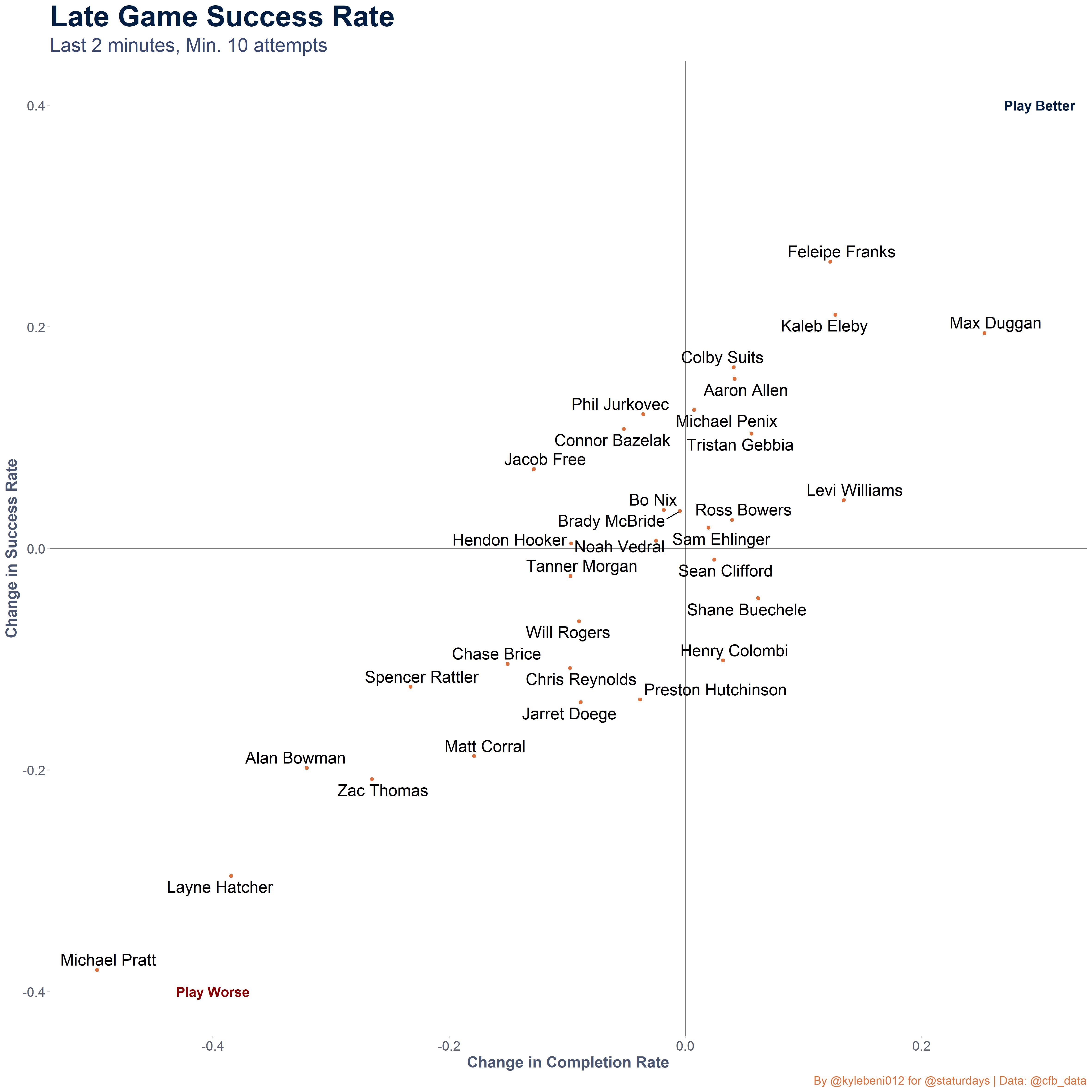
Here, we’re looking at QB play in the final two minutes of regular time. This graph has considerably fewer players because there weren’t as many quarterbacks who had thrown at least 10 passes in the last two minutes last season. Most teams that are winning will run the ball in the last two minutes, so that leaves only the QBs that trailed, and likely trailed more than once, late in games. Throw in a shortened season and our opportunities to collect this data last season were limited. Still, we see a good representation of players who stepped up, or crumbled, in the final two minutes.
Quarter to Quarter
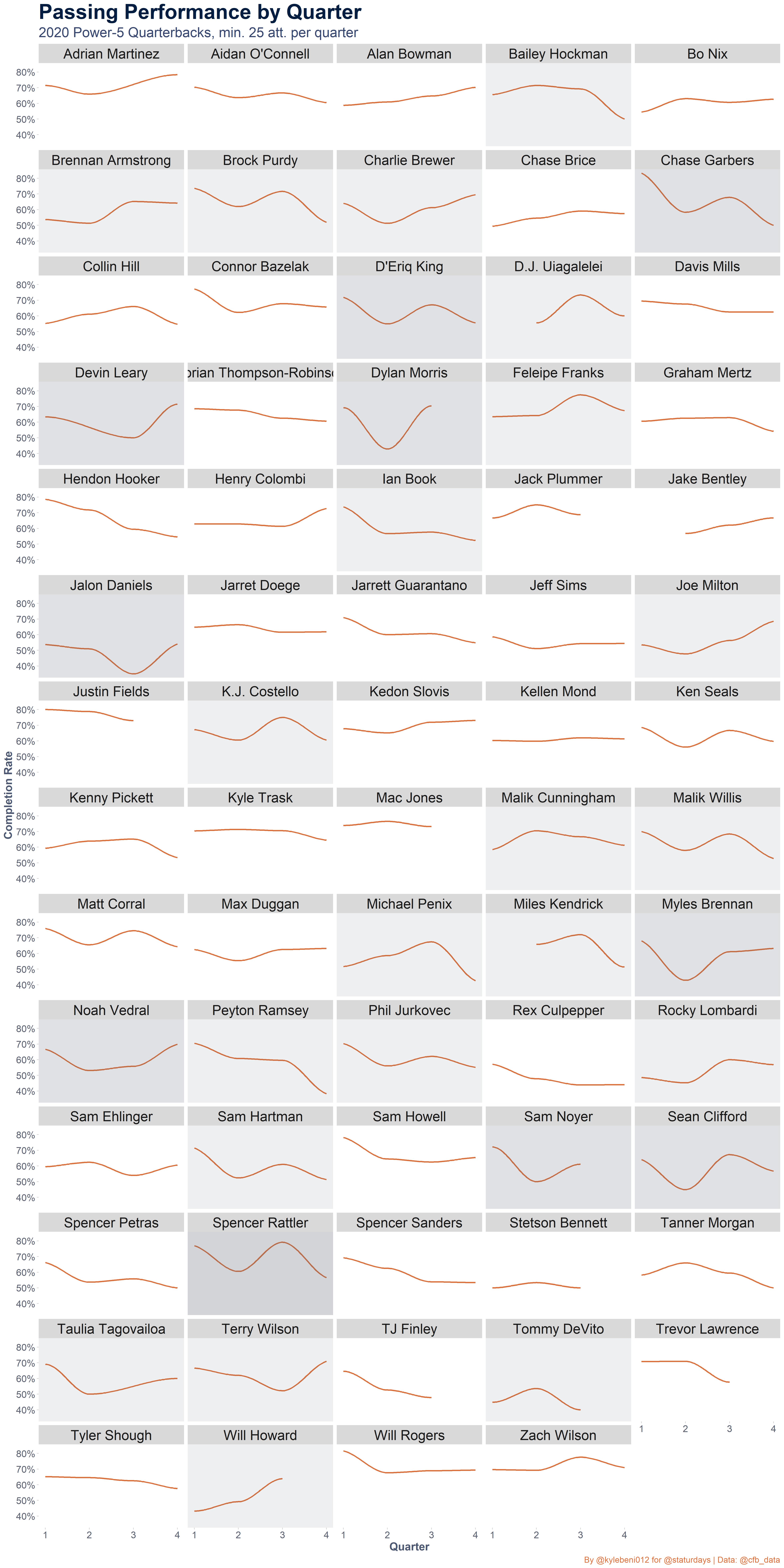
Last, I looked at success and completion rates from quarter to quarter to see if anything stood out. The darker boxes show greater variation in consistency from one quarter to the next. This first one shows success rate.

And last but not least, here’s how each QB’s completion rate changes by quarter.
 Staturdays