General

  • Which American Man is Most Likely to Win a Major First?

    Which American Man is Most Likely to Win a Major First?

    Entering the 4th round of the U.S. Open, each of the matches in the bottom half of the draw feature an American man. And there were three more chances yesterday for the top half of the draw to add another three Americans to the 4th round, for a total of seven Americans (two lost at the time of publishing, and the third—Tien—is trailing 2 sets to 1). But of these Americans, which is best poised to get across the finish line?

    “They are some of the biggest, strongest servers in the game, but struggle in the return game.”

    The Americans by seed are:

    (8) Ben Shelton

    (9) Taylor Fritz [Out]

    (11) Frances Tiafoe

    (14) Learner Tien

    (16) Brandon Nakashima [Out]

    (20) Tommy Paul

    So let’s take a look at their performance and stats and make an inference.

    Recent Performance

    Of the seeded Americans, Tiafoe is the most recent to play in an ATP 1000 final, where he lost to Arthur Fils (who then exited the U.S. Open in Round 1 to Stefanos Tsitsipas). That match was a three-setter which Tiafoe lost 6-0 in the third set due to poor serving and great returning by Fils.

    Just prior to that, Ben Shelton beat fellow American Brandon Nakashima in two sets to win in Montreal. While Nakashima would make it to the semifinals in that tournament, Shelton was out in his first match in the round of 64.

    The previous 1000-level tournament was on Clay in May, so I’ll stop there. The most recent 500-level tournament was D.C. in July, which Taylor Fritz won in two sets against the 19-year-old Rafael Jodar.

    Season Stats

    Serving

    While Ben Shelton is the undisputed biggest American server on tour with a first serve that can eclipse 145 mph, Taylor Fritz—with five years experience and an extra inch of height—has a slight edge when it comes to first serve points won and aces. Shelton has the edge on second serve points won and overall service game win rate, indicating that perhaps Shelton is a bit better than Fritz in a longer rally, although I couldn’t find data on this.

    Although, according to ATP’s “shot quality” metric (which is a bit of a black box but is described by them below), Fritz has a top-20 forehand and backhand on tour, while Shelton sits at 61 and 38 in those categories.

    Shot Quality – measures the quality of the player’s serve, return, forehand and backhand on a 0–10 scale. Shot Quality is calculated in real-time by analysing each shot’s speed, spin, depth, width, and the impact it has on the opponent. Tour averages: Serve 7.9, Return 6.5, Forehand 7.5, Backhand 7.1.

    – ATP Tour

    Returning

    Learner Tien is the best American returner on tour this year, winning 31.4% of first serve return points (Alcaraz is best at 34% and Sinner is fifth at 33%). Tommy Paul is 14th.

    I had to skip down the list past several other Americans who aren’t in the U.S. Open to find Tiafoe’s first serve return rate (58th, 26.4%), Nakashima (64th, 25.9%), and finally Fritz (73rd, 25.3%), and Shelton (79th, 24.4%).

    On second serve, the story is mostly the same for Shelton (70th) and a bit better for Fritz (30th), but therein lies the problem with the top American men at the moment: They are some of the biggest, strongest servers in the game, but struggle in the return game. So while they tend to hold serve, they struggle to find breaks themselves, especially when they face similarly good servers or highly competent returners. And winning by tiebreak only gets you so far.

    (At the time of writing this, Taylor Fritz lost to Francisco Cerundolo—the sixth-best returner according to ATP—in five sets.)

    Tien is the only American in the top 15 on both first and second return.

    Tommy Paul is the only American in the top 25 in both serving and returning.

    Below, what I tried to do is account for the in-rate on the 1st serve to downwardly adjust the 1st-serve win-rates. In essence, having a 90% 1st serve win-rate is great, but if you only get your first serve in 10% of the time, you should be severely penalized for that (so that your adjusted 1st-serve win rate would be 9%).

    Then, I summed all four numbers (with 1st-serve win rate multiplied by in rate first), because you want all four of these numbers to be high, and re-ranked the Americans.

    Looking at things this way, we can see that Tommy Paul is the most balanced player, performing adequately well on service games and above-average in returning. This jives with the finding above that he is the only American man ranked top 25 in both.

    Tien is an excellent returner but is held back by his weak serve win-rate compared to the rest.

    Tiafoe is held back by his first-serve in rate.

    Four- and Five-Set Performance

    The other key difference in majors is that it is best of five. So how do the top Americans fare when they need to go beyond the typical three-setter?

    I couldn’t get all historical data, so I pulled data for the past year manually, and while the sample size is small, we can see that Nakashima has struggled when going beyond three sets this year, while Fritz and Shelton have fared well in four but struggled in five. They, along with Tien, have the most experience in longer matches this year.

    Of course, there’s some inherent bias in this data. The three-setters that these men won (or lost) are not represented, so these are only the matches where there was inherently some competition. This is also not controlled for tournament round or strength of opponent.

    Both of Nakashima’s losses came in rounds one or two. Shelton’s was his shocking first-round exit at Wimbledon. All the rest were scattered between rounds two and five.

    What Does Elo Say?

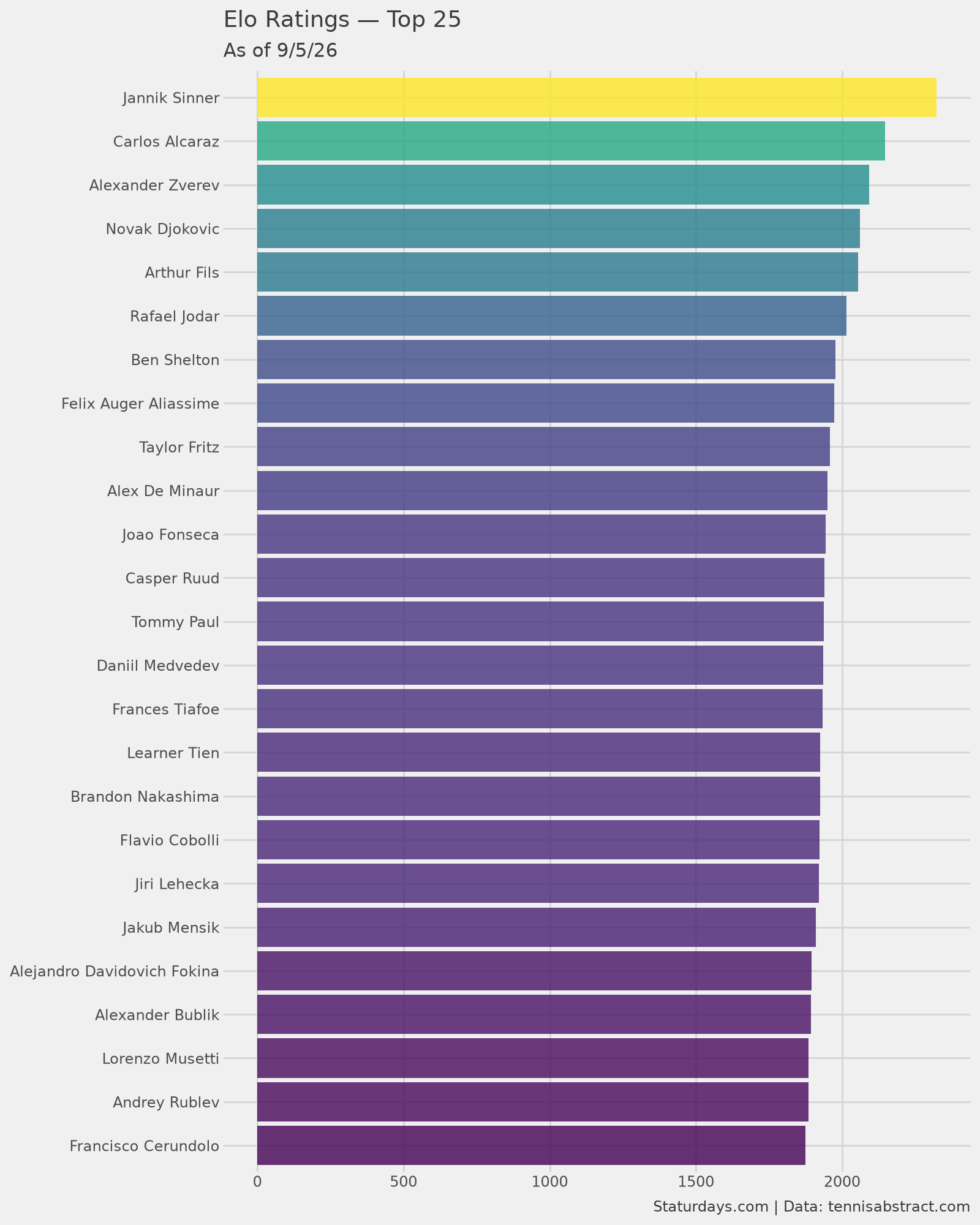
    I took a look at the Elo Ratings from Jeff Sackmann’s Tennis Abstract and this is where they are at currently (for a primer on Elo ratings, our explainer for our College Football Elo ratings is a pretty good intro and the general concept applies here as well. Jeff Sackmann has his own explainer on his Tennis elo too.):

    As you can see, Shelton leads the American men in seventh, but Fritz, Paul, Tiafoe, Tien, and Nakashima are all clustered just behind him in the top 20.

    Conclusion

    Each American man has gaps in his game which hold him back from achieving the pinnacle of winning a Grand Slam. Tommy Paul appears to be the most balanced of the bunch, performing above-average in serving and returning, while the big servers of Fritz and Shelton are top-class at serving and bottom-class at returning. We are only talking about a few percentage points difference, but those are the margins that matter in a best-of-five set match.

    Given that Paul is 29, his window for bringing his game to that peak level is closing. While it’s not unheard to win your first major at 29 (Zverev just did it this year) or even older, the list of first-time winners over 29 is small (seven, to be precise).

    Fritz is 28, and while he’s ranked higher in Elo and the more well-known player, he has arguably a steeper hill to climb than Paul with his returning woes.

    Ben Shelton is only 23, so he has time on his side. If he can focus on his return game over the next few years, then he likely has the best shot at winning a slam of the bunch.

    Tien, at only 20, might have an even better road to a slam than Shelton. He is an elite returner already, so if he can dial in his serve over the next few years, that will become a lethal combination. The only thing holding Tien’s serve back may be his 5’11” frame. (I will look at the relationship between height, serving, and winning in a future article.)

    Is it harder to improve on your serve or your return? I’m not sure, but I’d lean towards it being easier to improve your serve since it’s more down to biomechanics, while returning is all about reading body language, reaction times, flexibility, and intuition. That feels much harder to train and get good at if it doesn’t come naturally.

  • IndyCar Poised for A Breakthrough Season

    IndyCar Poised for A Breakthrough Season

    When F1 defiantly denied Andretti’s bid to enter the series, it rubbed a lot of open-wheel race fans the wrong way, not only in the US but abroad.

    Then, F1’s season-opener in Bahrain put fans to sleep, with only 10-cars finishing on the lead lap, Verstappen finishing 22 seconds ahead of the field (or rather his teammate; the field was 25 seconds behind), and no cars within one second of each other at the line.

    Now, Red Bull’s Christian Horner is embroiled in scandal, and the FIA president Mohammed Ben Sulayem is under investigation for tampering with a stewards’ decision last season. While some people may love the off-track drama, others may be tired of the “circus” that is F1, where more action occurs off the track than on it.

    Luckily for fans, Indycar awaits just around the corner this weekend. Race fans eager for some on-track action as well as uncertainty in the outcome should be chomping at the bit to tune in.

    Competitiveness and Driver Appeal

    The health of the IndyCar series is as good as ever. There were 10 different pole-winners and 7 race-winners in 2023, plus 16 different podium finishers. Alex Palou and Josef Newgarden took the major share of wins, but the series is also full of exciting young talents—Pato O’Ward, Scott McLaughlin, Colton Herta, and Kyle Kirkwood to name a few—and legendary veterans like Scott Dixon and Will Power that are still competing for both wins and championships. The series also brings the legitimacy of F1 in guys like Romain Grosjean and Marcus Ericsson with their experience in both series.

    The series strikes the right balance of international representation from Mexico to New Zealand to Sweden while still showcasing plenty of young American racing talents.

    Sustainability Focus

    They introduced the sustainably sourced “guayule” green-walled Firestone tires to the series, which just bolsters their sustainability efforts that took a huge leap forward with the biofuel they too quietly used to power the cars in 2023. Now in 2024, they’ll introduce the hybrid assist unit, which will come into play after the Indy 500 and also bring about more power for the drivers to pass with when deployed.

    Media Exposure

    To top it all off, IndyCar is more present on television than ever before. In 2023, NBC broadcast 15 races on NBC, 3 on USA network, and 1 race exclusively on Peacock. 100 Days To Indy aired on the CW, and returns for season 2 this spring, giving fans that behind-the-curtain look at the drivers and their lives that sports and reality TV fans alike are expecting these days. NBC has done a great job giving fans access to other sessions as well directly on Peacock and having the A-Team cover it, and they’ve been responsive to problems and suggestions from fans throughout the season, with Townsend Bell often going to Twitter and asking fans directly for feedback on the broadcast on the plane ride home after the race.

    There will be 12 NBC races this year, 6 USA races, and 2 Peacock races this season. With Peacock seeing subscriber growth from the NFL playoff game this year, and people being more accustomed to watching TV across multiple apps generally, we’ll see if Peacock becomes less of a friction point for fans.

    St. Pete Outlook

    St. Pete should be entertaining for fans, with opportunities for anyone in at least the top 10 to win. The average winner started 6th, and there were 7 lead changes on average per race.

    As with any street course, there’s also the chance for fireworks, with an average of 3.5 cautions for 16 laps.

    In the past 10 years, qualifying on pole only give you a slight edge, with two of the past ten winners coming from the pole position.

    With F1 fumbling their new Netflix-generated audience with every misstep they make, Indycar is poised to capture some of those fans that want the excitement of open-wheel racing that F1 has failed to deliver on.

    Qualifying starts at 2PM eastern on March 9th on Peacock, and the Firestone Grand Prix of St. Petersburg kicks off the IndyCar season on NBC at 12 PM eastern on March 10th.

  • Pebble Beach Weather Leads to Favorable Odds

    Pebble Beach Weather Leads to Favorable Odds

    I just recently started following the PGA Tour, and even more recently started dabbling in betting on golf.

    Thankfully, there’s a site called datagolf.com—probably one of the greatest sports statistics and betting sites I’ve come across—which makes it very accessible to get started. They offer live finishing odds for every player in every tournament. For paid subscribers, they even offer betting tools and expected values for various bets using live odds from popular sportsbooks. This makes it really easy to evaluate bets in realtime. (The PGA Tour site, on the other hand, is one of the worst and most poorly-organized sites for stat nerds I’ve ever used.)

    The bet I was following on Saturday was the leader Wyndham Clark’s odds of winning. He had a two-stroke lead on the field, which by the end of the round was down to one stroke to second and two-strokes to third.

    My philosophy so far has been to put more trust in the players who have been there before as opposed to the newcomers. Whether this is valid or not is to be determined. And Clark, just this past season, had won his first two pro tournaments. Second place Ludvig Åberg had four wins, but just one on the PGA tour, and third place Matthieu Pavon had just one win as well. Further bolstering my confidence was the fact the Clark was playing great golf, posting a 60 in the third round. Perhaps I was falling into the hot-hand fallacy, if that exists in golf.

    At the end of the third round, datagolf had Clark’s odds around 29% to win. DraftKings was offering him to win at +200 (33% implied probability). This initally looked like a negative expected value (EV) bet.

    Now, my impression of his play that day, his previous experience, and who he was up against bolstered my internal odds to about 33%. But there was one element that was not factored into either of these odds yet: the elements.

    The weather forecast for Sunday was dire, with heavy storms throughout the day not expected to let up until the late afternoon. There was a chance they would postpone until Monday, but there was also the chance that the tournament would be suspended entirely. It seemed almost certain that they wouldn’t play on Sunday, but whether or not they would cancel I had no way to know. However, I knew it was at least a possibility, meaning I should bump my internal odds up higher still, turning this into a positive EV bet.

    If there was a 33% chance of Clark winning if they played, and a 100% chance of him winning if they cancelled, and a 25% chance that they cancelled, then his win probability should really have been around 50%! This turns into a high EV bet. It appeared that DraftKings, and possibly other sports books, didn’t account for weather and early cancellations in their odds models.

    A probability tree of the possible outcomes for Clark if they played or if they cancelled the final round.

    Even if you disagree with my upping the initial odds from 29%, as long as you agree with at least a four percent chance of cancellation given the weather forecast, that puts positive EV on the +200 odds.

    At 33% implied odds and 50% actual odds on the current leader, DraftKings was essentially offering people free money.

    It’ll be interesting to keep an eye on weather-affected tournaments in the future to see if they’ve learned anything from this situation.