General

  • Villa no clue

    3-0 right now. Three wins and zero losses. Penn State started the season with a road win against #12 Wisconsin, a blowout victory against the reigning MAC champions, and an impressive defeat of the #22 Auburn Tigers (and referees). Coming off of a 0-5 start to last year and all the question marks that Penn State had, especially at QB, I did not possess a lot of confidence in this team if I am being honest. I wrote a few weeks back that it was essentially up to Sean Clifford performance in week one not only to earn a win against a tough road opponent but to set the tone for the season. In reality, I was mentally preparing for another disappointing season.

    Penn State did not allow my fears to come true. The defense, especially in the secondary, has been absolutely incredible this season. Names like Joey Porter Jr. and Jaquan Brisker are becoming household names across college football. The offense, now led by offensive coordinator Mike Yurcich, since the start of quarter three against Wisconsin looks inspired and noticeably different than in any post-Saquon season. Sean Clifford, who I put so much pressure on as essentially the make-or-break component of this team, just played his best career game in Blue and White against a very tough Auburn defense completing 87.5% of his passes for 280 yards and 2 scores. His one interception was more of a hail mary / punt anyways and I do not put much stock into that.

    I have been really quite impressed by Mike Yurcich and what the offense has been able to do this season. Every week a new facet of the offense seems to come alive, and his creative play calling and play design has kept defenses off balance. The tight ends against Auburn got more work including Tyler Warren, the third string, getting a few plays as a wildcat QB and even scoring a TD in the works. Defenses have focused their attention on Dotson (who is incredible by the way) but they have found creative ways to get him the ball in space despite that. There is some left to be desired when it comes to running the ball, but I have confidence that will be figured out in time especially with the improvements the offensive line has taken this season.

    Brent Pry’s unit is another top 10 defense in the sport but seemingly for a completely different reason than what fans have seen before. Usually, a Pry defense is very stout against the run but has trouble in the passing game. A lot of very mediocre QBs have had career days against Penn State defenses in the past. This year you are seeing a much stronger passing defense led by a very deep secondary but again some left to be desired in the run game. If I had to give my biggest worry about this team right now it would be our run defense. Penn State allowed about 5.1 yards per carry among the three main Auburn Ball carriers and only 4.7 yards per completion. When you are allowing more yards per carry than yards per completion a better passing attack could cause some issues and burn the Nittany Lions defense in a later game. My hope lies partially with Hakeem Beamon, who has yet to see the field and was touted to be one of the most important pieces in Penn States defensive line (as both a DT and DE). I imagine with some adjustments and his return the defense can remain as a top unit in the sport. Oh, and that Jaquon Brisker kid is pretty good. Joey Porter Jr. too.

    The first quarter of the Penn State season has been an absolute success, so let’s look ahead to the next. Penn State squares off at noon this Saturday against a tough FCS opponent in Villanova and then follows that up with a home game against Indiana and a road game against #5 ranked Iowa. Villanova is the #10 ranked team in the FCS and that is about all I know about them. I can read some articles and pretend like I am giving you insider knowledge, but the truth is that Penn State should easily handle this opponent even without having their best players on the field. This should be a good game to get some depth pieces playing time and ideally see what backup QB Ta’Quan Roberson is able to do over the span of more than a drive or two.

    I will save this conversation more for next week, but a likely 4-0 start followed by a primetime kick against a struggling Indiana (the team who beat PSU on a controversial call and derailed the entire 2020 PSU season) is enough to get me very excited for the future. The prospect of an undefeated Penn State going to face an undefeated Iowa in a top 6 matchup has me struggling to maintain Coach Franklins 1-0 mentality. None the less, Penn State needs to take care of business at home twice before we can truly get there. The fact that I even get to be excited about this again like I was before the disaster that was the 2020 season has me giddy.

    There is that excitement in the air again, can you feel it? Shades of 2016 and 2017 surround this Penn State football team. Fans are worried about losing Coach Franklin again instead of wanting him fired. The offensive coordinator is on the field and not in the booth. Penn State is already battle tested and came out unscathed. The Big Ten looks vulnerable. Put on your homer hats ladies and gentlemen its time to get excited about what we are seeing here. Let’s go beat Villanova and keep that ball rolling. We Are Penn State.

    1-0.
  • Week 4 Elo Rankings

    Week 4 Elo Rankings

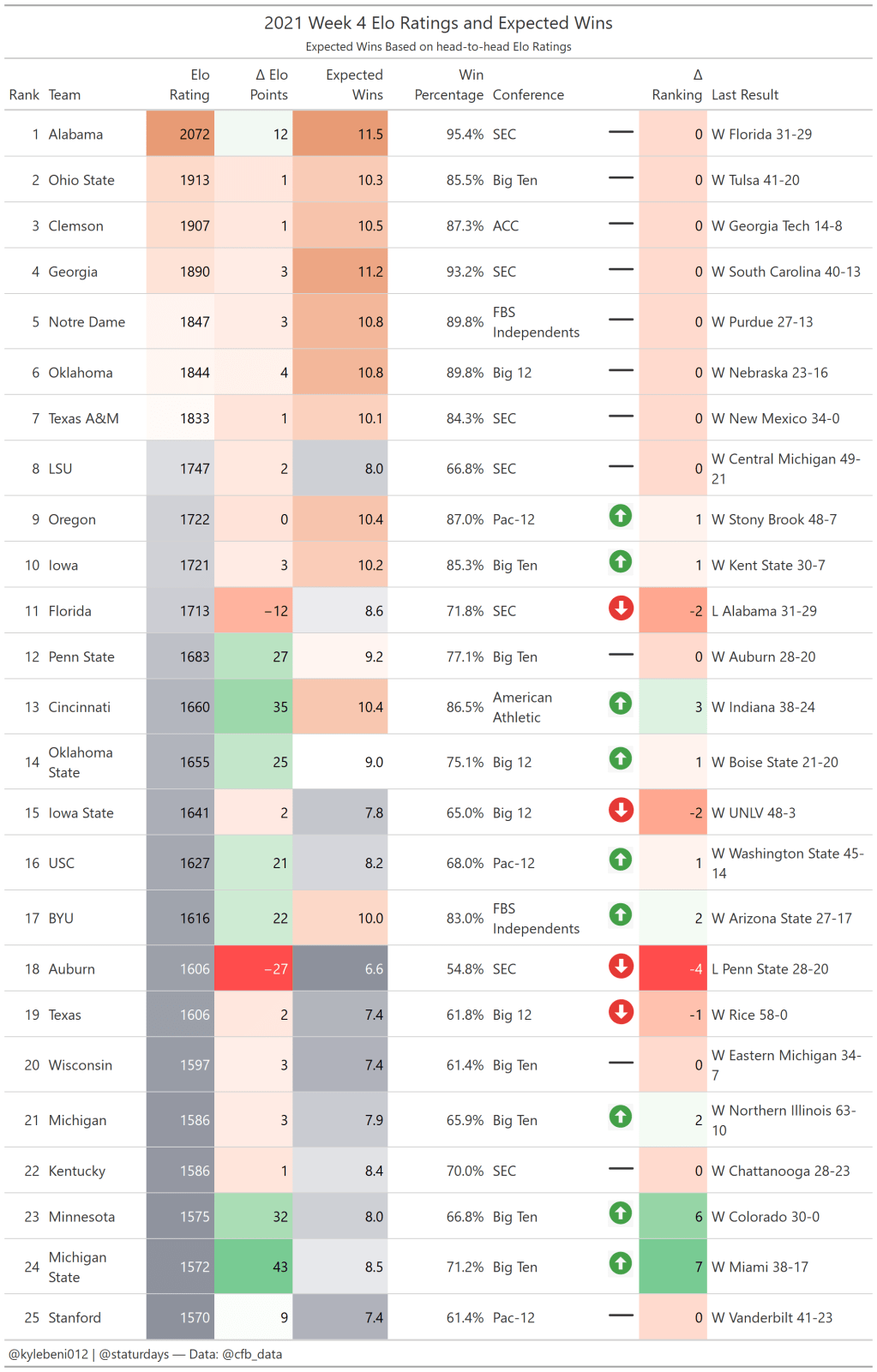
    Here are the rankings for all FBS teams heading into Week 4 of the college football season, using our Elo rating system.

    We’ve revamped the table to include more info on who each team beat last week, and how many spots up or down in the rankings they moved.

    Utah and Indiana dropped out of the Top 25 with losses to San Diego State and Cincinnati, while Michigan State and Minnesota moved in with wins over Miami and Colorado.

  • Quarterback Play After an Interception

    Quarterback Play After an Interception

    I’m here to tell you how college football quarterbacks handle adversity. Which ones crawl under a rock to hide after throwing an interception, and which ones brush it off and get back out there.

    Basically, which QBs play better after throwing an interception—learning from their mistake—and which ones sink into a depression and lose all their swagger.

    I looked at QB play from 2014-2020 and broke their games into two groups: before and after throwing an interception. If they didn’t throw an interception all game, all their plays on that day go into the “before an INT” category. If they threw an interception on the first play of the game, then all their throws afterwards go into the “after an INT” category for that day. Simple.

    We’re looking to see if anybody’s play changes dramatically after throwing an interception. Are they more conservative? Do they run the ball more? Check it down? Does one interception breed even more interceptions? Let’s find out.

    Overall Trends

    Before we look at individual players, let’s see how your average quarterback responds under pressure. Almost across the board, their stats get slightly worse.

    So already this indicates that maybe interceptions lead to more interceptions, albeit barely. But what it clearly shows is that interceptions lead to worse overall play by the QB, meaning less touchdowns, more sacks, less completions, and a lower overall PPA (predicted points added) per play.

    QB Play

    Let’s take a look at some individual players. For this first chart, I’m limiting our pool to just QBs who played in 2020, but I’m looking at their stats throughout college, so if they played in 2019 or earlier, I’m including those stats as well.

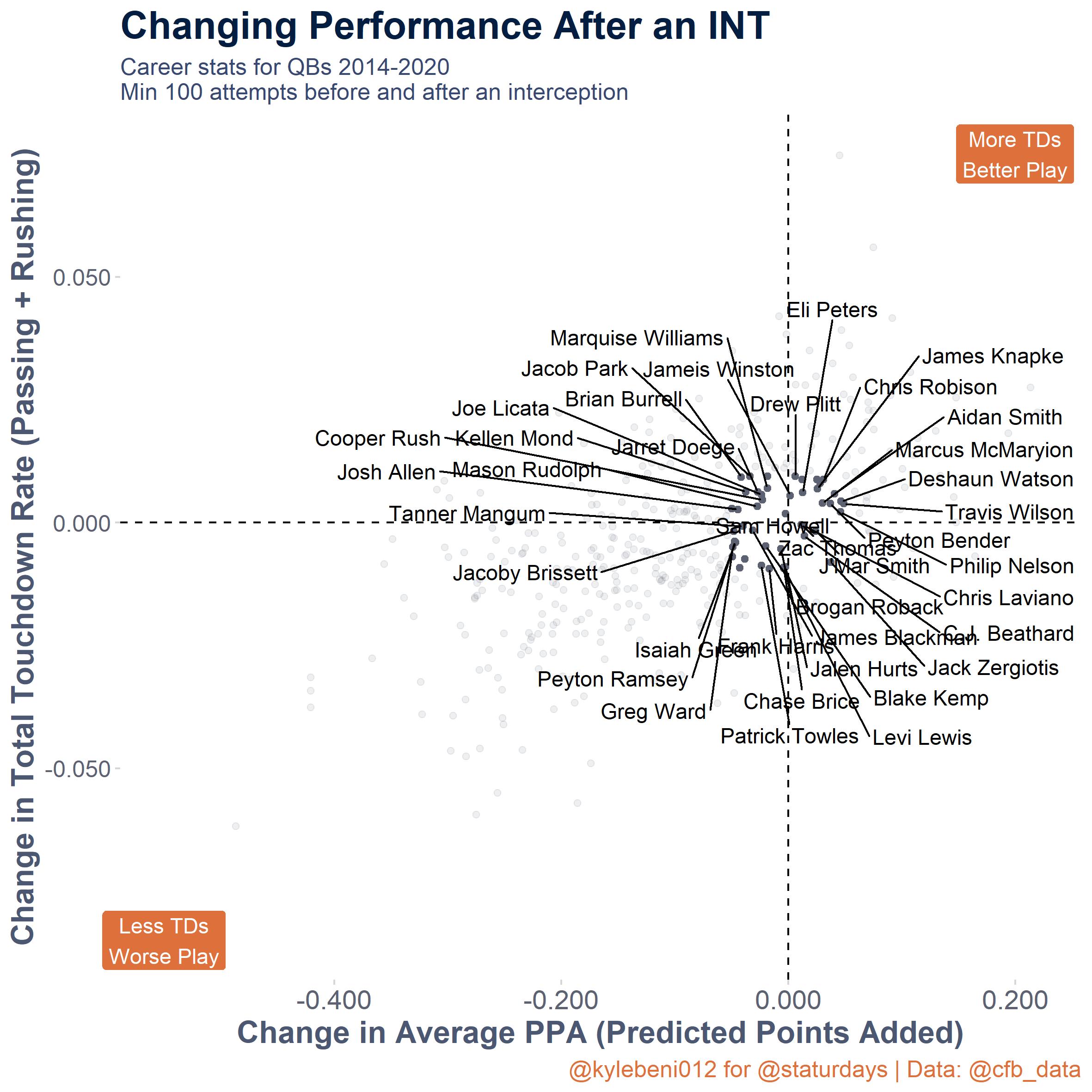
    Here’s PPA, a stat that looks at how many points you are contributing to your team on a per-play basis. As you’ll see, most quarterbacks struggle to bounce back from that first interception, and contribute negatively to the team the rest of the game.

    This could be happening for any number of reasons.

    • The QB loses confidence after the first interception
    • The defense is hungrier for more, after getting that first turnover
    • Play calling becomes more predictable, since the team is likely 3-7 points behind where they were previously, and the QB is forced into more obvious passing situations.

    Whatever it is, there are only a handful of quarterbacks that can elevate their team after making a mistake. This may be a sign of a true leader, rallying the troops and bouncing back quickly. It’s no surprise that two of the top NFL draft picks in 2021—Mac Jones and Trevor Lawrence, the latter being one of the most dominant players at the quarterback position in recent years—are among those who positively affected their team after making a mistake. And keep in mind, sample size isn’t an issue here because while Trevor Lawrence surely threw less overall interceptions, we’re only measuring the plays around an interception, so there’s plenty of data to work with for these guys.

    Some of the guys near the bottom of the board are a little surprising, like Zach Wilson, another first round draft pick this year. Ian Book was a leader for a great Notre Dame team, but he wasn’t necessarily known for his elite arm, so I can understand that one. Sean Clifford makes perfect sense as a Penn State fan.

    Passers from 2014-2020

    So let’s see some guys from recent years and see who the best and worst were. Of course, there’s also something to be said for the guys who play consistent throughout the ups and downs of a game, so we’ll look at them too.

    These are the standouts. Again, some key names show up that make you go “yep, okay yeah that checks out.” I’m looking at you, Mitch Trubisky. But again, there are a few where you are a bit surprised. Tua struggling to get back on track? Trace McSorley right up there with Joe Burrow? I swear I didn’t rig his stats just for this chart. He was a baller, there’s no denying that.

    Here are some of the most consistent guys after they throw their first interception.

    Here you see a blend of some really solid guys currently having great success in the NFL, and then guys that may have gotten the job done in college and that’s it.

    When it comes to completion rate, it’s not always the perfect indicator because there are a lot of external factors that go into it, like receiver play, how aggressive of throws your making, and more, but there’s not doubt that the best players in college football in recent years have held higher-than-average completion rates, so let’s see how they do after making a mistake.

    So, as expected, I’d call this a bit of a mixed bag. We’re seeing some guys that were strong in the PPA charts go down in completion rate, and vice versa. But again, they could be using their legs more, they could be making more aggressive throws, which are paying off in the long-run but leading to more short-term incompletions. Either way, it’s really interesting to see how some guys completely tank after a mistake, while others get laser-accurate.

    Last thing I want to look at here is sack rate. Some guys just get so much more sackable after their first interception. This can be because they’re taking longer on their reads post-INT, the defense is trying to force another mistake and sending more pressure to rattle the QB, or the play-calling is more pass-heavy in general.

    This one’s more evenly distributed positively and negatively. In this case, being negative is good, meaning you get sacked less after throwing that INT.

    Conclusion

    Overall it’s very clear that throwing that first interception negatively impacts QB performance the rest of the game. Whether it’s getting sacked, scoring less, being less productive, or turning the ball over again (although much less than you would think), it affects play across the board. However, some great quarterbacks are able to rebound better than most and rally their team to learn from their mistakes and move forward.

    Once there’s more data in the 2021 season, I can’t wait to rerun this and see how this year’s quarterback class has been handling adversity.