Kyle Bennison

  • Should Noah Cain be RB1?

    In the past few games, Noah Cain has proven himself to be a reliable and consistent weapon on offense. Penn State has famously been using a running back by committee philosophy for the first half of the season, and so far, it’s worked out fairly well. However, the backs are starting to separate themselves into tiers, and a tipping point is coming up.

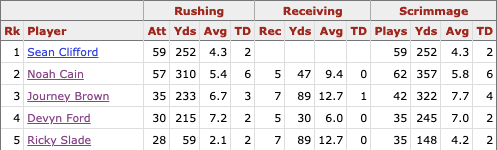
    Here’s the stats for the committee (including Sean Clifford, who, through 6 games, is Penn State’s leading rusher with 59 attempts.

    Performance from Penn State’s top-5 rushers so far this year, through 6 games.

    As you can see, Noah Cain is starting to set himself apart in terms of his attempts and his TDs. Now, attempts are James Franklin’s decision, so he hasn’t influenced that stat line (but he has made the most of it by being consistent).

    TDs are another one where he is obviously putting the ball in the endzone, but he is also being given the opportunity more than other backs. He hasn’t been nearly as explosive as Journey Brown or Devyn Ford. His TD runs have been for 3, 9, 2, 13, 2, and 5 yards. So, I’d give more credit to our offensive line for carving a hole, rather than him making some explosive play to punch it in himself.

    In terms of Yards per Attempt, as mentioned, Brown and Ford are the leaders here. Each of them are hovering around 7 yards per attempt. Brown has also been a threat in the pass game, albeit on a minuscule 7 receptions. That being said, Cain’s YPA are nothing to (I can never remember how this saying goes) sniff? — at. He’s averaging 5.4 yards per attempt, or in other words, half a first down per attempt. I’ll take that any day, considering only 16 teams in D-I average more than that. As in whole teams, that get to switch out their backs and put in fresh ones.

    So now that we have an idea of where Noah Cain stands in the hierarchy of RBs (in my opinion – pretty even with the top 3), the question is what to do about the snap count for each guy.

    My dad, and noted Staturdays commenter, brought up an interesting point about the transfer portal, and if Franklin is scared of its implications in the first full season of use. Given that Penn State lost a lot of prolific talent to other programs in the offseason (mainly the drop-plagued wide receivers and defensive backs), that fear might still be lingering in his mind.

    His concern was that Franklin may be spreading the ball out more than the data suggests in order to keep all four guys content with their decision to attend The Pennsylvania State University. This could be the case, but there are two edges to that sword.

    1. Play all four backs evenly, and they all get playing time and are happy, but you may not get the optimal production in the run game.
    2. Play all four backs evenly, and the true “star” RB that deserves more snaps than he’s being given enters the transfer portal anyway, looking for a program that will give him his fair share of the workload (Noah Cain currently carries 24% of it at Penn State. Not that these two players are comparable yet, but for reference Jonathon Taylor receives 47% of the workload in terms of attempts.)

    Either way, it looks like the committee is a risky option once you have found your guy. Now, in the first half of the season, Franklin didn’t have much of a choice. These guys are young and Franklin needs to play them to figure out what they’ve got in a real game (Brown is a junior, Slade is a sophomore, and Ford and Cain are Freshmen).

    Unfortunately for us (and Franklin), Penn State’s data doesn’t really hint at whether a committee or a star RB is best. In the games where we have employed the most committee-style run-game, they have been blowouts against bad defenses. Everybody and their little brother got into the game, and regardless of who was toting the ball, they were carrying it well. So the data is skewed.

    Yards per Attempt for the team in games where Penn State RBs shared the ball, vs. when they used a star RB (30% or more of the workload).

    When a Penn State rusher got over 30% of the workload (which has only happened in 3 of 6 games), we actually rushed worse than when the ball was spread out, by more than 1 yard per attempt difference. That being said, the games where we rushed by committee were against Idaho, Maryland, and Purdue, all of which we beat up on.

    So for now, I am arguing for Franklin to continue what he’s doing and spread the ball out. The past few weeks have given all of us a favorable impression of Noah Cain, and rightly so, but let’s not ignore the impact that having four (or five, shoutout Sean Clifford) versatile running threats can have on the game.

  • Podcast: Week 7 Preview

    It is Week 7 of the College Football season already, making this the official midpoint of the year. Penn State has a big night game coming up this week at Iowa, so we make some predictions and talk about last week’s performance in the run game against Purdue, and Iowa’s struggle against Michigan. We also decide whether we’re disappointed or delighted with the night game white out and Penn State’s run game, preview some big matchups between Florida and LSU, and Oklahoma vs. Texas, debate RB Jonathan Taylor’s chances of winning the Heisman, and it’s our mom’s birthday!

  • Should You Ever Run The Ball?

    Should You Ever Run The Ball?

    There has been a lot of discussion in recent years over teams not passing the ball enough. The infamous 4th and 5 run play from last season comes to mind as a recent example of the at-times hostile debate between run and pass. So what does the data tell us? We looked at the yards gained on run and pass plays in different down and distance situations. This is what we found.

    Average yards gained broken down by play type for each down, based on yards to go. As you can see, there are very few situations where rush plays gain more yards. Based on data from all D-I teams from 2016 – 2018.

    So, red represents the average yards gained on a pass play, and blue represents rush plays. As you can see, there aren’t too many situations where a run play is going to get you more yards. We can ignore most of the 1st down data because there were very few instances where you would have a 1st and 7, or a 1st and 1 (this is how a 1st and Goal from the 1 yard-line situation appears in the data). That being said, throwing on 1st and 10 is the move.

    Starting with 2nd down, you should pretty much always be throwing. Which kind of makes sense. If you are in 2nd and 10, it doesn’t make much sense to try to run the ball and leave yourself in a likely 3rd and long. If you are at 2nd and 1, defenses are probably expecting a run play, which makes for the perfect time to chuck one down field.

    3rd down is where it gets more interesting. The further you have to go, the closer runs and passes get to averaging the same yards per attempt. That being said, either one is unlikely to get you a 1st down, as both a pass and a run on 3rd and 10 average only 6 yards of the needed 10. Once again, defenses are selling out for the run on 3rd and 1 – it is the least efficient situation to run in on 3rd down – so it makes for a good opportunity to take a shot, or at least pick up a first down on a pass play and avoid getting stuffed at the line.

    4th and 1 poses by far the biggest discrepancy, and while fans may yell at their TVs if you throw an incomplete pass on 4th and 1, you may be able to defend yourself as a coach if you show them this chart. That being said, your 4th and 1 run play is averaging almost 3 yards, which is more than enough to move the sticks. One of the few instances where running the ball makes complete sense is interestingly on 4th and 4 (sorry James Franklin, it’s not 4th and 5).

    Now of course, this has to be adjusted slightly based on the skillset of your team and the opponent you are facing that week. If you’re Army, you probably aren’t that great at throwing the ball. So you have to take that into account when making your decisions. Let’s take a look at their chart (prepare yourself – it’s insane).

    Army has only bothered to pass on 2nd and 1, 3rd and 1, and 4th and 1 one time each.

    Take a second look at the y-axis. Yeah, it goes up to 40. That’s because Army passes so little, that when they do, it catches defenses off-guard and they gain up to 40 yards on the play. Now that 4th and 3 that I’m referring to was only one play, so you have to take that for what it’s worth – we’re looking at an average of 1. Still, we see across the board that when they do pass, especially in short yardage to go situations, it seems to pay off whether its 1st, 2nd, 3rd, or 4th down. This isn’t to say that Army should pass the ball more, because they will quickly lose this advantage of huge gains on pass plays, and if they up their pass game, their average is bound to drop. However, it is an important weapon to have in their back pocket.

    So how do you know when you are passing the right amount? Ideally, once the right mix of passes and rushes is found, all of these bars will be even. That means that each rush and pass will average the same amount of yards. It makes sense, because the more you pass the ball, the more defenses protect against the pass, and the more vulnerable they become to a run or a draw play. So as passing becomes the norm, run efficiency will improve until they reach an equilibrium.

    Just look at a little over 10 years ago until 2015, the game was eerily similar.

    Coaches have made a few changes to their philosophy over the years, but for the most part the game remains unchanged even though all that red represents opportunity.

    Less than 10 years ago, the disparity was a bit larger, but mostly the same – this implies that coaches still have room to grow. The argument was slightly greater for the pass, probably because coaches were running more often and defenses were prepped for the run. Now there are two reasons that could be the case:

    1. QBs were much less accurate and receivers didn’t catch the ball. So coaches trusted the run more.
    2. The rules favored running the ball over passing.

    So for point number one, I checked by looking at QB completion percentage. From 2008-2015, QB completion percentage was 60.35%. From 2016 – 2019, completion percentage went up to 61.1%. Now this may seem like a small blip, but in the grand scheme of 128 teams over 8 years and 3 years respectively, that is a significant bump. So option 1 has some weight to it.

    Option 2 we’ve all been able to see over recent years. Refs are calling a tighter game and it’s harder than ever to be a defensive back. The combination of targeting penalties, hits on a defenseless player over the middle being outlawed, stricter pass interference calls, better offensive playcalling, and the redefinition of a catch have made passing a much more viable option in today’s game.

    Last, let’s look at Penn State, a fairly balanced team over the past 3 years (they’ve passed on 46.4% of plays).

    Penn State is a team that has slightly favored the run, and in some situations (like 3rd and short), you can’t really blame them.

    Penn State has had a lot of success on the ground in the past 3 seasons (partly due to one Saquon Barkley). As a result, they see a few more cases for the run than your average D-I team. Particularly, 3rd and short poses a good opportunity for a run-play, and somehow 4th and 3 is the best opportunity (once again, not 4th and 5 James). This is only on 2 data points for the run and 5 for the pass, so really too small a sample size to draw any conclusions from.

    The best places to make some inferences are on common downs like 1st and 10 and 2nd and 10, where we’ve got over 1000 and over 200 plays, respectively, over the past 3 years. In each of these scenarios, the pass favors the rush, more so on 1st down than on 2nd down.

    Overall, some of the spots where Penn State need to pass the ball more are on:

    • 2nd and 5 – 5.3 Yard Difference – Over 60 Attempts
    • 2nd and 9 – 6.2 Yard Difference – Over 50 Attempts
    • 3rd and 1 – 8.2 Yard Difference – 39 Attempts (Rushed on 35)
    • 3rd and 6 – 5.7 Yard Difference – 37 Attempts

    Of course, if you are just trying to pick up the 1st down, running on 3rd and 1 is a pretty safe bet. On average, Penn State picked up 3.5 yards on a 3rd and 1 rush, which is more than enough to get a fresh set of downs. However, it is worth considering a pass play to catch the defense off-guard and pick up a bigger gain, something this team is all too desperate for after the Week 3 struggle vs. Pitt.