College Football

  • The Best Teams in College Football at Getting First Downs

    The Best Teams in College Football at Getting First Downs

    Exploratory Data Visualizations of First Down Rate, Average Yards to Go, and Passing Rate by Down

    Like most of you, I am finding myself realizing that there is not much to do when you can’t make “plans”, per se. I decided to try to use some of my time productively this past weekend by messing around with some college football data (courtesy of @CFB_Data). The results paint an interesting picture about individual teams (just how good LSU was in 2019; just how much Maryland struggled on 4th downs), as well as overall trends in college football playcalling.

    So let’s just dive right into it. I won’t get into too much detail other than sharing my takeaways from some of these graphs. They’re not gamechanging, but they’re interesting to look at.

    Looking at individual teams on 3rd and 4th downs
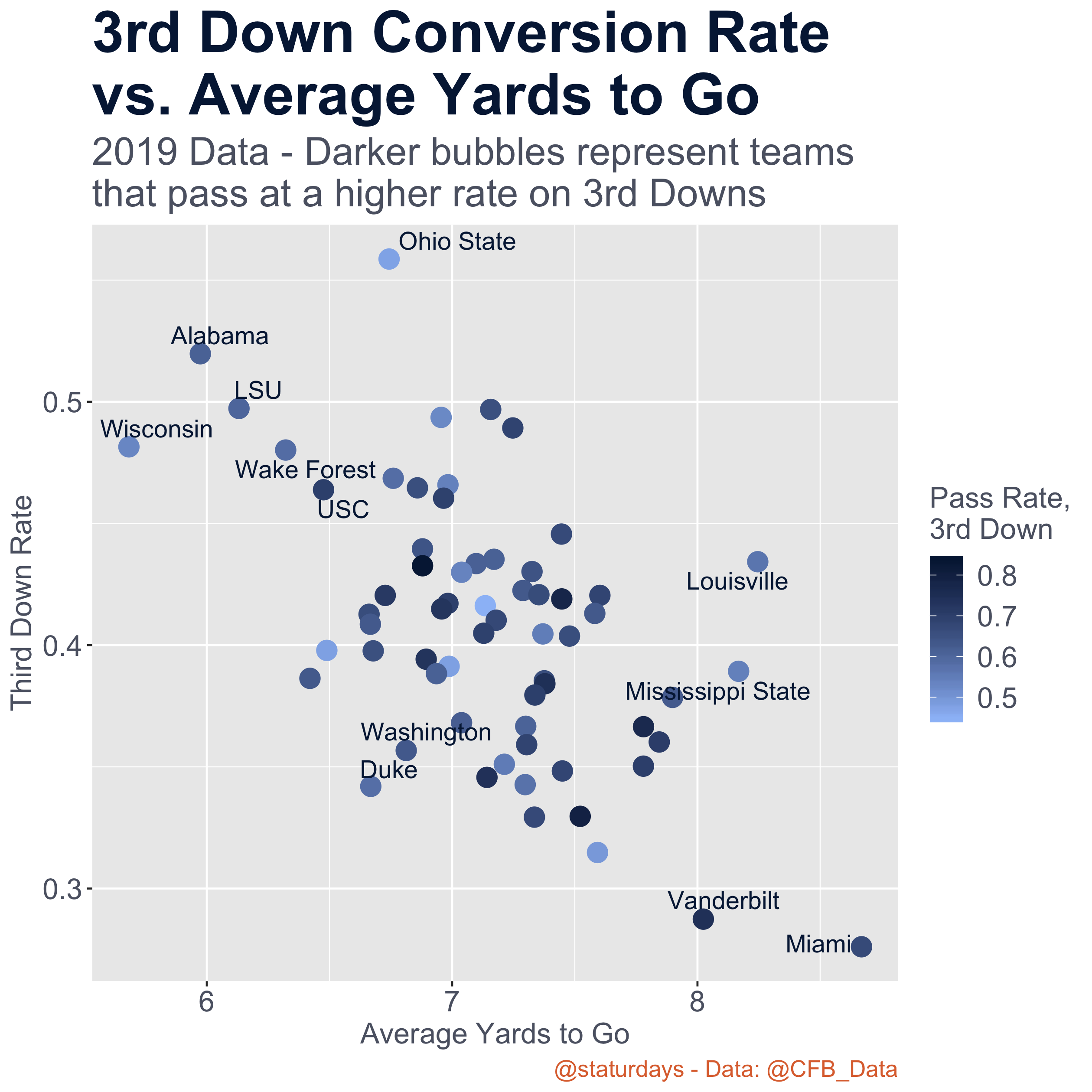
    Intuitively, you see that the less yards teams have to-go on 3rd downs, the higher their conversion percentage. However, there are some interesting exceptions. Ohio State outperformed their counterparts.
    Intuitively, you see that the less yards teams have to-go on 3rd downs, the higher their conversion percentage. However, there are some interesting exceptions. Ohio State outperformed their counterparts.

    Intuitively, you see that the less yards teams have to-go on 3rd downs, the higher their conversion percentage. However, there are some interesting exceptions. Ohio State outperformed their counterparts with the highest 3rd down conversion rate in the Power 5 at .552. Wisconsin, Alabama, and LSU were experts at getting in 3rd and short situations.

    It doesn’t look like being pass-heavy on 3rd downs really favors or disadvantages you based on the graph – the darker bubbles (pass-heavy teams) are fairly spread out high and low on the graph.

    Despite regularly being in 3rd and long situations, Mississippi State and Louisville actually outperformed many of their counterparts with shorter distances to go on average, namely Duke and Washington.

    4th down conversion rates and yards to go were all over the place, as expected. But some teams converted at a very high rate, like Alabama, Wisconsin, UNC, and VT.
    4th down conversion rates and yards to go were all over the place, as expected. But some teams converted at a very high rate, like Alabama, Wisconsin, UNC, and VT.

    4th down conversion rates and yards to go were all over the place, as expected. But some teams converted at a very high rate, like Alabama, Wisconsin, UNC, and VT. Some did not fair so well, like Tennessee, Texas, Stanford, and Maryland.

    It looks like teams prefer passing the further they have to go, which makes sense. It doesn’t appear to help all that much.

    Looking at the grand scheme of all teams, broken out by down
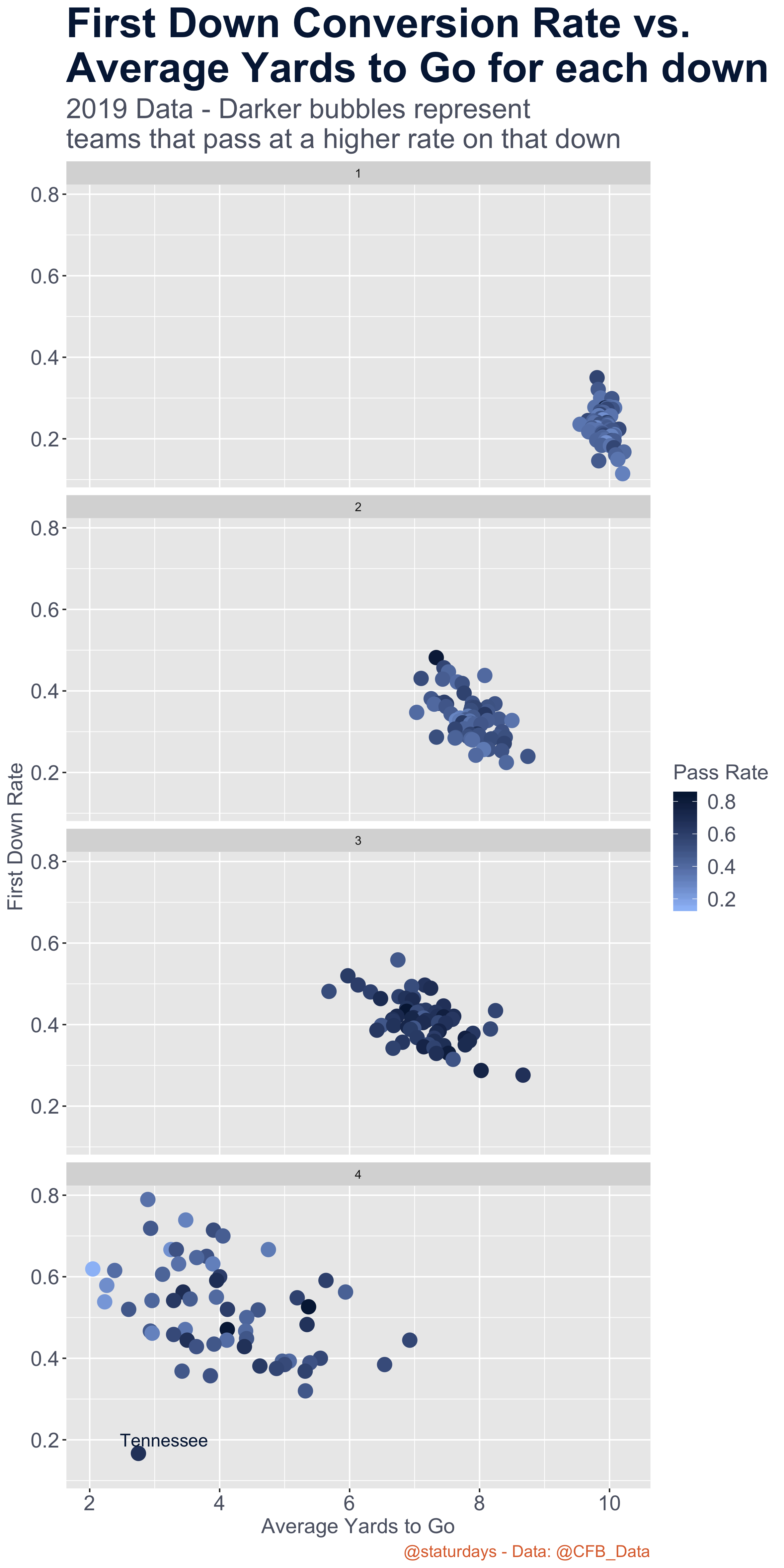
    This graph shows the first-down conversion rate for each team by down and starting position. Obviously, on 1st down, teams usually have 10 yards to go, and conversion rates are low. What's interesting is when we get into 2nd and 3rd downs, where there is a noticeably higher tendency to pass on 3rd downs, even though the distance to go is shorter.
    This graph shows the first-down conversion rate for each team by down and starting position. Obviously, on 1st down, teams usually have 10 yards to go, and conversion rates are low. What’s interesting is when we get into 2nd and 3rd downs, where there is a noticeably higher tendency to pass on 3rd downs, even though the distance to go is shorter.

    This graph shows the first-down conversion rate for each team by down and starting position. Obviously, on 1st down, teams usually have 10 yards to go, and conversion rates are low. What’s interesting is when we get into 2nd and 3rd downs, where there is a noticeably higher tendency to pass on 3rd downs, even though the distance to go is shorter.

    What this graph tells me is that teams should probably be passing more on 2nd down (not an uncommon point-of-view). Tennessee… wow – just wow. They converted less than 20% of their 4th down attempts with less than 3 yards to go on average.
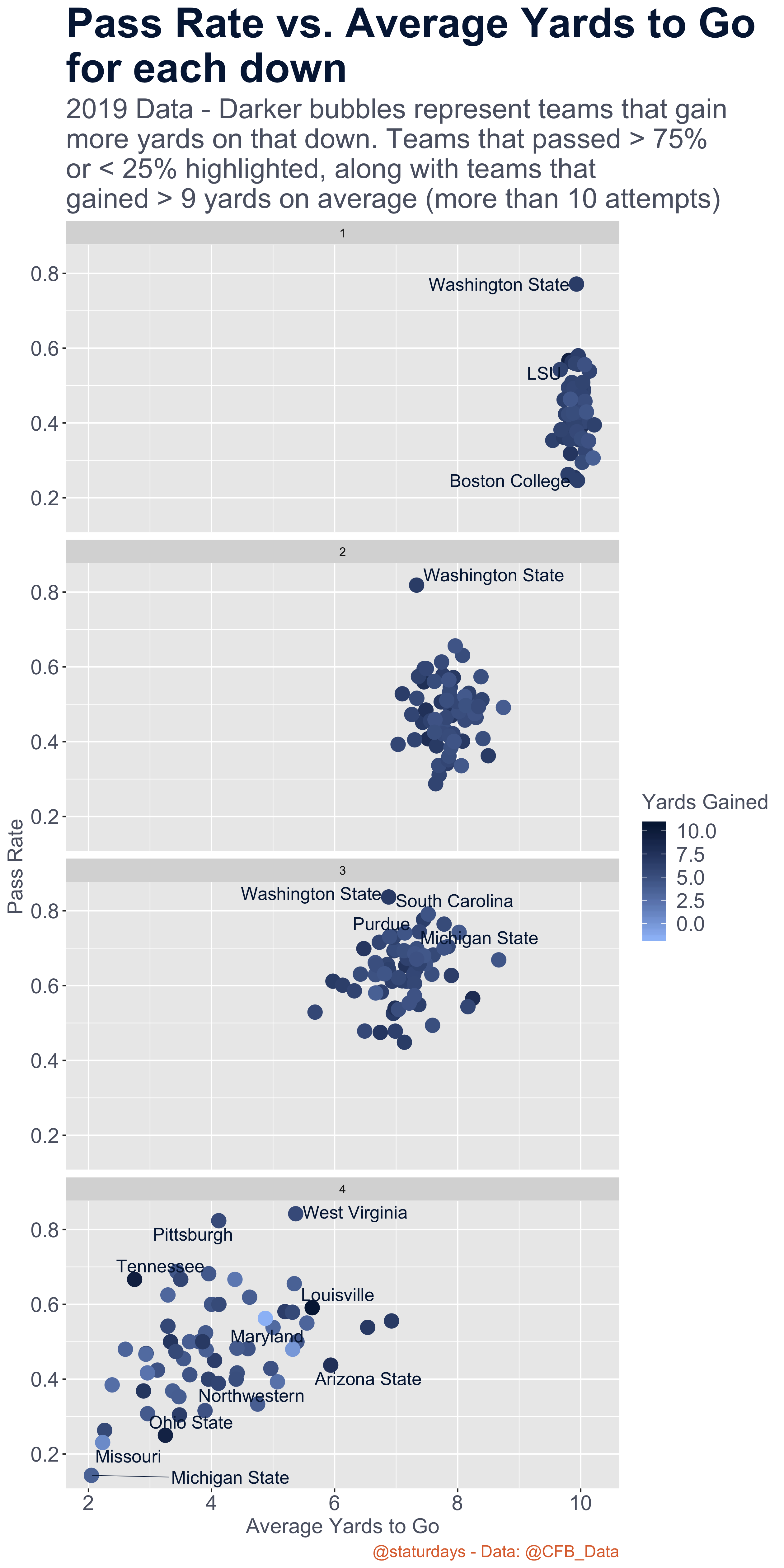
    Here are the teams that pass the most, broken down by yards to go and down. This doesn't show much else, but it is interesting to see who the major passers are on each down. No surprise the air raid Washington State offense is the top of all standard.
    Here are the teams that pass the most, broken down by yards to go and down. This doesn’t show much else, but it is interesting to see who the major passers are on each down. No surprise the air raid Washington State offense is the top of all standard.

    Here are the teams that pass the most, broken down by yards to go and down. This doesn’t show much else, but it is interesting to see who the major passers are on each down. No surprise the air raid Washington State offense is the top of all standard.

    Boston College running on three-quarters of 1st down attempts seems a bit bizarre in this day and age, huh?
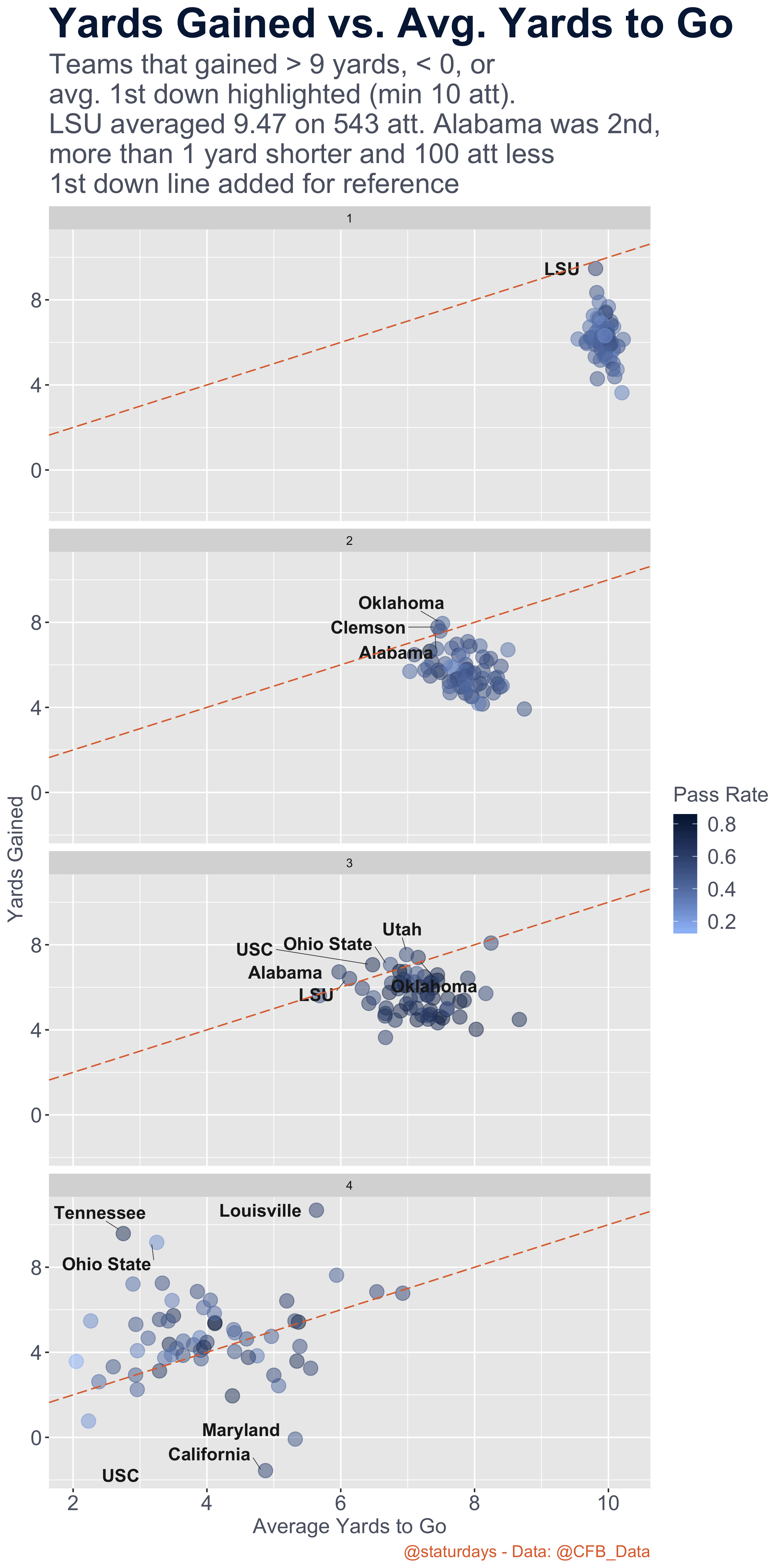
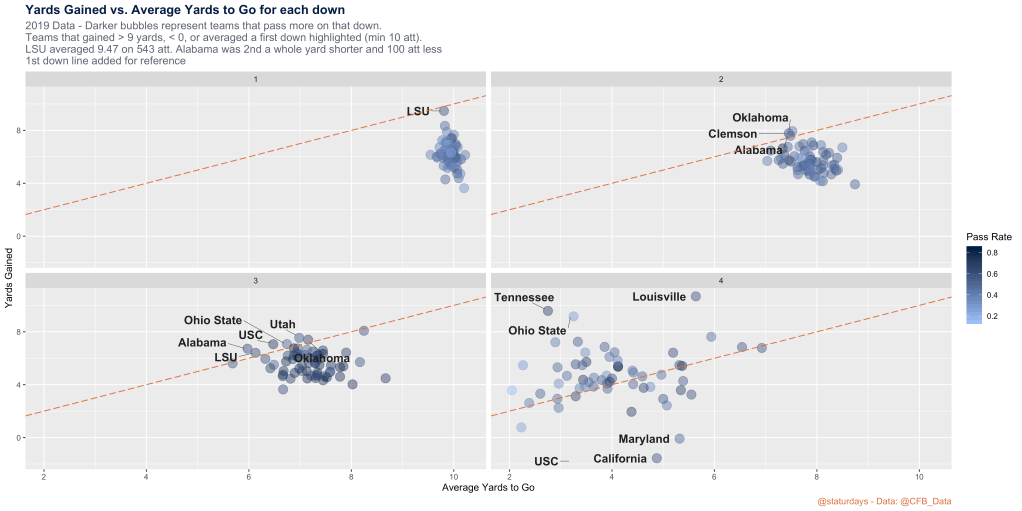
    This one is pretty fun. It's just yards to go vs. yards gained on each down. And it's honestly the most insane of any of the graphs, because look at LSU. They nearly averaged a 1st down on 1st downs! In my opinion, this graph is the best indicator of who the best teams are because it is showing the teams that pick up (or nearly pick up) 1st downs on each down.
    This one is pretty fun. It’s just yards to go vs. yards gained on each down. And it’s honestly the most insane of any of the graphs, because look at LSU. They nearly averaged a 1st down on 1st downs! In my opinion, this graph is the best indicator of who the best teams are because it is showing the teams that pick up (or nearly pick up) 1st downs on each down.

    This one is pretty fun. It’s just yards to go vs. yards gained on each down. And it’s honestly the most insane of any of the graphs, because look at LSU. They nearly averaged a 1st down on 1st downs! In my opinion, this graph is the best indicator of who the best teams are because it is showing the teams that pick up (or nearly pick up) 1st downs on each down.

    And look who’s at the top on 1st and 2nd downs particularly: LSU, Clemson, Alabama, and Oklahoma. As Warren Sharp always says, early-down aggressiveness is a key-factor in winning football games, and we are not seeing enough of it at present. And it doesn’t always mean just passing on early-downs (LSU passed on 57% of 1st downs, which is 22nd highest). Oklahoma only passed on 40% of 2nd downs too. Of course, it helps to just be dominant regardless of whether you run or pass, but it’s interesting. Dial up your big plays (be it a run, pass, or trick-play) on early downs and you can reap the rewards.
  • Another Look at the Penn State RB Position: Success Rate, Yards Gained Distribution, and Standard Deviation

    With Noah Cain out the last two weeks, we’ve seen a lot more of Journey Brown in the run game as the official RB1 — he’s handled nearly 50% of the workload in the past two games. It’s been exciting at times, given Brown’s big-play ability in both the run and the pass game. However, he’s always felt like a boom-or-bust back to me. I wanted to see what the data showed and see if my impression was true.

    While Brown has been leading the RB committee most of the season in yards per attempt both on the ground and in the air, the fan consensus has been for Noah Cain to be RB1. I have been wondering why this has been the case, given that both Brown and Devyn Ford have better YPA than him. The only conclusion I could draw, given the eye-test and feedback from loyal PSU fans, is that Cain is the more “reliable” back. Some people call this “success rate”: the percentage of plays that are deemed “successful”.

    In essence, this looks like:

    • gaining 5 yards on 1st and 10
    • 70% of the yardage to go on 2nd down
    • all the remaining yards to go on 3rd or 4th down.

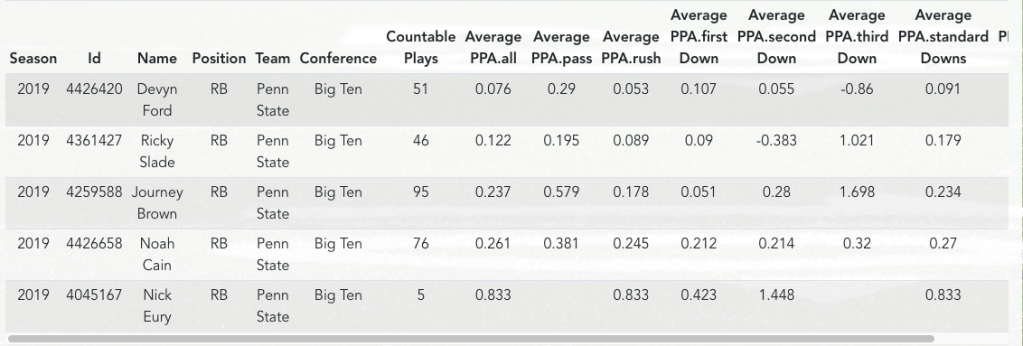
    Success rate is factored into PPA (Predicted Points Added), the cousin of EPA. At a glance, justifying the majority opinion is the fact that Noah Cain leads the RB committee in PPA (Data is courtesy of CollegeFootballData.com, and you can see this data for yourself here).

    Noah Cain leads all PSU RBs with .261 average predicted points added in the 2019 season.

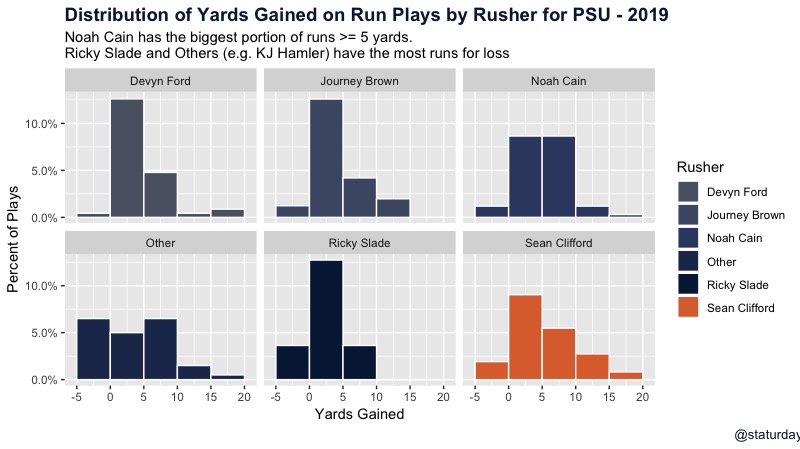
    I decided to look at it in two additional ways: the distribution of yards gained on each run, and the standard deviation of run plays. Let’s take a look at the graph first.

    Distribution of yards gained on run-plays only, for the Penn State rushers.

    This graph shows us how many yards each runner gains, bucketed into groups of 5 yards. I limited the graph to 20 yards so we can compare everyone easily, but this doesn’t do Brown justice in terms of just how explosive he can be. Even from this graph, we can see that he has a higher percentage of rushes of 10+ yards than any of the other feature backs. What the graph doesn’t show is that he also has five runs of greater than 20 yards, the most of any RB. Noah Cain has the fewest.

    With all that being said, we can quickly see that Noah Cain (top right) is the most consistent in short-yardage situations, which is why so many fans love him. Quite simply, he gets first downs. Cain has the largest proportion of his runs that go for 5-10 yards. He doesn’t get many gains of larger than that, but he also doesn’t lose yards too often. While more explosive, both Brown, Ford, and Slade have a considerably larger portion of their runs going for less than 5 yards.

    Finally, let’s look at the standard deviations of these backs’ yards per play. This will give us an idea of how much variation there is in their yards per attempt. For a simple example, if a running back ran for 5 yards every time, his mean would be 5 and standard deviation would be 0. If a running back averaged 5 yards per attempt, but only ran for either 10 yards or 0, his standard deviation would be 5, indicating more of a boom-or-bust style back (this is a rough estimate).

    Average yards per attempt (mean) and standard deviation of rushing attempts for Penn State rushers.

    So from this very exciting chart, a smaller standard deviation implies a more consistent back with less variation in each individual run play. Cain’s is considerably lower, at 4.7 yards, than the rest of the top backs. Ford and Brown, unsurprisingly, lead the way in terms of variability in their run plays. This chart further validates what the histogram above was hinting at.

    While Brown (and Ford) are certainly the undisputed backs with big-play ability, when you need a first down and a reliable few yards, Noah Cain still appears to be the guy. His status for Saturday is still up in the air, but Lord knows we’re going to need plenty of both to have a shot at the upset against #2 Ohio State.

  • Podcast: Franklin Tailgates White Out Games, Belated Penn State HBO Viewing, Tua Out and Heisman Update + Week 9 Picks

    PSU holds off against Michigan in the White Out but struggles managing the clock, Tua is out and his Heisman hopes are getting bleak, Penn State is one of two teams to have two ranked wins, and could play FIVE ranked teams by the end of the season, Franklin is a confirmed tailgater, we give our thoughts on the Penn State Football HBO special, debate whether we’d be satisfied with a Rose Bowl bid this season, and pick a bunch of Top 25 matchups in Week 9 including Wisconsin vs. Ohio State, Notre Dame vs. Michigan, Auburn vs. LSU, and of course Penn State vs. Michigan State.

    Listen to episode 11 here.