
I’m here to tell you how college football quarterbacks handle adversity. Which ones crawl under a rock to hide after throwing an interception, and which ones brush it off and get back out there.
Basically, which QBs play better after throwing an interception—learning from their mistake—and which ones sink into a depression and lose all their swagger.
I looked at QB play from 2014-2020 and broke their games into two groups: before and after throwing an interception. If they didn’t throw an interception all game, all their plays on that day go into the “before an INT” category. If they threw an interception on the first play of the game, then all their throws afterwards go into the “after an INT” category for that day. Simple.
We’re looking to see if anybody’s play changes dramatically after throwing an interception. Are they more conservative? Do they run the ball more? Check it down? Does one interception breed even more interceptions? Let’s find out.
Overall Trends
Before we look at individual players, let’s see how your average quarterback responds under pressure. Almost across the board, their stats get slightly worse.

So already this indicates that maybe interceptions lead to more interceptions, albeit barely. But what it clearly shows is that interceptions lead to worse overall play by the QB, meaning less touchdowns, more sacks, less completions, and a lower overall PPA (predicted points added) per play.
QB Play
Let’s take a look at some individual players. For this first chart, I’m limiting our pool to just QBs who played in 2020, but I’m looking at their stats throughout college, so if they played in 2019 or earlier, I’m including those stats as well.
Here’s PPA, a stat that looks at how many points you are contributing to your team on a per-play basis. As you’ll see, most quarterbacks struggle to bounce back from that first interception, and contribute negatively to the team the rest of the game.

This could be happening for any number of reasons.
- The QB loses confidence after the first interception
- The defense is hungrier for more, after getting that first turnover
- Play calling becomes more predictable, since the team is likely 3-7 points behind where they were previously, and the QB is forced into more obvious passing situations.
Whatever it is, there are only a handful of quarterbacks that can elevate their team after making a mistake. This may be a sign of a true leader, rallying the troops and bouncing back quickly. It’s no surprise that two of the top NFL draft picks in 2021—Mac Jones and Trevor Lawrence, the latter being one of the most dominant players at the quarterback position in recent years—are among those who positively affected their team after making a mistake. And keep in mind, sample size isn’t an issue here because while Trevor Lawrence surely threw less overall interceptions, we’re only measuring the plays around an interception, so there’s plenty of data to work with for these guys.
Some of the guys near the bottom of the board are a little surprising, like Zach Wilson, another first round draft pick this year. Ian Book was a leader for a great Notre Dame team, but he wasn’t necessarily known for his elite arm, so I can understand that one. Sean Clifford makes perfect sense as a Penn State fan.
Passers from 2014-2020
So let’s see some guys from recent years and see who the best and worst were. Of course, there’s also something to be said for the guys who play consistent throughout the ups and downs of a game, so we’ll look at them too.

These are the standouts. Again, some key names show up that make you go “yep, okay yeah that checks out.” I’m looking at you, Mitch Trubisky. But again, there are a few where you are a bit surprised. Tua struggling to get back on track? Trace McSorley right up there with Joe Burrow? I swear I didn’t rig his stats just for this chart. He was a baller, there’s no denying that.
Here are some of the most consistent guys after they throw their first interception.
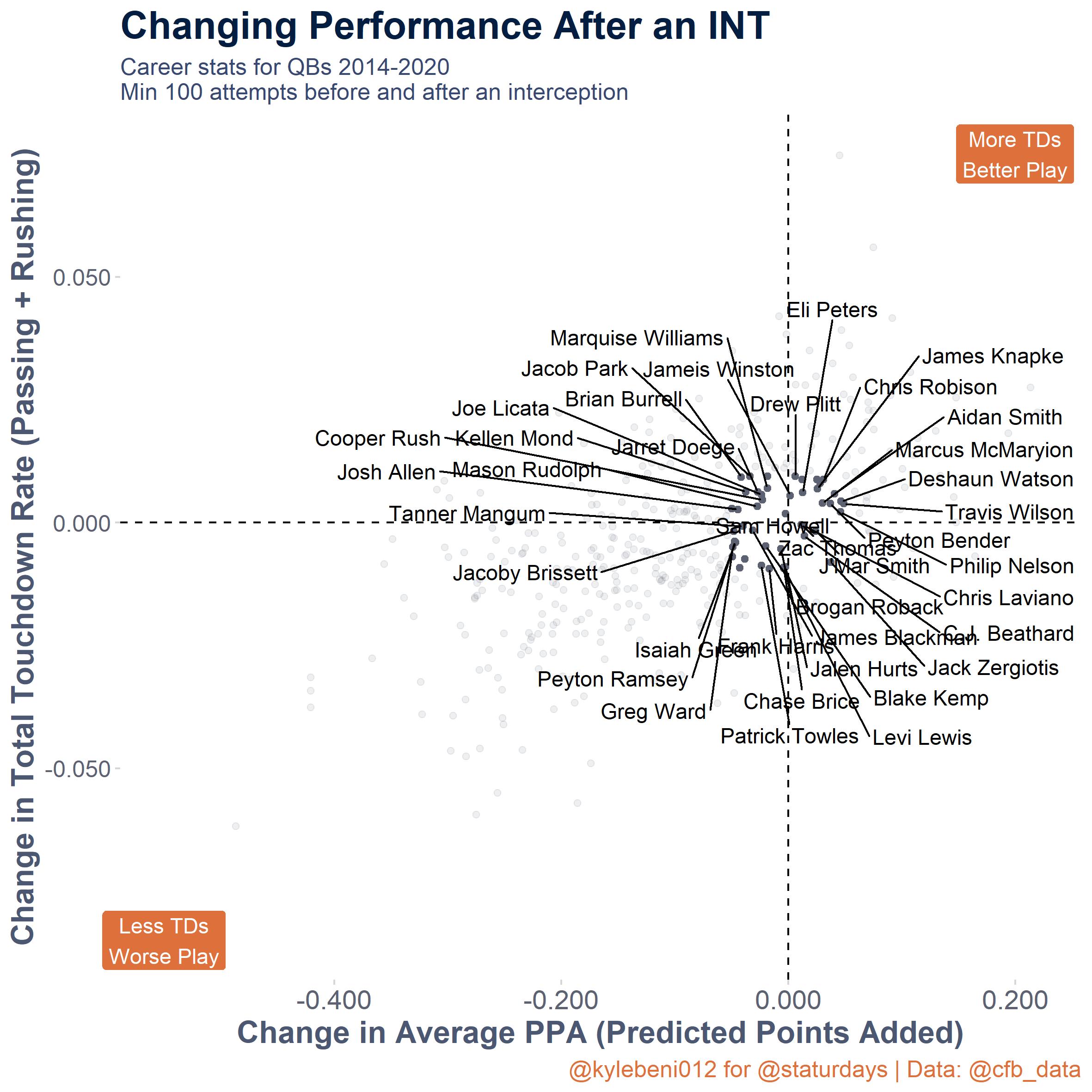
Here you see a blend of some really solid guys currently having great success in the NFL, and then guys that may have gotten the job done in college and that’s it.
When it comes to completion rate, it’s not always the perfect indicator because there are a lot of external factors that go into it, like receiver play, how aggressive of throws your making, and more, but there’s not doubt that the best players in college football in recent years have held higher-than-average completion rates, so let’s see how they do after making a mistake.

So, as expected, I’d call this a bit of a mixed bag. We’re seeing some guys that were strong in the PPA charts go down in completion rate, and vice versa. But again, they could be using their legs more, they could be making more aggressive throws, which are paying off in the long-run but leading to more short-term incompletions. Either way, it’s really interesting to see how some guys completely tank after a mistake, while others get laser-accurate.
Last thing I want to look at here is sack rate. Some guys just get so much more sackable after their first interception. This can be because they’re taking longer on their reads post-INT, the defense is trying to force another mistake and sending more pressure to rattle the QB, or the play-calling is more pass-heavy in general.

This one’s more evenly distributed positively and negatively. In this case, being negative is good, meaning you get sacked less after throwing that INT.
Conclusion
Overall it’s very clear that throwing that first interception negatively impacts QB performance the rest of the game. Whether it’s getting sacked, scoring less, being less productive, or turning the ball over again (although much less than you would think), it affects play across the board. However, some great quarterbacks are able to rebound better than most and rally their team to learn from their mistakes and move forward.
Once there’s more data in the 2021 season, I can’t wait to rerun this and see how this year’s quarterback class has been handling adversity.



 Staturdays