College Football Elo Ratings

  • Big Ten Kickoff: Elo Rankings, Best Matchups + Strength and Difficulty of Schedule

    With the Big Ten kicking off this Friday night with Illinois at Wisconsin, and then a full slate of games on Saturday, we thought we’d look at each team’s position heading into Week 1 (Week 8 for everyone else). Below are the rankings from 1-14 based on preseason Elo rating.
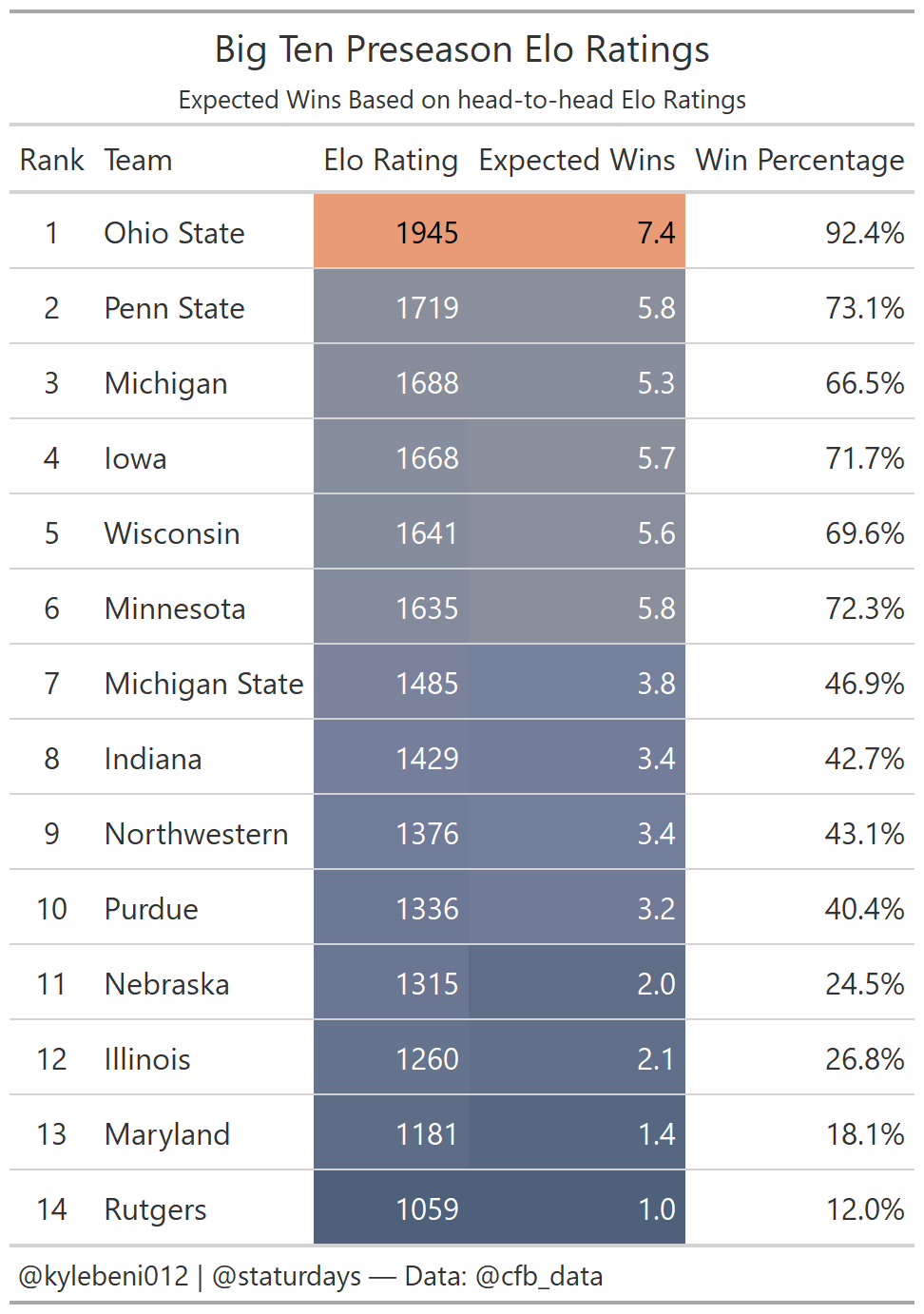
    As you can tell, Ohio State really are in a league of their own this season. Now, Penn State may be able to change that early on when they face-off in Week 2, but it’ll be a tall order with the Lions looking at just a 27% win probability. Not terrible, but they definitely will have to play their best football early on, especially without the usual home-field-advantage effects of the White Out.

    You can really see the tiers of the Big Ten make themselves clear by looking at the above table. There is Ohio State, and then everyone else.

    Top Games of the Big Ten Season

    If you’re looking for games to mark on your calendar, you’re in luck. The best game in terms of strength-against-strength comes early on in Week 2 (Week 9 – wow, that’s gonna be annoying to keep up all season). Outside the OSU-PSU game, most of the big matchups take place later in the season.

    Strength of Schedule

    So who plays the toughest opponents each week on average? Since there are no nonconference games, it’s going to be hard to have a winning record for a lot of these lower-tier teams. Nebraska will be up against it, with an average Elo deficit of 258 points. That equates to an average win probability of 18.5% if they played the same opponent each week with that disadvantage.

    Ohio State have the easiest schedule (partly because they can’t play themselves), while Penn State manages a middle-of-the-road strength of schedule, which would make their ability to win-out all the more impressive if it were to happen.

    Difficulty of Schedule

    When you look at difficulty of schedule, it paints a slightly different picture. Despite facing tougher opponents on average than 6 other teams, Penn State still manages the 2nd least difficult schedule based on their ability to outmatch even the toughest of opponents.
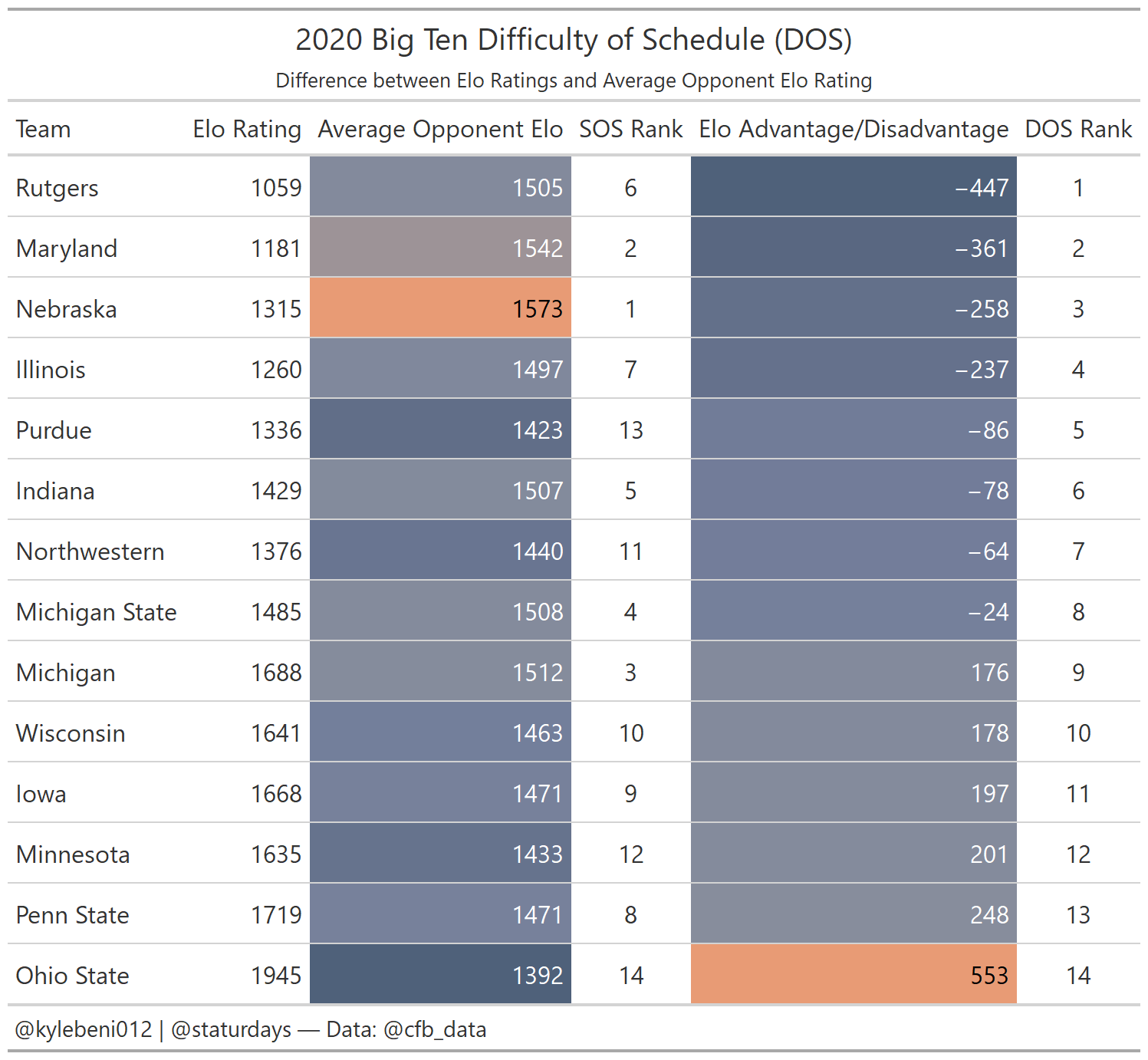
    Rutgers and Maryland, unsurprisingly, will be the most likely to struggle against their opponents, despite Rutgers having only the 6th-toughest opponents on average. Their Elo rating is just so low that they will struggle regardless. On average, they would have a 7% win probability if they played their average opponent each week.

    For some context on just how bad Rutgers is rated going into 2020, the average Elo for Power-5 schools is 1500. For all other D-I teams, it’s 1200. So they would be considered a below-average Group-of-5 school right now. Even against the 2nd-worst team in the Big Ten, Maryland, they would only have a 33% win probability right now.

    Ok, enough harping on Rutgers. The point is, this season is going to be brutal for some, disappointing for others, and an absolute breeze for one: Ohio State. With the shortened season and a lot of turnover, opt-outs, injuries, and eventually three-week COVID-ineligibles, it is going to be a major challenge for any team to get up to speed with Ohio State in time to keep up with their level of talent. And when their biggest challenger plays them Week 2 in an empty stadium and loses that home-field-advantage, it looks all the more likely that OSU is able to run the table.

    We’ll see, but either way, it’ll be great to have one-play-at-a-time, blue-collar, hard-nosed, disciplined Big Ten football back on Saturday. Let’s be thankful for that.
  • Updated Preseason College Football Rankings

    Updated Preseason College Football Rankings

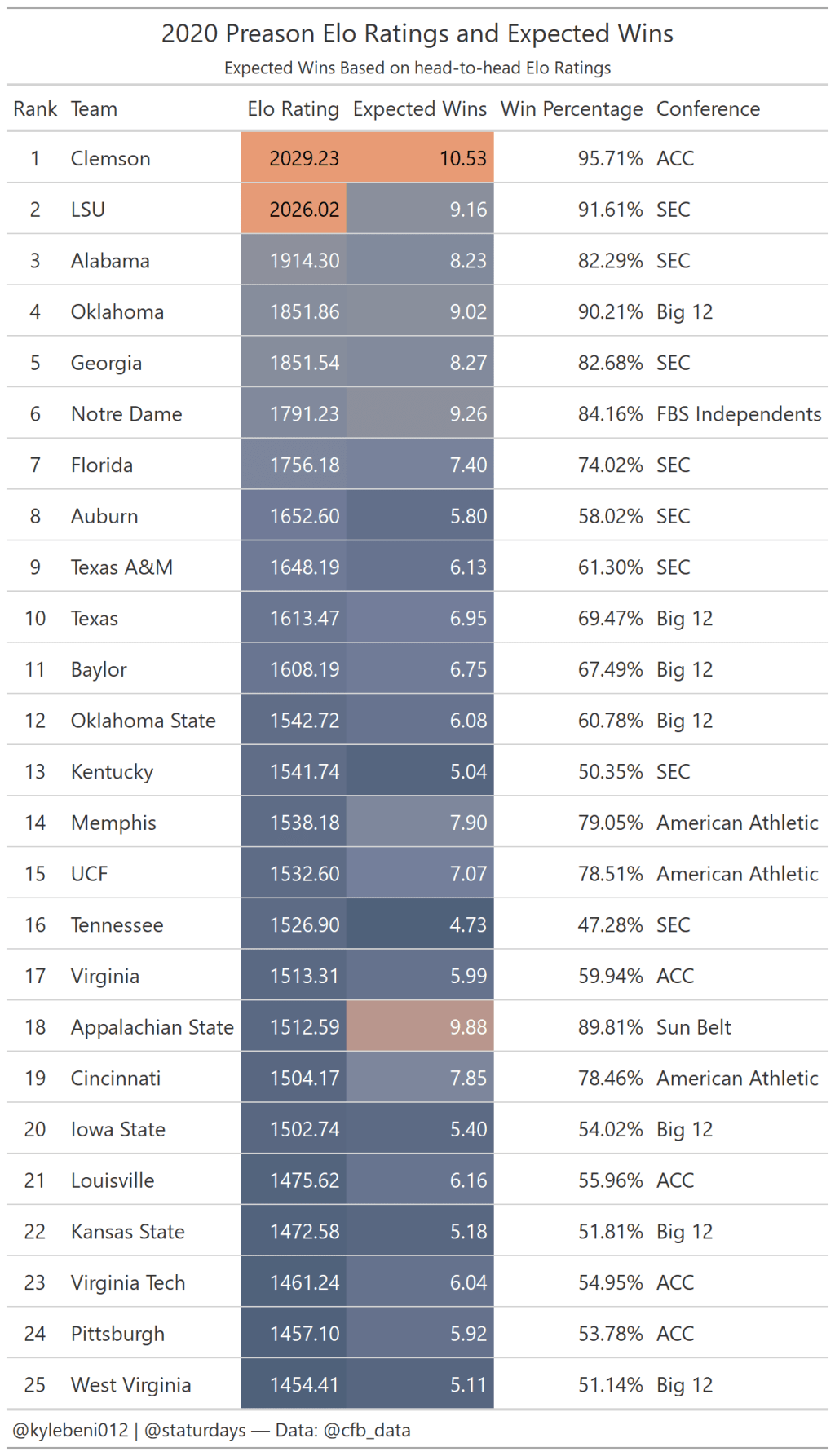
    We’ve updated our Elo Ratings since the last time we wrote about them. Specifically, we’ve recalculated the expected wins and win probabilities of all the teams based on their updated schedules. This resulted in lower overall win totals given the shortened season, but some teams have a higher win probability for the season as a result of the easier conference-only schedule (looking at you Notre Dame).

    We’ll update these every week or so as the games are played, and the expected wins will update accordingly based on the actual result of the games. So we’ll have a clearer picture as the season goes on of exactly where each team will end up. But for now, this will give us a good idea of what we should expect.

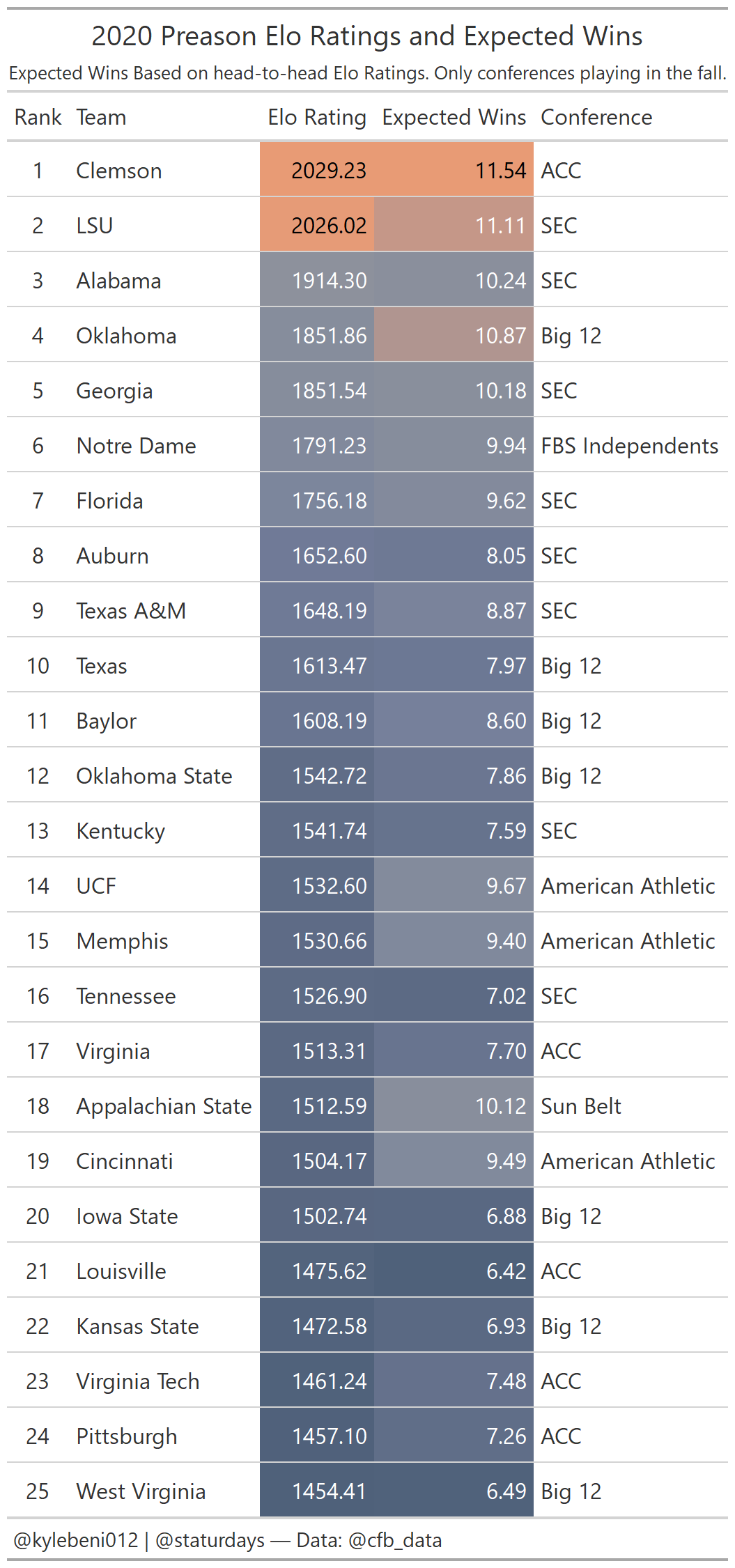
    Updated Top 25 rankings in Elo Rating.

    What’s interesting/sad is that there are several teams in the top 25 that are projected to lose nearly half their games. In a normal season, that would never happen, but it’s a real possibility this year with only six conferences playing in the Fall. That’s very good news for teams like Appalachian State, UCF, and Memphis. These non-power-5 schools would be a long shot to make any sort of playoff in a normal year, but the door is wide open if they were able to win out and one or two of the top four lose a game or two.

    Of those three, Appalachian State has the best chance to win out according to our simulation. We’ll post the full results of the season sim in the coming days.

    Full Rankings For All Teams

    The entire rankings based on Elo Rating for all 77 teams.

    BYU is also in a good position after their win against Navy. The rankings and expected wins reflect the fact that BYU has already won a game, essentially giving them a 100% win probability for any games that have been won already, or a 0% for any games already lost. They’re now projected to win 84% of their scheduled games. However, they are only scheduled for 8 games so they won’t be factored in to any playoff discussion in all likelihood.

  • 2020 Preseason College Football Elo Ratings

    Earlier this month, we introduced College Football Elo Ratings: our new take on the stat used to track the strength and head-to-head win probabilities of teams. Now we’ll use it to rank every team and give a prediction on how many wins they’ll achieve. Right now, we’re including teams that will not be playing in the fall, and we are looking at their schedule before the reduction in games. We will update this again once the schedules are updated in the database.

    These 2020 preseason rankings can also be thought of as the 2019 postseason rankings, since the 2020 ratings are a regressed version of the final ratings of each team at the end of their 2019 season. Elo is a smart rating system, but not smart enough to know what’s happened in the offseason. That being said, if there were any major changes to a team’s roster or staff, it’ll take a few weeks for Elo to catch up and decide how that impacts their performance on the field. With that in mind, let’s take a look at the top 25.

    2020 CFB Preseason Top 25 in Elo Ratings

    The Top-25 for the 2020 College Football season, including teams that are in conferences that have since postponed the season, ranked based on Elo Ratings and Expected Wins.

    Unsurpisingly, Clemson and LSU sit on top of the list going in to 2020. Clemson, even after their loss to LSU, were still rated higher than LSU at the end of the 2019 season.

    The teams are ordered by their Elo, and as you go down the list, if you see a color difference between the Expected Wins column and it’s Elo Rating counterpart, it may indicate either a relatively easy schedule (light blue or orange) or a more difficult schedule (darker blue) compared to that team’s neighbors. For instance, Oklahoma has a lower Elo Rating than Alabama, but their Big-12 schedule results in 10.87 predicted wins, versus just 10.24 for the higher rated Alabama. This might tell us that Oklahoma has a slightly easier schedule, an unsurprising conclusion in this case.

    On the other hand, USC were projected to struggle with their Pac-12 schedule (or what would’ve been) with just 6.92 projected wins while comparably-rated Washington has 7.95 expected wins, more than one extra win. Oklahoma State also leads USC by nearly one win with their Big-12 schedule, and UCF in the American is projected at a whopping 9.67 wins, despite having an Elo Rating nearly 50 points lower to start the season.

    Non-Conference Strength of Schedule

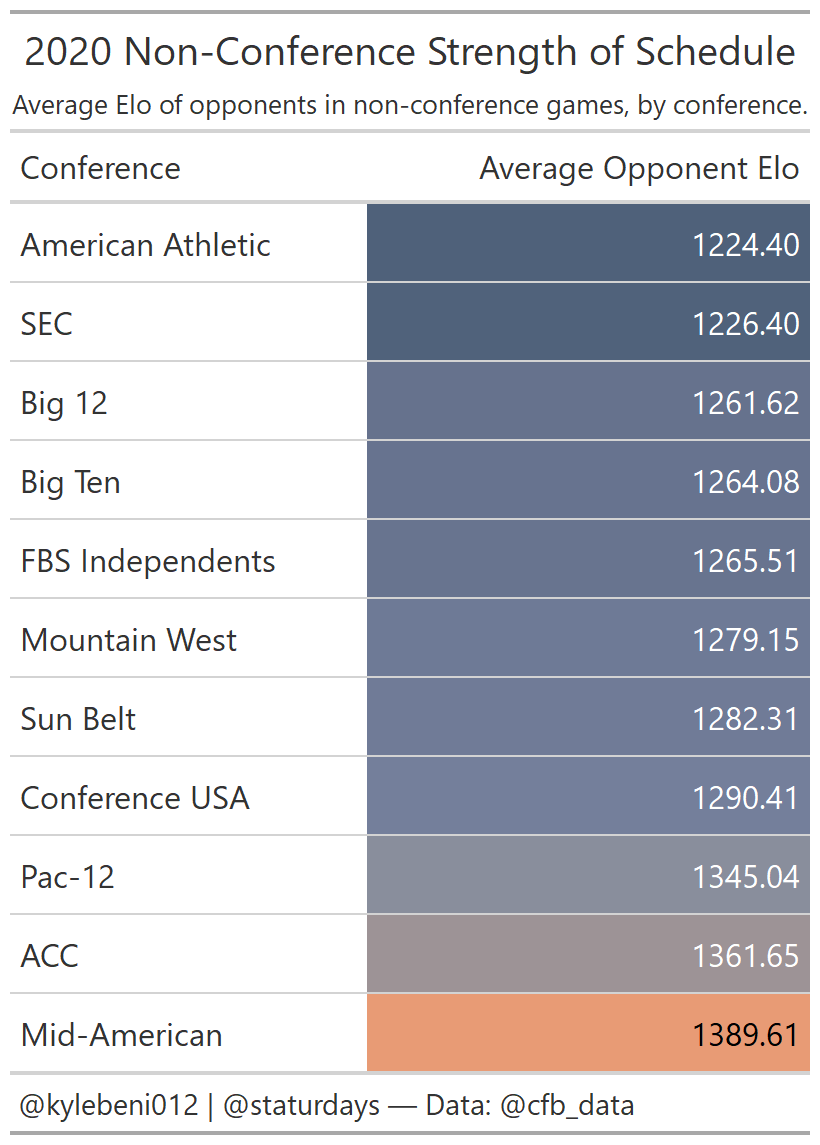
    Expected Wins are calculated simply by summing up each team’s win probabilities for all their regular season games. Once again, this was run with the old schedule, which is why you see Clemson at 11.54 Expected Wins, which is .54 more wins than games that they’ll be playing this season. As soon as the data is updated, we’ll rerun this and put out a new Expected Wins table. In the original schedule which included more out-of-conference games, the SEC had the highest average Expected Wins with 7.26 wins on average, followed by the Big 12 with 6.87, the Big Ten with 6.76, the ACC with 6.66, and the Pac-12 with 6.63. Their Elo Ratings also moved in the same order. The Mountain West was the top non-Power-5 conference in Expected Wins with 6.26. This can hint at two things: conference strength (SEC having more strong teams across the conference than the Pac-12 or ACC), and out-of-conference game difficulty (e.g. SEC scheduling easier non-conference games than the Pac-12). We can’t say for sure which is driving this value more, but both are plausible. Here’s a look at the non-conference opponent Elo ratings for each conference.

    Non-conference opponent Elo Ratings by conference. This shows us which conferences are scheduling the toughest non-conference opponents.

    So it turns out the SEC does have a fairly easy non-conference schedule, while the Pac-12 have one of the most difficult ones.

    Top Team’s Schedules and Win Probabilities

    Looking at the schedules of the top teams, the toughest matchup by far for top-ranked Clemson was (and still will be with the updated schedules) against Notre Dame. This is their only game where they do not have greater than a 90% win probability. Instead, they have a 79.7% win probability according to preseason Elo Ratings. That game was originally slated to be played away and is still an away game right now.

    LSU’s home game against Alabama shows them at a 65.5% win probability. This will likely change as the season plays out, as LSU is a big candidate to regress to the mean with Joe Burrow leaving for the NFL after a historic season in terms of QB stats. Remember, Elo doesn’t know that Joe Burrow left. Instead, Elo automatically reduced LSU’s preseason rating back down towards 1500 (by 5%) to account for any shakeup in the roster, coaching, and general year-to-year variation. LSU has three away games in the 80-percent win-probability range, with their toughest matchup coming against Florida in mid-October. Let’s look at the Top 25 with the Big Ten and Pac-12 pulled out.

    Rankings without the Big Ten and Pac-12

    The Top 25 in Elo Rating and Expected Wins for all conferences that are currently scheduled to play games in 2020.

    So the top teams move up slightly, and some less-common preseason Top-25 teams make it in this year. Outside of the top 10 or so, the teams get fairly average, with Elo Ratings near the mean of 1500. This does not bode well for the competitiveness of this season outside of the top contenders. I wouldn’t be surprised if we end the season with several undefeated teams. And with a lack of non-conference games to weigh the relative strength of each conference head-to-head, it will be a difficult year to choose who gets left out of the playoff, even with the Pac-12 and Big Ten champions out of the picture.

    A note on Elo Rating methodology

    Since we posted the initial Elo article, we’ve made some slight improvements to the calculation that resulted in a Brier score of .172, compared to our previous score of .175. We’ve eliminated the tendency to under-predict actual results. We did this by adjusting teams’ Elo Ratings based on their conference. The Power-5 stays at an initial value of 1500, but the Group of 5 schools are now initialized at an Elo of 1200, and each season they revert to 1200 as their mean. All others, including other D-I and all D-II/D-III opponents, now get initialized at a value of 500. FBS Independents like Notre Dame get lumped in with the Power-5 at 1500 as well. We used 2019 as the baseline for what conference a team should fall into, since some schools have changed conferences since the start of the Elo Ratings in 2000. We’ll continue to analyze this and tinker with it to find the optimal balance when it improves predictive power.

    View the full rankings of all 130 FBS Teams below

    The rankings and expected wins of all 130 FBS D-I college football programs based on Elo Rating for the 2020 season.

    Sign up to receive our weekly win probabilities and Elo Ratings straight to your inbox