General

  • Should You Ever Run The Ball?

    Should You Ever Run The Ball?

    There has been a lot of discussion in recent years over teams not passing the ball enough. The infamous 4th and 5 run play from last season comes to mind as a recent example of the at-times hostile debate between run and pass. So what does the data tell us? We looked at the yards gained on run and pass plays in different down and distance situations. This is what we found.

    Average yards gained broken down by play type for each down, based on yards to go. As you can see, there are very few situations where rush plays gain more yards. Based on data from all D-I teams from 2016 – 2018.

    So, red represents the average yards gained on a pass play, and blue represents rush plays. As you can see, there aren’t too many situations where a run play is going to get you more yards. We can ignore most of the 1st down data because there were very few instances where you would have a 1st and 7, or a 1st and 1 (this is how a 1st and Goal from the 1 yard-line situation appears in the data). That being said, throwing on 1st and 10 is the move.

    Starting with 2nd down, you should pretty much always be throwing. Which kind of makes sense. If you are in 2nd and 10, it doesn’t make much sense to try to run the ball and leave yourself in a likely 3rd and long. If you are at 2nd and 1, defenses are probably expecting a run play, which makes for the perfect time to chuck one down field.

    3rd down is where it gets more interesting. The further you have to go, the closer runs and passes get to averaging the same yards per attempt. That being said, either one is unlikely to get you a 1st down, as both a pass and a run on 3rd and 10 average only 6 yards of the needed 10. Once again, defenses are selling out for the run on 3rd and 1 – it is the least efficient situation to run in on 3rd down – so it makes for a good opportunity to take a shot, or at least pick up a first down on a pass play and avoid getting stuffed at the line.

    4th and 1 poses by far the biggest discrepancy, and while fans may yell at their TVs if you throw an incomplete pass on 4th and 1, you may be able to defend yourself as a coach if you show them this chart. That being said, your 4th and 1 run play is averaging almost 3 yards, which is more than enough to move the sticks. One of the few instances where running the ball makes complete sense is interestingly on 4th and 4 (sorry James Franklin, it’s not 4th and 5).

    Now of course, this has to be adjusted slightly based on the skillset of your team and the opponent you are facing that week. If you’re Army, you probably aren’t that great at throwing the ball. So you have to take that into account when making your decisions. Let’s take a look at their chart (prepare yourself – it’s insane).
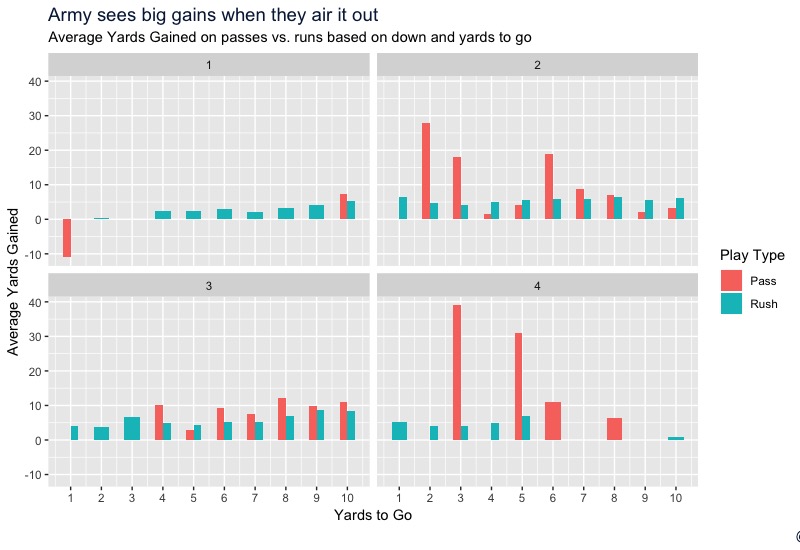
    Army has only bothered to pass on 2nd and 1, 3rd and 1, and 4th and 1 one time each.

    Take a second look at the y-axis. Yeah, it goes up to 40. That’s because Army passes so little, that when they do, it catches defenses off-guard and they gain up to 40 yards on the play. Now that 4th and 3 that I’m referring to was only one play, so you have to take that for what it’s worth – we’re looking at an average of 1. Still, we see across the board that when they do pass, especially in short yardage to go situations, it seems to pay off whether its 1st, 2nd, 3rd, or 4th down. This isn’t to say that Army should pass the ball more, because they will quickly lose this advantage of huge gains on pass plays, and if they up their pass game, their average is bound to drop. However, it is an important weapon to have in their back pocket.

    So how do you know when you are passing the right amount? Ideally, once the right mix of passes and rushes is found, all of these bars will be even. That means that each rush and pass will average the same amount of yards. It makes sense, because the more you pass the ball, the more defenses protect against the pass, and the more vulnerable they become to a run or a draw play. So as passing becomes the norm, run efficiency will improve until they reach an equilibrium.

    Just look at a little over 10 years ago until 2015, the game was eerily similar.

    Coaches have made a few changes to their philosophy over the years, but for the most part the game remains unchanged even though all that red represents opportunity.

    Less than 10 years ago, the disparity was a bit larger, but mostly the same – this implies that coaches still have room to grow. The argument was slightly greater for the pass, probably because coaches were running more often and defenses were prepped for the run. Now there are two reasons that could be the case:

    1. QBs were much less accurate and receivers didn’t catch the ball. So coaches trusted the run more.
    2. The rules favored running the ball over passing.

    So for point number one, I checked by looking at QB completion percentage. From 2008-2015, QB completion percentage was 60.35%. From 2016 – 2019, completion percentage went up to 61.1%. Now this may seem like a small blip, but in the grand scheme of 128 teams over 8 years and 3 years respectively, that is a significant bump. So option 1 has some weight to it.

    Option 2 we’ve all been able to see over recent years. Refs are calling a tighter game and it’s harder than ever to be a defensive back. The combination of targeting penalties, hits on a defenseless player over the middle being outlawed, stricter pass interference calls, better offensive playcalling, and the redefinition of a catch have made passing a much more viable option in today’s game.

    Last, let’s look at Penn State, a fairly balanced team over the past 3 years (they’ve passed on 46.4% of plays).
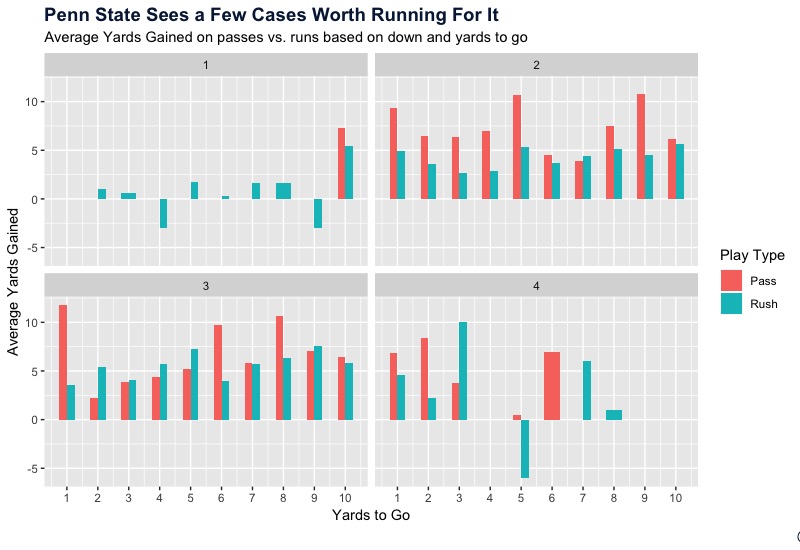
    Penn State is a team that has slightly favored the run, and in some situations (like 3rd and short), you can’t really blame them.

    Penn State has had a lot of success on the ground in the past 3 seasons (partly due to one Saquon Barkley). As a result, they see a few more cases for the run than your average D-I team. Particularly, 3rd and short poses a good opportunity for a run-play, and somehow 4th and 3 is the best opportunity (once again, not 4th and 5 James). This is only on 2 data points for the run and 5 for the pass, so really too small a sample size to draw any conclusions from.

    The best places to make some inferences are on common downs like 1st and 10 and 2nd and 10, where we’ve got over 1000 and over 200 plays, respectively, over the past 3 years. In each of these scenarios, the pass favors the rush, more so on 1st down than on 2nd down.

    Overall, some of the spots where Penn State need to pass the ball more are on:

    • 2nd and 5 – 5.3 Yard Difference – Over 60 Attempts
    • 2nd and 9 – 6.2 Yard Difference – Over 50 Attempts
    • 3rd and 1 – 8.2 Yard Difference – 39 Attempts (Rushed on 35)
    • 3rd and 6 – 5.7 Yard Difference – 37 Attempts

    Of course, if you are just trying to pick up the 1st down, running on 3rd and 1 is a pretty safe bet. On average, Penn State picked up 3.5 yards on a 3rd and 1 rush, which is more than enough to get a fresh set of downs. However, it is worth considering a pass play to catch the defense off-guard and pick up a bigger gain, something this team is all too desperate for after the Week 3 struggle vs. Pitt.

  • Stickler for PSU

    How does anyone start off writing their first article? Well, um … hi!

    I’m Brian (semi-new to Staturdays) and I wanted to introduce myself seeing that I’m going to be writing more and more for this blog this upcoming college football season. If you follow me on Twitter (@Brian_Stickler) you know that I have very intense specific interests and tastes in things – which makes it somewhat hard to follow me I think. To be honest, I am not sure why anyone follows me. Unless you’re super into Penn State Football, the New York Yankees, Breaking Bad, and like a whole bunch of miscellaneous movies and TV shows that I happen to be watching at that moment, I’m not sure that the package of information I send out into the world is all that relevant to you. So assuming that you don’t know my twitter account and frankly don’t care either, I’d like to start by telling you a little bit about me and my relationship to college football, and specifically Penn State.

    I am a novice college football fan. In fact, before I attended Penn State as a freshman I don’t think I ever even watched a college football game in my life. During a tour of campus when I was 16 years old, a tour guide told the group that we would all become the biggest football fans in the world after spending a few years at school. She was definitely right … but not immediately. Admittedly, the Christian Hackenberg era didn’t do much for me right off the cuff. I did love the atmosphere of the games, the tailgating, and the community that surrounded the football games – but it wasn’t until Penn State started really winning that I became really invested.

    Does that make me a bad fan? I don’t think so. In a class I took with our beloved StaturDAD, Kyle, we learned that the product on field is what makes the difference for attendance, more than any other external factor (such as promos, weather, cost, etc.). I don’t know much, but what I can tell you is that that is unequivocally true. When Penn State beat Ohio State in the 2016 white out game there was a clear difference in the way the community behaved. The campus and surrounding areas came alive and it hasn’t died down yet, not 3 years later. Penn State Football demanded our attention, and boy did it suck me right in. I was hooked and since then I haven’t been able to unattach myself, even if I wanted to. I became a superfan – living and breathing Blue and White during the fall and craving even the heartbreak of a 3-hour rain delay loss to Michigan State during the summer. I love the games, the anticipation, the atmosphere, the players, the coaches, and especially my peers. But that last one is where I feel I differ from the rest of the twitter-verse – and this should give you a good look at what to expect from me in the future. Here are a few things that fundamentally define my fandom:

    • I do not think the backup quarterback should be starting. I am sure Will Levis is an unbelievably talented player and has tremendous potential to be a huge impact at Penn State. I am sure that Tommy Stevens did too. But QB is a really hard job … a really hard job. Our friend Sean Clifford (4 Heisman) is going to be a first-year starter for the Nittany Lions this season, and while there will be times where he will shine, there will also be times where he will struggle. That doesn’t mean he sucks or should be replaced — that means he is growing and learning on the field in one of the most competitive environments in all of college sports. Twitter was ready to write off Trace McSorely during the Michigan game last year. Yes, #9 was getting monstrous hate every single pick or incompletion. That absolutely baffled me. He was arguably the best QB in the history of Penn State, and a large portion of the fan base thought his backup was going to be better than him. What are the odds of that? Kyle? Drew? You are the stat guys, let me know the probability that anyone was going to outperform the PSU leader in almost every measurable offensive statistic. It’s unlikely. We need to trust our coaches and know that they evaluate talent much different (and way better) than we do. Which brings me to my next point…
    • I am not one to call for the firing of coaches off the cuff. I will not use the heinous hashtag, #FireFranklin, every single time Penn State loses a football game. You know why? Because it is ridiculous. There are not many proven coaches in college football like James Franklin right now, and I am curious where all these fans calling for his head would like to find his replacement. How many active coaches right now have won a Big Ten Championship? The answer is 2 – and we have one of them. The truth is, sometimes coaches do need to go – like David Corley (PSU WR Coach) after a horrid year for the receiving core. I am just far more comfortable with someone who knows more than me making that decision. I said before, I know almost nothing – but here are two things I do know.
      1. Penn State exceeded all expectations following the sanctions in 2011
      2. I like people who like Penn State

    This is why I like Franklin — He wins with integrity, he recruits competitively with the best teams in the country, and he leads with clear direction — all of which demand respect and exude warmth. The guy is a really good coach, and just because we lost a few games doesn’t mean he should go. That, and he’s going to lead the Nittany Lions to a national championship during his tenure. @OldTakesExposed.

    • I root for the guys in Blue and White. All I have been saying over and over again is that I really don’t know much other than that I want to see us perform well. I am not an athlete, a coach, or a scout – I am simply a fan. So when there is someone on my screen in Nittany Lion gear, I am going to root for that dude to kick ass. I will not root for someone on this team to fail so that another can get an opportunity.

    Those three points make up my fundamental beliefs about sports and Penn State in general. It is important to make that clear because if you are looking for an overly emotional reactional blog this is not necessarily the place for you to get that release.

    It’ll come up over and over again throughout the season, but I cannot wait to experience that joy, excitement, anticipation, and even heartbreak with you all over the next 16 weeks. Let’s watch some college football together. Man does it feel good to be saying that again! We Are!

    Your Pal,

    Brian