With Noah Cain out the last two weeks, we’ve seen a lot more of Journey Brown in the run game as the official RB1 — he’s handled nearly 50% of the workload in the past two games. It’s been exciting at times, given Brown’s big-play ability in both the run and the pass game. However, he’s always felt like a boom-or-bust back to me. I wanted to see what the data showed and see if my impression was true.
While Brown has been leading the RB committee most of the season in yards per attempt both on the ground and in the air, the fan consensus has been for Noah Cain to be RB1. I have been wondering why this has been the case, given that both Brown and Devyn Ford have better YPA than him. The only conclusion I could draw, given the eye-test and feedback from loyal PSU fans, is that Cain is the more “reliable” back. Some people call this “success rate”: the percentage of plays that are deemed “successful”.
In essence, this looks like:
gaining 5 yards on 1st and 10
70% of the yardage to go on 2nd down
all the remaining yards to go on 3rd or 4th down.
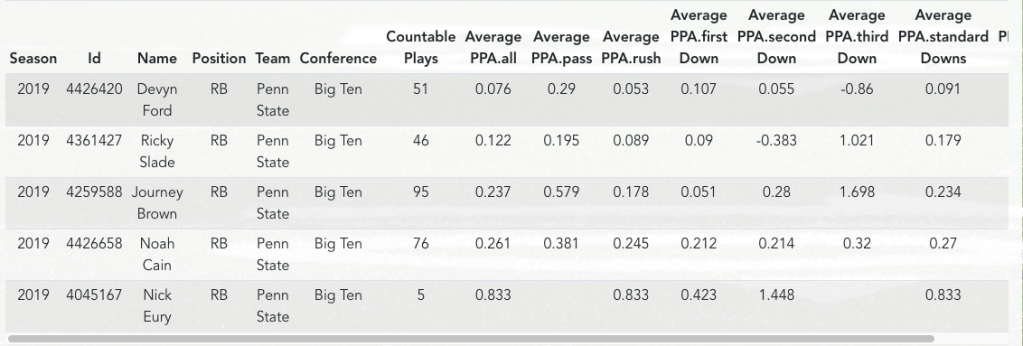
Success rate is factored into PPA (Predicted Points Added), the cousin of EPA. At a glance, justifying the majority opinion is the fact that Noah Cain leads the RB committee in PPA (Data is courtesy of CollegeFootballData.com, and you can see this data for yourself here).
Noah Cain leads all PSU RBs with .261 average predicted points added in the 2019 season.
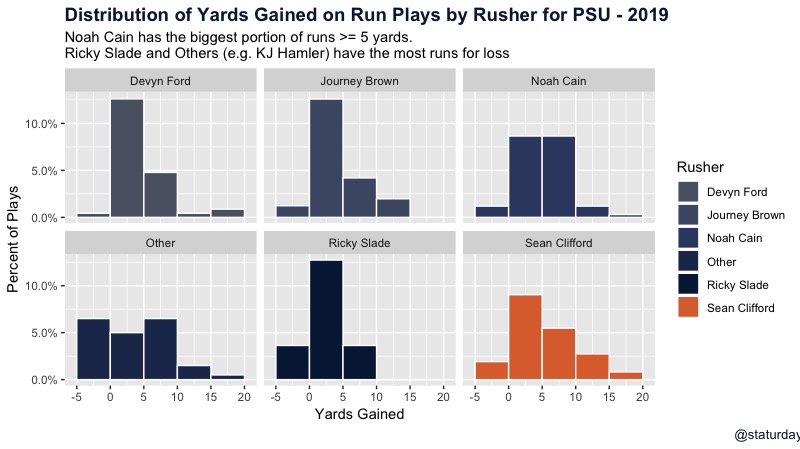
I decided to look at it in two additional ways: the distribution of yards gained on each run, and the standard deviation of run plays. Let’s take a look at the graph first.
Distribution of yards gained on run-plays only, for the Penn State rushers.
This graph shows us how many yards each runner gains, bucketed into groups of 5 yards. I limited the graph to 20 yards so we can compare everyone easily, but this doesn’t do Brown justice in terms of just how explosive he can be. Even from this graph, we can see that he has a higher percentage of rushes of 10+ yards than any of the other feature backs. What the graph doesn’t show is that he also has five runs of greater than 20 yards, the most of any RB. Noah Cain has the fewest.
With all that being said, we can quickly see that Noah Cain (top right) is the most consistent in short-yardage situations, which is why so many fans love him. Quite simply, he gets first downs. Cain has the largest proportion of his runs that go for 5-10 yards. He doesn’t get many gains of larger than that, but he also doesn’t lose yards too often. While more explosive, both Brown, Ford, and Slade have a considerably larger portion of their runs going for less than 5 yards.
Finally, let’s look at the standard deviations of these backs’ yards per play. This will give us an idea of how much variation there is in their yards per attempt. For a simple example, if a running back ran for 5 yards every time, his mean would be 5 and standard deviation would be 0. If a running back averaged 5 yards per attempt, but only ran for either 10 yards or 0, his standard deviation would be 5, indicating more of a boom-or-bust style back (this is a rough estimate).
Average yards per attempt (mean) and standard deviation of rushing attempts for Penn State rushers.
So from this very exciting chart, a smaller standard deviation implies a more consistent back with less variation in each individual run play. Cain’s is considerably lower, at 4.7 yards, than the rest of the top backs. Ford and Brown, unsurprisingly, lead the way in terms of variability in their run plays. This chart further validates what the histogram above was hinting at.
While Brown (and Ford) are certainly the undisputed backs with big-play ability, when you need a first down and a reliable few yards, Noah Cain still appears to be the guy. His status for Saturday is still up in the air, but Lord knows we’re going to need plenty of both to have a shot at the upset against #2 Ohio State.
Let’s all collectively pour one out for Trace. He is no longer the FBS leader in consecutive games with a touchdown pass. You could just tell that he wanted to throw the ball in one of the two red zone trips where he ended up practically jogging it into the end zone. We all wanted him to throw it too, but the gaps were too wide open and the game too close to care about some meaningless streak. In the grand scheme of things, it didn’t matter, and Trace didn’t really care.
That’s why we love him: he has a win at all costs attitude.
It also showed earlier in the game when he gave up another passing touchdown opportunity to Tommy Stevens, who – in his first attempt of the season – slipped one into the corner like he’d been the starting quarterback all season. Our backup QB’s are now a combined 6/6 with 3 TD’s – talk about depth. Unfortunately for Sean Clifford, you usually need a larger body of work to warrant votes from actual Heisman voters. But hey, he still has mine.
Trace, on the other hand, does have a large body of work, and that body just hit the gym and worked on its glamour muscles in the win against Indiana. Trace put in work, despite not having a passing TD, and he saw a big jump in our QB rankings for Week 8. Up into the top 10 for Power 5 QB’s, and up 9 spots to 18 in the FBS rankings. It wasn’t pretty at times, and McSorley came away with another lackluster completion rate, partly due to the drops that continue to plague the PSU wide receivers. McSorley walked away with a 52.8% completion rate, but if we factor out the drops (which I painstakingly counted by hand, and then debated over who was at fault with my dad), he comes out to 68.1% on the day – a much more respectable number. If the Penn State receivers can somehow get out of their own heads and use their super-sticky gloves to catch the ball (which, as anyone who has used them will tell you, make it nearly impossible to drop a ball), then Trace could see a second half comeback and at least be in those stupid ESPN Heisman voting tweets.
That would be a worthy accomplishment after this season, because I don’t see any of the top quarterbacks regressing so much that McSorley has a chance to win the Heisman. Kyler Murray is playing out of his mind against stupid-bad defenses, at 3 standard deviations above the average QB level. That’s insane. Now I didn’t do research on this, but it may be the first time we see back-to-back Heisman-winners from the same school and position ever (I know, I know, this is a stats website, but we don’t do stupid shit like that historical records crap).
After some brief half-assed research, I can confirm that this is an accurate statement by me. You heard it hear first on Staturdays blog. Tell your friends.
Will Grier is also playing ridiculously well, and he’s responsible for almost 90% of West Virginia’s TDs, while Trace is only responsible for half. Kinda hard to argue with that. But hey, Trace still had a good week!
Finally, football is back. After an earlier-than-expected playoff bid scare for Penn State, our heart rates have collectively settled and we can get back to the business of what has become an annual tradition of crushing Pitt (2016 excluded. Wiping it from my memory).
The other week I talked about Trace McSorley’s upcoming Heisman campaign, but I also talked about the defensive efficiency of each conference. This week, with the college football season in full swing, I’m going to take a look at the offensive side of the ball. We’ll also find out who is the most balanced on both sides. This data is from the 2017 season, so keep checking back here as I will be updating these rankings for each week of the 2018 season.
Now, Big Ten fans: shield your eyes. This one isn’t pretty. When I found the offensive efficiency scores of every team and averaged them out by conference, the Big 10 was dead last. Make sure to check the appendix at the bottom to see in detail where these stats came from.
Worst Offensive Conferences in College Football?
The Big 10 has 11 and 8 teams below the mean offensive efficiency score for the FBS (my version of the FBS – the Power 5 conferences and the American) on offense and defense respectively, where the PAC 12 has 8 teams above the mean on both offense and defense, which leaves only 4 teams under the mean. The Big 10 particularly struggles on offense. Intuitively this would make sense if the Big 10 is the strongest defensive conference; you would expect their offenses to struggle with tougher opposition. However, with the new version of defensive efficiency or DAD’s, the PAC 12 is actually the conference with the highest average ranking on defense too!
So now I’m really thrown off. The Big 10 is actually just the 2nd best defense, and their offense is last by a mile. So what’s going on? The Big 10 is brought down by a lot of teams being under the mean, but also by a few outliers that are dramatically worse at offense than the rest of college football. Illinois falls 2 standard deviations below the average, and Rutgers is close behind (ahead? Not sure how to phrase this) at 1.93 standard deviations, also known as the bottom two teams in college football in offensive production. You could’ve guessed this if you watched any of their games: they combined for a hard-to-watch 15 passing touchdowns last year, each with a completion percentage under .500. On the other side of the ball, Nebraska is also 1.8 standard deviations below the mean on defense. The Pac 12 doesn’t have as drastic of outliers. The standard deviation for each conference backs this up. The Big 10 is the 2nd most spread out conference on offense behind the Big 12, while the Pac 12 has the lowest standard deviation, meaning all of their offenses are similarly balanced.
The average Z score for offenses and defenses of each conference
Most balanced teams
To figure out who the most balanced teams were on both sides of the ball, I took the Z score of their offense and subtracted it from the Z score of the defense to find the range, then took the absolute value so they were all positive. This results in what I’m calling Offensive/Defensive Balance. A low score is *sometimes better (note: a team can be balanced by being great on offense and defense, but they can also be equally crappy on both sides of the ball). So who were the most balanced teams? Well, bad news Penn Staters:
The most balanced teams in the FBS
The good news is, as indicated by red, Pittsburgh (and others) are the bad kind of balanced, meaning both their offense and defense are equally bad (within .001 for Pitt), which is an accomplishment in itself. Notice that Clemson and ‘Bama come in at number 3 and number 17 (the good kind of balanced). Penn State is down at number 29: just about average. Now for the bottom 20:
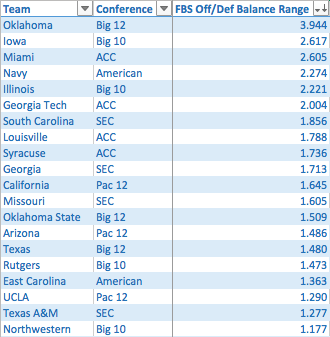
The least balanced teams in the FBS
Now, this one isn’t color coded because it’s all bad. And who’s on top, none other than Oklahoma straight outta the “defense optional” Big 12. Also rounding out the top 10 is Georgia, who beat the slightly more unbalanced Oklahoma but went on to lose to the much more balanced Alabama. Now anybody who watched that game knows it was Georgia who looked the better team for most of it, so I’m not saying that balance wins games. But, it is an interesting trend and definitely looks like it pays off down the stretch to have strength on both sides of the ball. For you Eagles fans, think how vital it was to have that wild-dog defense in the playoffs when the offense sputtered against the Falcons. And then how key it was to have the offense pick up the slack when Tom Brady tried (and failed) to play receiver.
Offensive Powerhouses
The top of this one should come as no surprise:
The top 20 teams on offense
What is a bit surprising is lower down the list. Navy, a rushing powerhouse, sneaks in at #13. They are right above Wake Forest, an underrated team in the ACC. Clemson and Washington show up a bit lower than we’d expect, but they make up for it in having really balanced teams as we saw above. We’ll have to see how the ACC looks this year as the season progresses. Virginia Tech, who came in at #39 for 2017, looked pretty good against Florida State.
Also need to shout out PSU for being #9 in the FBS. Anybody that lived through the Hackenberg years knows that our current offense is looks about as different as possible from the one John Donovan and guys before him ran. When I look back on those years, I think of grey clouds, muddy fields, and WR screens being thrown into the dirt. Now I think of sunny skies and T-McSorley guns-out, heaving bombs that only our guys can get to. We’ve come a long way.
Best all-around teams
So who are the best overall teams, determined by summing up each team’s offensive and defensive Z scores? Penn Staters can finally rejoice for once during this article. Here’s the top 20:
The top 20 teams on offense and defense in the FBS
Surprisingly, the least represented conference here is the SEC, followed by the Big 10. Penn State comes in at a solid #6, right next to their Big 10 East rivals “The” Ohio State. UCF and Memphis are helped by their inflated numbers by playing some truly god-awful teams. I talked about unbalance in the Big 10 with Rutgers and Illinois… well the American conference has two even worse teams in East Carolina and Cincinnati, both 2 standard deviations below the FBS mean total team Z score. UConn is also 1.7 standard deviations below average. They’re reflected in the bottom 20:
The bottom 20 teams on offense and defense in the FBS
The Big 10 isn’t as good as people say it is
I mean, seriously, look how many Big 10 teams are in the bottom 20. SEVEN! Some of them you expect, but Michigan has seriously got to pick up the slack. They were plagued by seriously bad quarterback play this past year (9 passing TD’s, 10 INT’s). Hopefully it gets better for all of our sakes.
This paints a different picture than what you will hear in the media: that the Big 10 is the strongest conference out there; they may be ONE of the strongest defensively, but overall having half of your conference in the bottom 20 of teams is not a good look. I think the Big 10 gets its reputation from its low scoring games (in part due to good defense, in larger part due to bad offense), which football savants respect as “better, hard-nosed, how-the-game-is-meant-to-be-played” football. In reality, it’s PSU, OSU, and Wisconsin that are lifting up the conference. Now, these are 2017 numbers. Like I said, I’ll be updating this as the 2018 season goes on. Hopefully some influx of new talent and quality coaches will start to see a shift. We already have some hope with Maryland taking down Texas yet again in their season opener. Should we Penn State fans start to *gasp*… root for Rutgers and Maryland to get better? Time will tell.
Appendix
Here is a list of the stats I used to find offensive and defensive efficiency ratings, as well as explanations for other metrics that I reference:
Offensive Efficiency Score Per Game
This is similar to the QB score I had last week, except at a team level. It looks at the following stats (if it is scaled that is in parentheses):
First Downs
Penalty Yds (-1)
Pass Yards
Completion Pct
Pass TD (7)
INT (-4.35)
Sacks
Rush Yards
Rushing Yards Per Attempt
Rush TD (7)
FG Made (3)
FG Pct
XP Made
XP Pct
It is summed up for the season and divided by the number of games that the team played, to control for different season lengths.
Defensive Efficiency – DADs Per Game
Defensive Actions Distressing QB’s, the stat you know and love from my last article, is back and better than ever. It is now improved to provide a raw score rather than just comparing conferences to the top conference. I also calculated it for every team individually instead of on a conference level. Once again, controlled for games played. Stats included with scales in parentheses are:
Total Tackles (0.1)
Sacks
Passes Defensed
Interceptions (4.35)
Fumbles Recovered (4.65)
I will continue to tweak this as the season goes on to include more variables like yards allowed, points allowed, etc. Right now this is all ESPN offers.
Converting Raw Scores to Z Scores
In order to be able to add, subtract, and otherwise compare these offensive and defensive efficiency scores, they have to be standardized. This is because the average offensive score per game was 408 while the average defensive score per game was 19.5. To compensate for this, I used a Z score. This takes each raw score, subtracts the average score of the entire FBS from it (so 408 or 19.5), and then divides that by the standard deviation of the FBS scores. This normalizes the scale so that the most average team will have a score of 0. The entire league will be distributed on a normal curve with a mean of 0 and a standard deviation of 1. Now, we can add a team’s defense that scores a 1 (meaning 1 standard deviation above the average team) and their offense that scores a -2 (meaning 2 standard deviations below the average team) to say that their total team Z score is a -1.
Off/Def Balance
Takes the absolute value of the range of offensive and defensive Z scores. This tells you who is the most balanced between offense or defense. Low score is *sometimes better (note: a team can be balanced by being great on offense and defense, but they can also be equally crappy on both sides of the ball).
Team Total Z Score
Sum of offensive and defensive Z scores. Tells you who is the best on both sides of the ball. Higher is better, meaning they are above the mean on both offense and defense.






 Staturdays