Penn State Football

  • The Caboose of the Boilermakers

    We are coming up on another homecoming week in Happy Valley this Saturday, October 5th. The Boilermakers of Purdue are limping their way to State College to face off against the Nittany Lions for the 19th time in their competitive history. Penn State holds a 14-3-1 all-time record against Purdue and are strong favorites to get that 15th win. As of Monday, Penn State is favored by four touchdowns – a large margin, that to be honest, is likely modest.

    The other day during a press conference, Purdue Head Coach Jeff Brohm told media that 6 of his players would not be playing in the game due to injury. These include: starting QB and promising athlete Elijah Sindelar, DT Lorenzo Neal, WR Jared Sparks, backup RBs Tario Fuller and Richie Worship, and most importantly, superstar in the making, all-purpose WR Rondale Moore.

    These injuries are bound to do massive damage to whatever offensive attack Purdue wants to implement against Penn State on Saturday. Most teams would not be able to survive their QB, 2 RBs, and a WR all out for the same game – but Purdue especially, who relies on Moore and Sindelar to execute (basically anything), does not look favorable this weekend.

    Elijah Sindelar, the senior QB, was having a great start to his season; in just three games:

    • he was completing 64.3% of his passes for about 1000 yards
    • he had 9 TDs and 3 INTs
    • he was able to run in another TD

    Their backup QB (who PSU will face Saturday) has not been nearly as good, only completing 51.4% of his passes for 3 TDs and 4 INTs, reminiscent of Kyle’s long-lost Heisman darkhorse D’Eriq King. Losing your starting QB is always going to be a tough hill to climb, but the absence of Rondale Moore is much more damning for Purdue. This kid is a superstar and if you don’t want to take my word for it just check out his highlight reel against Ohio State in 2018. His freshman year he caught 114 passes and put up nearly 1500 scrimmage yards with 14 TDs. This year there was more than plenty of Heisman buzz about him and led Purdue with 29 receptions and 390 scrimmage yards. These two playmakers are the heart and soul of this offense and without them Purdue will surely struggle to move the ball against a stout Penn State defense in Happy Valley in front of a homecoming crowd.

    I predict that Penn State will win this game without much controversy. Coming off of a strong momentum building game in Maryland, the #LawnBoyz will be ready to stomp the Boilermakers and their weird mascot.

    The betting line for this game is Penn State -28.0 and 55.5. For those who don’t know, that means the total points scored between both teams is meant to be 55-56 and Penn State is supposed to win by 28 points. Basically Vegas is predicting a 42-14 win for Penn State. I think the score will more resemble something along the lines of 49-3. The parlay (combined odds of multiple bets) of choosing Penn State to win by more than 28 and for the score to be less than 55.5 is +440. These odds essentially work out as such, if you bet $100 on said parlay and win – you will receive a total of $440. I put down some of my own money on this parlay because I really do think that Purdue will have an immensely hard time scoring points. Following my logic, this would allow PSU to win by more than 28 and not allow more than 55 points to score (Staturdays can not be held responsible for your gambling losses, however may be entitled to fair compensation for your profits. LLC, all rights reserved, yada yada.)

    Outside of the game lines themselves, there are a few things to watch for going into the 5th game of the season:

    • Any true-freshman who has played snaps in all 4 previous games will burn their Red Shirt if they do get playing time.
      • Players like LBs Lance Dixon and Brandon Smith, DBs Jaquan Brisker and Keaton Ellis, OL Caedan Wallace, and RBs Noah Cain and Devyn Ford have all played 4 games already in their true-freshman year. If they do play against Purdue, they will have officially burned their Red Shirt. It is safe to say that Noah Cain and Devyn Ford have earned playing time all season – but we will wait to see who else will be year-long contributors.
    • Micah Parsons coming back with a vengeance.
      • LBs and DLs had a feast on the Maryland offense last Saturday, but unfortunately due to a targeting penalty – Micah Parsons sat most of the game. I expect him to come back hungry against Purdue this week. Don’t be surprised if Micah puts up a multi-sack game or maybe even forces a fumble or two.
    • Clarity among the RB situation.
      • We are coming to the time now where either a hierarchy of RBs will emerge or a true rotation will be the situation going forward. Journey Brown has earned the starting role but really is more or less splitting time with the other backs. They all have proven their worth be it in the run or the passing game. After this game we will have a clearer look into the future of this teams RB situation heading into the more competitive part of the schedule.
    • Another career game for Sean Clifford?
      • Purdue’s defense has been gashed in the passing game so far this season, letting up 295 passing yards to Nevada, 420 to Vanderbilt, and 396 to Minnesota. If Purdue struggled to get pressure on Nevada’s Carson Strong and allowed him to nearly clip 300 passing yards and 3 TDs – what will Clifford be able to accomplish?

    All in all, these are some exciting times for Penn State. Fans should head to Beaver Stadium confident on Saturday and should hope for a nice comfortable win. There is a tough road game ahead, but we can only look at the game currently on the schedule. Let’s go win game number five. We Are.

    4-0.

  • Should You Ever Run The Ball?

    Should You Ever Run The Ball?

    There has been a lot of discussion in recent years over teams not passing the ball enough. The infamous 4th and 5 run play from last season comes to mind as a recent example of the at-times hostile debate between run and pass. So what does the data tell us? We looked at the yards gained on run and pass plays in different down and distance situations. This is what we found.

    Average yards gained broken down by play type for each down, based on yards to go. As you can see, there are very few situations where rush plays gain more yards. Based on data from all D-I teams from 2016 – 2018.

    So, red represents the average yards gained on a pass play, and blue represents rush plays. As you can see, there aren’t too many situations where a run play is going to get you more yards. We can ignore most of the 1st down data because there were very few instances where you would have a 1st and 7, or a 1st and 1 (this is how a 1st and Goal from the 1 yard-line situation appears in the data). That being said, throwing on 1st and 10 is the move.

    Starting with 2nd down, you should pretty much always be throwing. Which kind of makes sense. If you are in 2nd and 10, it doesn’t make much sense to try to run the ball and leave yourself in a likely 3rd and long. If you are at 2nd and 1, defenses are probably expecting a run play, which makes for the perfect time to chuck one down field.

    3rd down is where it gets more interesting. The further you have to go, the closer runs and passes get to averaging the same yards per attempt. That being said, either one is unlikely to get you a 1st down, as both a pass and a run on 3rd and 10 average only 6 yards of the needed 10. Once again, defenses are selling out for the run on 3rd and 1 – it is the least efficient situation to run in on 3rd down – so it makes for a good opportunity to take a shot, or at least pick up a first down on a pass play and avoid getting stuffed at the line.

    4th and 1 poses by far the biggest discrepancy, and while fans may yell at their TVs if you throw an incomplete pass on 4th and 1, you may be able to defend yourself as a coach if you show them this chart. That being said, your 4th and 1 run play is averaging almost 3 yards, which is more than enough to move the sticks. One of the few instances where running the ball makes complete sense is interestingly on 4th and 4 (sorry James Franklin, it’s not 4th and 5).

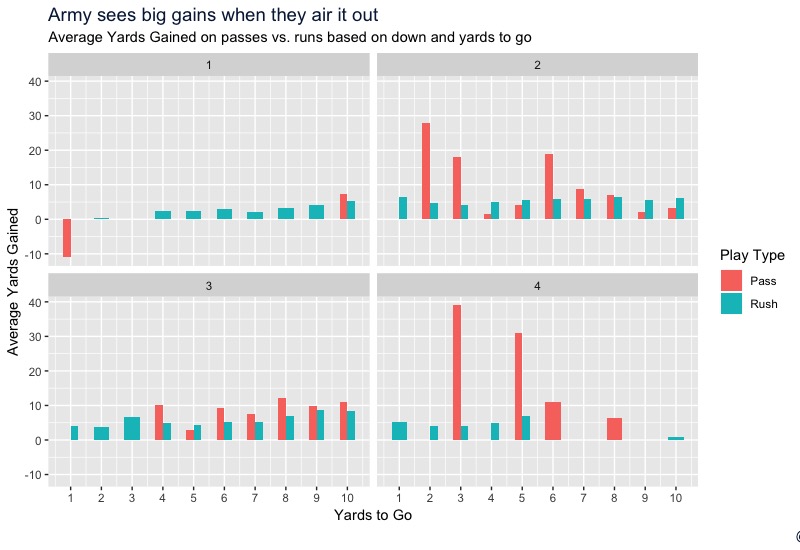
    Now of course, this has to be adjusted slightly based on the skillset of your team and the opponent you are facing that week. If you’re Army, you probably aren’t that great at throwing the ball. So you have to take that into account when making your decisions. Let’s take a look at their chart (prepare yourself – it’s insane).

    Army has only bothered to pass on 2nd and 1, 3rd and 1, and 4th and 1 one time each.

    Take a second look at the y-axis. Yeah, it goes up to 40. That’s because Army passes so little, that when they do, it catches defenses off-guard and they gain up to 40 yards on the play. Now that 4th and 3 that I’m referring to was only one play, so you have to take that for what it’s worth – we’re looking at an average of 1. Still, we see across the board that when they do pass, especially in short yardage to go situations, it seems to pay off whether its 1st, 2nd, 3rd, or 4th down. This isn’t to say that Army should pass the ball more, because they will quickly lose this advantage of huge gains on pass plays, and if they up their pass game, their average is bound to drop. However, it is an important weapon to have in their back pocket.

    So how do you know when you are passing the right amount? Ideally, once the right mix of passes and rushes is found, all of these bars will be even. That means that each rush and pass will average the same amount of yards. It makes sense, because the more you pass the ball, the more defenses protect against the pass, and the more vulnerable they become to a run or a draw play. So as passing becomes the norm, run efficiency will improve until they reach an equilibrium.

    Just look at a little over 10 years ago until 2015, the game was eerily similar.

    Coaches have made a few changes to their philosophy over the years, but for the most part the game remains unchanged even though all that red represents opportunity.

    Less than 10 years ago, the disparity was a bit larger, but mostly the same – this implies that coaches still have room to grow. The argument was slightly greater for the pass, probably because coaches were running more often and defenses were prepped for the run. Now there are two reasons that could be the case:

    1. QBs were much less accurate and receivers didn’t catch the ball. So coaches trusted the run more.
    2. The rules favored running the ball over passing.

    So for point number one, I checked by looking at QB completion percentage. From 2008-2015, QB completion percentage was 60.35%. From 2016 – 2019, completion percentage went up to 61.1%. Now this may seem like a small blip, but in the grand scheme of 128 teams over 8 years and 3 years respectively, that is a significant bump. So option 1 has some weight to it.

    Option 2 we’ve all been able to see over recent years. Refs are calling a tighter game and it’s harder than ever to be a defensive back. The combination of targeting penalties, hits on a defenseless player over the middle being outlawed, stricter pass interference calls, better offensive playcalling, and the redefinition of a catch have made passing a much more viable option in today’s game.

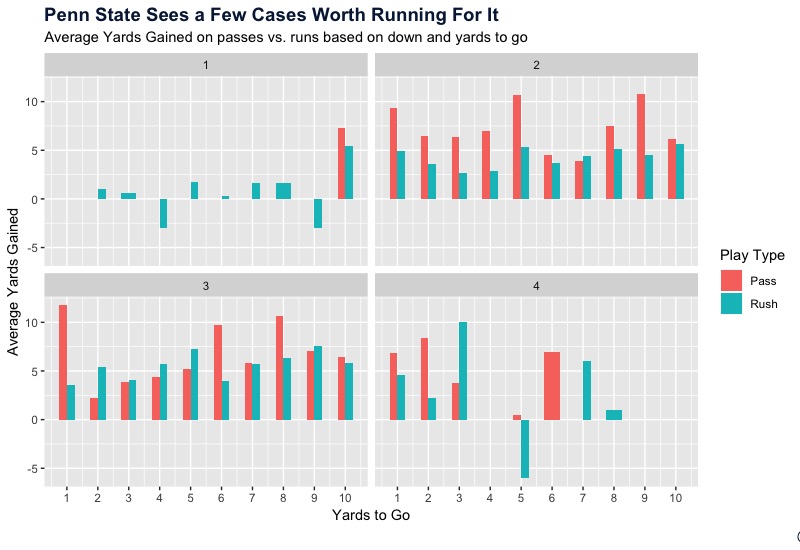
    Last, let’s look at Penn State, a fairly balanced team over the past 3 years (they’ve passed on 46.4% of plays).

    Penn State is a team that has slightly favored the run, and in some situations (like 3rd and short), you can’t really blame them.

    Penn State has had a lot of success on the ground in the past 3 seasons (partly due to one Saquon Barkley). As a result, they see a few more cases for the run than your average D-I team. Particularly, 3rd and short poses a good opportunity for a run-play, and somehow 4th and 3 is the best opportunity (once again, not 4th and 5 James). This is only on 2 data points for the run and 5 for the pass, so really too small a sample size to draw any conclusions from.

    The best places to make some inferences are on common downs like 1st and 10 and 2nd and 10, where we’ve got over 1000 and over 200 plays, respectively, over the past 3 years. In each of these scenarios, the pass favors the rush, more so on 1st down than on 2nd down.

    Overall, some of the spots where Penn State need to pass the ball more are on:

    • 2nd and 5 – 5.3 Yard Difference – Over 60 Attempts
    • 2nd and 9 – 6.2 Yard Difference – Over 50 Attempts
    • 3rd and 1 – 8.2 Yard Difference – 39 Attempts (Rushed on 35)
    • 3rd and 6 – 5.7 Yard Difference – 37 Attempts

    Of course, if you are just trying to pick up the 1st down, running on 3rd and 1 is a pretty safe bet. On average, Penn State picked up 3.5 yards on a 3rd and 1 rush, which is more than enough to get a fresh set of downs. However, it is worth considering a pass play to catch the defense off-guard and pick up a bigger gain, something this team is all too desperate for after the Week 3 struggle vs. Pitt.

  • No Need to Panic Yet: Volume One

    Odds are if you’re anything like me and watch the Penn State Football games from start to finish you were less than impressed with last weeks game versus Buffalo – especially in the first half. The Nittany Lions were down 10-3 going into halftime and a restless Beaver Stadium crowd booed the team off the field.

    The truth is, they deserved the Booing. Outside of a fumble recovery followed by a quick touchdown, Penn State had been outmatched on offense and defense by a Buffalo team that lost all of their all conference players from a year before. I am not here to tell you not to boo, in fact I encourage it. You boo bad performances; you cheer for good ones.  This is how sports has always worked for its entire history.

    What I am telling you is that there is no need to panic just because Penn State didn’t look like Penn State for 30 minutes against a MAC opponent. There is a lot of good that came out of this game that matches up with the bad; and luckily fans can take away a lot more from their matchup with Buffalo than with Idaho. Let’s talk about some of the things we saw and what they could mean.

    • The time of possession favored the Bulls extremely. Buffalo had the ball for over 42 minutes of this game leaving Penn State with 17. That is more than double the time the Nittany Lions were on offense. A pretty staggering statistic, right? Frankly, it is more misleading than anything. The style of offense that each team brought Saturday night was pretty much always going to yield this result. Buffalo has two running backs they truly believe in and a QB who was starting his second ever game. They were always going to try to work the clock and have long meticulous drives down the field. Penn State was much more focused on the big play and tried to gain their yardage in chunks. They were relatively successful in this through the air (and one Sean Clifford run) because Buffalo for the most part was selling out for the rush. #14 took advantage and threw for four Touchdowns this game.
    • Third downs were a problem again. Only converting on two of nine chances, Penn State failed to extend drives when getting to third down. Comparatively, Buffalo converted on 10 of 23 attempts – nothing to brag about, but much better than the Nittany Lions. This was a bigger concern for me than the time of possession. If Penn State wants to have success against better opponents, they will need to find ways to convert on third down as well as prevent their opponents from doing the same.
    • Where the hell were all the running backs? The big four running backs total had only 10 carries for 39 yards this game, making me feel like a big dumb idiot for writing a novel about them last week. Truth is, this isn’t a real concern of mine. Buffalo looked like they were selling out to defend against the run this game, daring Clifford to be the one to beat them in his second ever start… which he did. I imagine once #14 gets a little more comfortable with his reads and Penn State faces more balanced defenses, the running backs will get many, many more opportunities to rush.
    • Ricky, my man. Ricky Slade fumbled right near the red zone the first possession back in the second half, stalling a really promising looking drive. His stat line for the day was 3 carries for 8 yards and a fumble … yikes. This is a really talented RB room and if you put the ball on the ground, you’re probably done for the day. I know it has only been two games, but Journey Brown is looking more and more like RB1. Watch that transfer portal.
    • Only one sack? Penn State was only able to drop the QB behind the line one time during this game, prompting me to tweet “Penn State DLine looking very quiet??”. From my perspective (the corner of the third floor of NYC PSU bar, Tonic East), it looked like Buffalo was able to hold off the D Line completely and run 4-8 yards whenever they wanted to. The truth is, they were dropped for 10 tackles for loss and only averaged about 3ish yards per carry as a team. On top of all of that, QB Myers released the football extremely quickly during pass plays. Not as dramatic as it seemed on TV. I think it was more frustrating to see Buffalo sustain long drives than it was actually damning for the defense.

    So overall, not so bad. It wasn’t the rout that fans and myself hoped we would see but it was enough to get a good look at some things to improve upon and things to look forward to.

    The Good: Sean Clifford looks awesome. The WRs and Pat Freiermuth are dangerous. Defense is completely solid all around.

    The Bad: Third downs on both sides of the ball. Running Back mix into the offense. Accepting a penalty on what would have resulted in a fourth down, just to let Buffalo get another chance to (successfully) convert on third down.

    The Ugly: 2-3 drops by KJ Hamler. Ricky Slade fumble. Jake Zembiec mustache.

    No need to panic just yet. I am confident that Penn State will learn from their mistakes and iron out the necessary wrinkles they will need when facing tougher opponents. After all, under Franklin, they always have. It is a very good thing to earn a comfortable win all while learning a little more about your weaknesses this early. Buffalo proved to be a worthy opponent and we thank them for their time. On to Pitt. Let’s go State.

    2-0