Max Verstappen

  • Norris Qatar Grand Prix Throttle Trace Analysis

    Norris Qatar Grand Prix Throttle Trace Analysis

    At the Qatar Grand Prix on Sunday, an errant side mirror from the Williams ended up on the front straight, causing some brief yellow flags that Norris did not heed to, resulting in a 10-second stop-and-go penalty and effectively ending his day.

    Let’s take a look at the data and see what actually happened.

    A wing mirror sits in the middle of the straight as Perez and Hamilton drive by.

    First, lets look at the normal braking points for reference. This was the lap before the yellow, lap 29:

    Between 600-650 meters is the normal braking point.

    Now lets look at the next lap, focusing on the top drivers who actually saw the yellow flag—remember, the yellow flag only came out for a moment, and then was removed for several laps until the mirror was run over by Bottas.
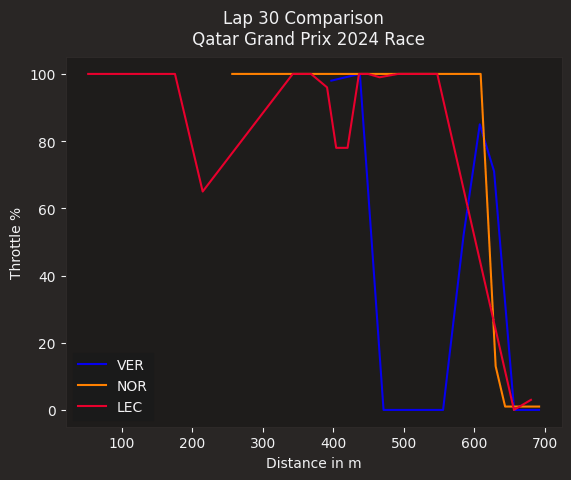
    Here we see that the flag actually came out late into the straight for Max, who throttled down almost 200 meters before normal. Norris was further back down the straight and did not lift, and Leclerc (who was behind Piastri, not shown) lifted a quite early, throttled back up, then down again.

    Piastri was right behind Norris and lifted very early, while Sainz was behind Leclerc and throttled down about 100 meters early. And by the time Perez came around, the flags were gone.
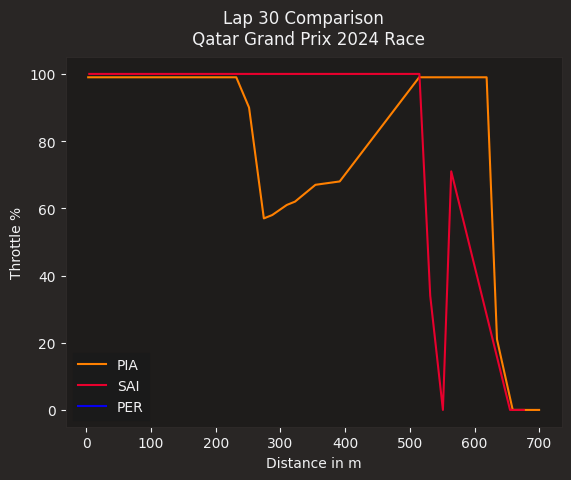
    By these traces, it’s clear that Norris was the heaviest infringer here. So I’d say a penalty was warranted. However, a few questions remain.

    First, what’s considered sufficient slowing for a yellow flag? Verstappen lifted completely, while Leclerc lifted slightly and seemed unsure of where to continue on, and Sainz went through the majority of the flag area at full throttle and lifted near the actual debris.

    And second, why was the yellow flag rescinded with no change in the situation? If the mirror was deemed hazardous, then every driver should have been made to lift in that section (or more reasonably, a VSC should have been deployed to keep the field even until the piece was removed).

    This issue was clear as day and folks at home could have reacted in an instant, but it took the race director six laps to decide what to do, and it was only prompted by Bottas hitting the debris and two punctures coming at the same time.

    Just to emphasize the differences, here’s the speed differences of the Top 6 going into turn 1 on Lap 30, and as you can see Norris is just well ahead of the rest of the field (although I should note that the rest of the field, with maybe Max as the exception, were all going almost 300 kph through the majority of the straight until the actual debris point.)

  • Did Alonso Have A Chance to Win Monaco?

    Did Alonso Have A Chance to Win Monaco?

    Fernando Alonso and Aston Martin ended up making a crucial mistake as the rain started to fall, opting for a set of Medium compound tires as everyone else jumped on the Intermediates. It ended up costing him an extra pit stop just a lap later and the approximately 25-second delta along with it.

    Had he and the team made the correct decision the first time, is it possible that we could’ve had a race for P1 in the final 20 laps?

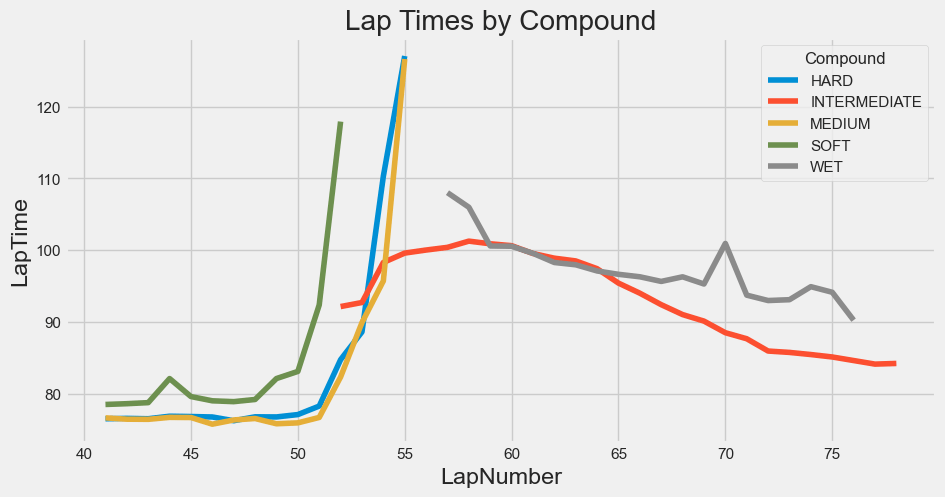
    Let’s use the best intermediate times as a reference to see what could’ve been possible in the crucial lap between Alonso and Max Verstappen’s pitstops.

    The Lap Before

    On lap 53, the hard was still the fastest tire, with George Russell clocking the fastest lap. So Alonso would have no data to go on to know that the inter would soon be the fastest. Valtteri Bottas and Lance Stroll would be the first to try them on, with their first full lap of data coming on Lap 53. Of course, Alonso was ahead of them so would have had less time to know the results of those laps as he’d already be well into Lap 54.

    Alonso Boxes

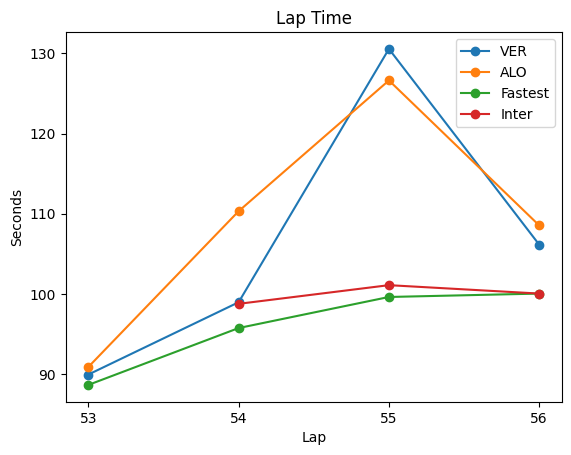
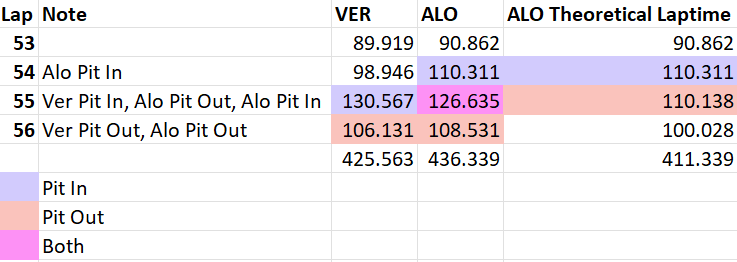
    Before Alonso’s first pitstop on lap 54, he was 9.8s behind Verstappen. At the end of his first stop, he was up to 26.1s behind, with Verstappen yet to pit, with his stop taking 24.4 seconds in total. If you’re wondering why he wasn’t 34.2s behind, it’s because Verstappen had some major moments on Alonso’s pit-in and pit-out laps that helped ease the damage of his stop tremendously. All the more reason the tire choice was crucial.

    On 54, the Medium was the fast tire with Charles Leclerc clocking a 1:35.7 and the fastest Inter a 1:38.7.

    Verstappen Boxes

    This is where it gets interesting. While the Hard, this time of Lewis Hamilton, was yet again still the faster tire on Lap 55, the Inter was only 1.5s slower and closing the gap as people still on slicks started to slide.

    Verstappen would make his one and only pit stop on lap 55 in 24.8 seconds, coming back out on the Inters. However, a major point is his in-lap, which was an astonishing 130.6 seconds, 31.5s slower than Alonso’s in-lap a lap before! This theoretically does Alonso massive favors, essentially erasing any time he lost in the pits.

    Alonso Boxes Again

    On the same lap, Alonso would pit a second time for Inters as well, this time in 25.9 seconds, and unerasing the advantage that Verstappen handed him that very same lap.

    What Could Have Been For Aston Martin

    So, if we keep his pit-out from lap 55, subtract Alonso’s second pit-in from Lap 55 and his pit-out from 56, then he makes up 20.4s on Verstappen in Lap 55 alone (mostly due to VER’s stop and slow in-lap), but crucially another 6 seconds on Lap 56 (instead of the 2.4 seconds he lost to VER in actuality on 56).

    In all, Alonso left 25s on the table by pitting a second time (right around the pit delta), and could’ve ended up 2.2s ahead of Verstappen at the end of Lap 56 had he gotten Inters the first time and ran them at their best pace for two laps.

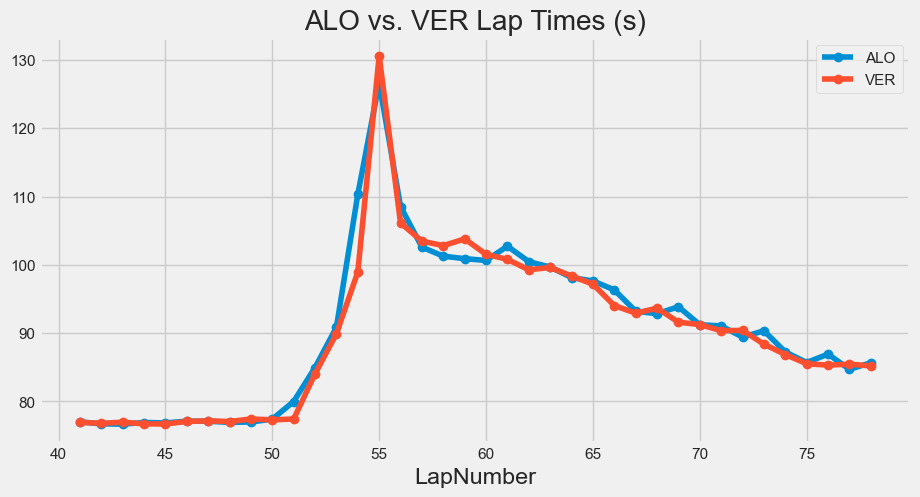
    In reality, he ended up losing 10.8s to Verstappen with his double-pit. The only reason he didn’t lose more was because Max struggled mightily on his pit-in lap as well as the previous lap.

    In the last 22 laps, Verstappen pulled out another 4.8s on Alonso, so Max definitely had better pace once both were on the Inters. However, at Monaco, you could easily imagine Alonso being able to hold off the Red Bull, even with its quicker pace.

    It’s impossible to know for sure if Aston Martin would’ve pulled out the win, but it certainly looked promising up until that pit stop blunder.