
This is an excerpt from a recent edition of the Staturdays newsletter. Subscribe to get weekly content like this in your inbox.
Let’s talk moneylines and expected value, something that’s essential to understand if you want to stand a chance at profiting off sports betting in the long run.
Before I go into too much detail, let me just clarify some key terms for any new people to sports betting:
- Moneyline: A bet placed on a team to win outright, regardless of the score. Usually you’ll see these formatted like “-350” or “+200”. These are called “American Odds”. Seeing “-350” means that you’d need to bet $350 to win $100, plus your initial bet back, so $450 total. Seeing “+200” means you would win $200 if you bet $100, for $300 total. The team with the positive odds are the underdog.
- Spread: The points a team is expected to win or lose by. It is usually written in terms of the home team, so if it’s Alabama @ Georgia and the spread is -3, that means Georgia is expected to win by 3 points. If you see a line and it just says “Alabama +3”, that would mean that Alabama is expected to lose by 3 points in whatever game they’re playing that week.
- If you were to bet on Alabama +3, that means you expect them to “cover” the spread, or lose by less than 3 (or win outright). If you bet on Georgia -3, that means you expect them to cover, winning by more than 3.
- Oftentimes you’ll see the spread at half-points, like “-5.5”. That just means that if the favored team wins by 6, they cover, and if they win by 5, they don’t. This just ensures that no bet is a “push“, meaning everyone get’s their money back because the spread and actual score margin were the same.
- Implied Win Probability: This is the win probability (WP) calculated based on the moneyline odds set by sportsbooks. You can actually take the fact that a team has +400 odds and convert that into a likelihood of them winning. To do this, you follow two simple steps:
- If the odds are positive, do 100 / (odds + 100)
- So for +400, it would be 100 / (400 + 100) = 100/500 = 20% Implied WP
- If the odds are negative, do odds / (odds + 100)
- So for -300, it would be 300 / (300 + 100) = 300/400 = 75% Implied WP
- If the odds are positive, do 100 / (odds + 100)
Calculating Expected Value
So one thing you need to do when evaluating potential bets is look at expected value. If not, you’ll end up placing bad bets and getting underpaid for your wins and overpaying on your losses, which is a good formula for going bankrupt. Expected value is basically the average you can expect to win or lose if you place the same bet many times. So if you bet $10 on a -200 moneyline (66% implied win probability), and that team actually wins that matchup 66% of the time, then you can expect to win nothing on that bet on average.
But, if you can find a team that has +200 odds (33% implied win probability) that you actually think you know has more like a 45-50% win probability, then you can expect to make a profit on bets like that in the long run. Maybe that first one, or three fails, but over time, assuming your win probability model is tuned right—meaning teams with a 50% win probability actually win 50% of the time, not more, not less—you will profit.
Let’s clarify this with an actual formula real quick:
Expected Value = (Potential Profit * Predicted Win Probability) – (Potential Loss * Predicted Lose Probability)
“Predicted Lose Probability” can also be written as (1 – Predicted Win Probability) since they’re inverses.
Let’s also do an example real quick. I’m placing a $10 bet on a team with +200 (33% Implied Win Probability) with my predicted win probability being 50%.
If I win the bet, my profit will be $20 ($30 total minus the $10 I bet). If I lose the bet, my loss will be the $10 I put down.
So the formula get’s us this.
Expected Value = ($20 * .5) – ($10 * .5) = $10 – $5 = $5 Expected Value.
So this would be a positive expected value bet because a team that Vegas is saying wins 33% of the time, I have winning 50% of the time, and if my model is tuned correctly, then I will make money on bets like this over time.
Elo and Moneylines This Season
So let’s say you took every bet that Elo has recommended that had positive expected value, even if it was just 10 cents. Well, bad news: You’d be down nearly $70 after almost 200 bets, assuming each bet you placed was $10 (not advisable).
So far this season, right around $6 in expected value has been the breakeven point, meaning you’d be profiting if you bet on all the games where a team had greater than $6 in expected value. Now ideally, when the season ends, we’d want the breakeven point to be $0, so hopefully by then that’ll be the case once the sample size has increased.
Unfortunately, $6+ expected value opportunities don’t come along too often (only 38 times so far this year), because Vegas is pretty in-tune with what’s going on with these teams, and they also set the lines slightly in their favor no matter what (this is referred to as vig).
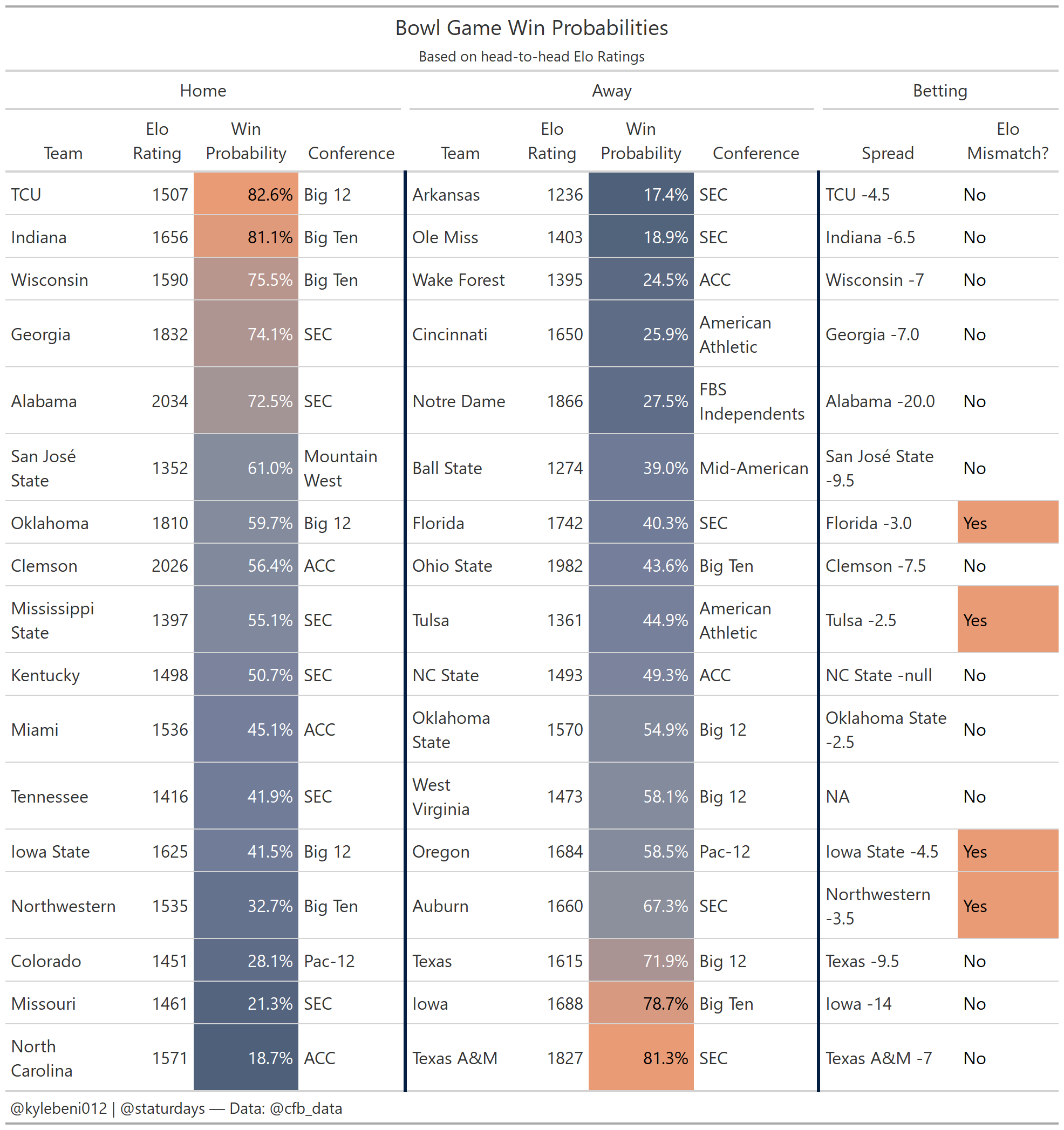
Here’s an example of applying the Expected Value calculation using this week’s games. You’ll notice that a lot of the teams with the highest expected values are the undesirable teams like Navy, Georgia Southern, Hawai’i, and Kentucky, who are huge underdogs this weekend against #1 Georgia, despite being undefeated themselves. These teams have the highest expected values because Vegas pays the best when underdogs win, and can tend to overlook the improbable happening, leading to massive profit opportunities.

If you look at the data, it’s these boring teams that pay the best. Georgia Southern, Navy, Hawai’i: these are the teams that get the good-paying odds, and when they hit, it makes up for a lot of the misses and then some. These can also be the ones where you take both the moneyline and the spread, and you hedge if they lose but keep it closer than Vegas thought, or boost your profit if they win.
The Bottom Line
The majority of games will have a negative expected value for both teams, so that’s why it’s important to calculate the expected value on each game before you place any bets, because otherwise you might bet on something that happens 80% of the time, and only get paid as if it happens 95% of the time, and over time that will come back and bite you (and your wallet.
We share all the positive expected value college football games each week in our newsletter, delivered to you every Thursday morning. You can sign up for free here.




 Staturdays