2020 College Football Season

  • Was the 2020 College Football Season a Success?

    Now before you close out of this article, I’m going to warn you: I’m going to bash college football, the sport you and I both love, a lot during this article. I’m also going to give it some credit. Please don’t get mad: I’ve tried to give as fair and thorough an analysis of the college football season as I can. So if you’ll stay with me through to the end, hopefully you’ll agree.

    The 2020 college football season comes to a close with Alabama crowned champion in a season like no other before it and hopefully after it. However, there’s an empty feeling inside as I reflect back on the season we just witnessed. Sure, there were some highs, some great moments, some exciting games enjoyed by fans and casual viewers alike. But it left me with a hollow feeling, as empty as many of the stadiums where the games were played this year.

    So I wonder: was playing college football in the fall of 2020 worth it? Was it the right decision? Was the benefit of a partially funded athletic department worth the unknowable number of additional COVID cases and deaths sourced from outbreaks at practice facilities around the country? Let’s go through the pros and cons of a season made up of perseverance, protocols, and conflicting priorities.

    One more quick note: you’ll notice a lot of the pros have cons mixed in, and a lot of the cons have pros. This was inevitable as I wrote and found multiple sides to each story, and further illustrates the gray area we are all living in each day amid this pandemic. There is no single right or wrong answer to most things.

    Why the 2020 season was a success

    We got through it. And I don’t mean got through it like the NFL is boasting getting through 17 weeks of football in 17 weeks. We got through it by playing when we could, and cancelling when we had to. Yes, there were cancellations, but rightfully so. It is a good thing that we cancelled games when there was an outbreak, and didn’t try to play through it. That should be celebrated.

    Kids got exposure for the NFL. This is a benefit that only affects a select few, but undoubtedly, there were new stars made this year that may have missed their shot if they graduated without playing their last season.

    It probably didn’t make much a difference in the grand scheme of the pandemic. It’s hard to point the finger at college football and say they did anything egregiously worse than the rest of the country. We’re all just trying to get by. If everyone else was quarantining and college football was trudging on, then that would be a different story. Dr. Doug Aukerman, senior associate athletic director for sports medicine at Oregon State, argued that college athletes were incentivized to be good followers of COVID safety protocols by being able to play their sport as the reward. I don’t disagree with that logic, and fans and other students may have bought into mask wearing when they saw Nick Saban, Trevor Lawrence, or their local campus stars wearing theirs around campus and in-press conferences on national television. They were probably also negatively influenced by seeing Dabo Swinney and many other coaches pull their masks down every time they had something to say, or perhaps it was just amusing.

    Fans stayed home on Saturdays and watched college football. Depending on who you ask, ratings are up or down this season compared to 2019, but likely down due to cancellations and teams not playing, or playing shortened schedules. For the National Championship, the ratings were the lowest since 2004. Despite the ratings, there was a group of fans that chose to stay home and watch college football on Saturday, who may have otherwise tried to go out and find something to do to cure the boredom.

    Now, a few caveats. Watch parties would be counterintuitive to my whole point, and those surely occurred, but hopefully at a much lower rate, or distanced and outdoors. There were, of course, fans in-person at many games as well. Sporting events mean crowds, shouting, and strangers: two of which the CDC lists as risk-factors. Shouting has also been labeled as an unsafe behavior. The one benefit is that games are held outdoors.

    In addition, we’ve seen plenty of chin-mask or maskless fans on TV, the mass celebrations that occurred after Alabama won the National Championship this week, and Notre Dame students rushing the field after upsetting Clemson. To Notre Dame’s credit, every student appeared to be wearing a mask, and my quick review of Notre Dame’s COVID cases didn’t show any notable spike in the weeks after that game. The same can’t be said for Alabama fans, many of whom were maskless since they weren’t in a controlled environment like the Notre Dame fans were.

    Finally, there are other ways to keep people entertained on the weekends that don’t rely on compromising the wellbeing of 18-22 year old amateur athletes. The NFL could have easily taken over Saturdays and spread their games across the entire weekend slate. That would have probably drawn more viewership than college football could, while still keeping the masses entertained all weekend without it being at the expense of unpaid student-athletes.

    It funded athletic departments and kept thousands across the country employed. Whether it meant employees of the university continuing to get paychecks, or local businesses seeing a little business in town with a small crowd, as opposed to no business whatsoever: college football propped up economies across the nation. Smaller, revenue-losing sports were kept alive in some cases. Not to mention the networks and their employees who had content on Saturdays, articles to write, shows to produce, and ad space to sell.

    Why the 2020 season wasn’t worth it

    A lot of players got COVID, and we don’t know what that means for them in the future. Not six months from now, or six years from now. We have seen studies showing increased risk of heart conditions, brain fog and other ailments lasting many months after infection, and more.

    Athletes (generally, based on my analysis of the Big Ten) got COVID at a higher rate than their peers, meaning that it was not indeed safer to play sports than to not play, as many argued. And how could it be? Would you feel safer in a spread out classroom (or much more likely, in your dorm on Zoom) with a mask on, or huddled up in the locker room celebrating post-game? Many schools implemented regular random testing, returning positive rates of around 1% at schools like Penn State, Alabama, and Clemson. Even during the worst parts of the pandemic (read: now), the positive rate is around 15% nationwide.

    However, we’ve seen how quickly COVID spreads in a locker room. Ed Orgeron notoriously said “most our players have caught it”, without citing any data. The Clemson locker room had an outbreak almost immediately when they got back on campus, with 23 players infected. On a roster of about 100 players in CFB, that’s a 23% positive rate. This is clearly higher than the rate of spread that casual students on campus were experiencing (the Clemson positive rate currently, even during the new height of the pandemic, is only 2.5%). Athletic departments in the Big Ten with complete datasets averaged around 8% of all cases at their respective universities, ranging from 2% of all cases to 21%, much more representative than their makeup of the overall student-body in most cases, with most Big Ten schools having somewhere between 40,000 and 60,000 students.

    They also probably gave it to their peers, where it slowly leaked out and decimated vulnerable residents in college towns. It’s impossible to know how many other people these players potentially infected. Nobody is writing headlines about the roommate of the college football player who is in the ICU, or mother or Aunt or professor. It’s a rolling ball that just keeps growing.

    While infection rates, hospitalizations, and deaths among university students were low compared to the general population, the same can’t be said for those living in the surrounding areas who were at higher risk. All it took was a few interactions between student and townie to send the virus through a college town.

    Players and teams that wanted to play, didn’t feel that way so much by the end. As seen by the bowl game opt-outs (at least 21 teams formally opted-out, forcing 16 bowl games to be cancelled), and a post-mortem done by Sports Illustrated, the enthusiasm was high at the start of the season, and quickly dwindled, a feeling we can all probably relate to. That being said, at least one player interviewed said it was 100% worth it despite their disinterest in competing beyond the regular season.

    Kids were forced to make extraordinary sacrifices. Not seeing family or friends for months at a time. Being deemed “essential” employees as student-athletes. People will argue it helped their chances at the NFL. Most will not play in the NFL. People will say they were given the chance to opt-out without consequence. When there is uncertainty, and no guarantees from the NCAA, that your scholarship will be waiting for you next year instead of handed to an incoming freshmen, is that really without consequence? Coaches were also caught telling kids to hide symptoms, as detailed in a report with mixed conclusions and no consequences.

    Coaches, ADs, even parents, also actively lobbied their conferences to return to play because their kids wanted to play. A lot of people also want to dine indoors, open up bars, or beat COVID via herd immunity. However, kids (and many adults, as we all now know), don’t always know what’s best for themselves, or others around them. So listing “the kids want to play” as a reason to play is irrelevant during a pandemic. People want to do a lot of things they shouldn’t do.

    Coaches COVID-shamed other programs. Most notably, Dabo Swinney claiming Florida State blamed COVID to get out of a matchup between the two teams. This type of squabbling, as thousands died each day, belittled the seriousness of the pandemic.

    There were a lot of prime-time blowouts. It certainly felt that way, at least. But was it an unbalanced season? The actual margin of victory in 2020 was nearly 2 points less, at 17.2, than it was in 2019 at 19.1. But that could be due to the elimination of most blowout non-conference games. So when excluding non-conference games, 2020 still had a 0.5 point advantage over 2019 at 16.1 points. However, when you look at the start time of games, the 8-9 PM Eastern Time games (primetime) in 2020 had the largest margin of victory at 23.8 points. So we can agree that the primetime games sucked this year, but let’s not say the whole season was that way.
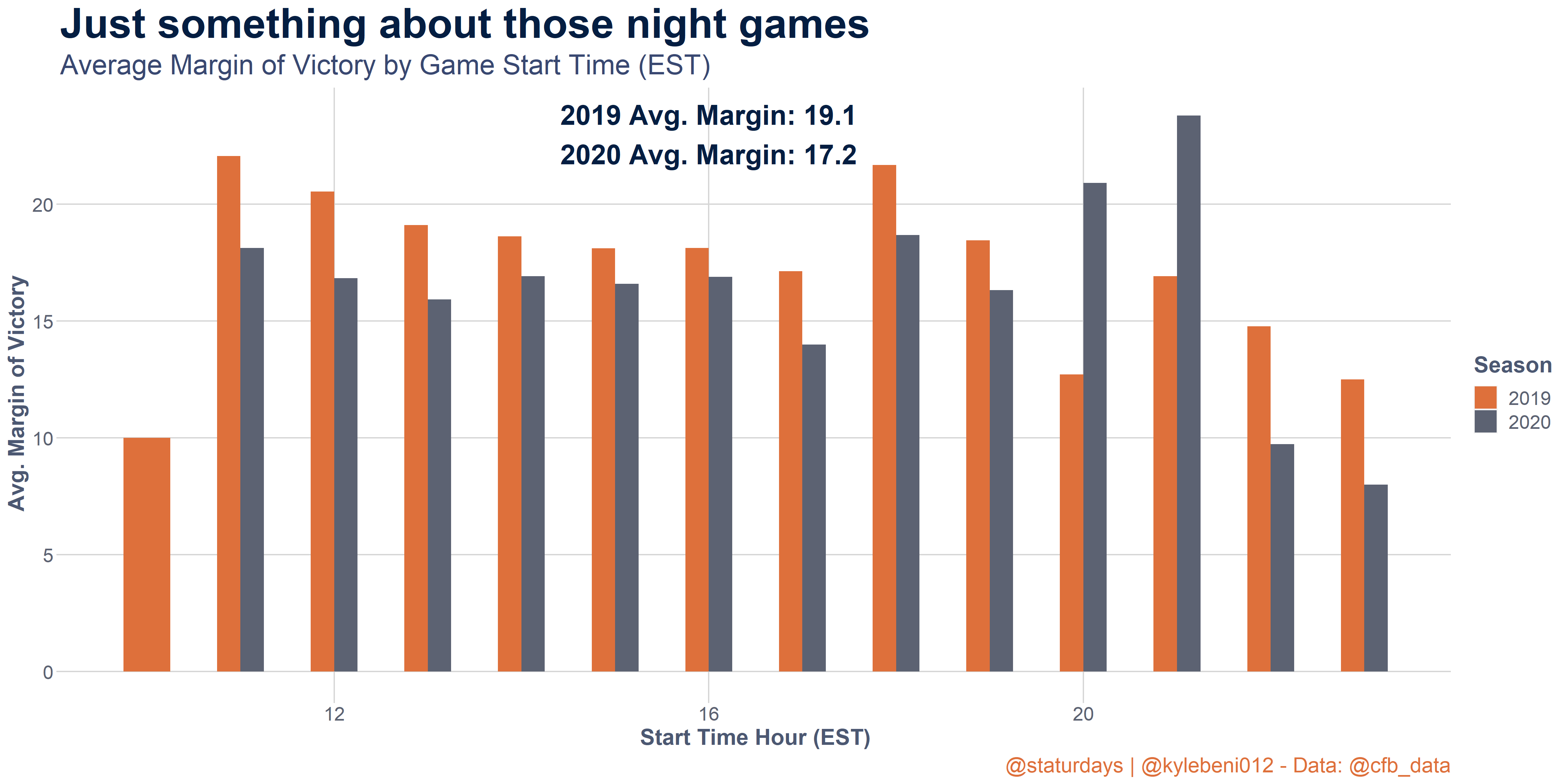
    While the primetime games were blowouts, the overall 2020 season was actually more competitive in terms of margin of victory than last year.

    The scheduling differences made the race to the Playoff more unfair than normal. A 7-0 team played a 12-0 team in the National Championship. I’m not saying they didn’t deserve to, but a lot of people didn’t like seeing that, and I don’t blame them. A lot of good teams got left out, which is an issue that goes beyond just 2020. And viewers made their opinions heard by not watching, whether because they didn’t like the teams, or thought it was going to be yet another primetime blowout.

    We lost a college football player to COVID-19. I wrote at the beginning of the season that if we lost even one player to COVID-19, it would not be worth it. Now, from what they know, it sounds like the infection was linked to a party, and not a football activity, so I don’t think it would be fair to attribute this to college football in any way. His team was not playing in the Fall, and students were going to return to campuses whether football was played or not. Still, this is of course very sad to hear.

    Jamain Stephens Jr., a defensive lineman for California University of Pennsylvania, died from a blood clot in his heart after contracting Covid-19. “I’m very, very nervous for these young men and women … These kids, their lives are priceless. And it’s just not worth it,” his mother, Kelly Allen, told CBS News.

    This excludes high school football, which I would argue was many times more dangerous given the number of high schools there are for each individual D-I program out there. Several high school coaches have lost their lives from the virus. And high schools don’t have the resources to test their athletes like these colleges do: without rapid and regular testing, college football likely wouldn’t have been feasible.

    So was it worth it?

    I feel guilty, like my enjoyment of the season came at the expense of young athletes’ wellbeing, and potentially people’s lives. It’s the same way I feel when I eat out at a restaurant and shamefully remove my mask while a minimum-wage server takes a deep breath and comes to wait on me, praying I won’t be rude or ill. “I’m supporting local business. She’s glad that I’m here. It’s better than the place being empty.” But my dollar is just as good picking up takeout without putting her or other diners at risk, so why am I here? It’s the guilt we battle with every day.

    I stand by my statement at the beginning of the season: if we lost even one player, coach, or assistant from COVID that could have been avoided by not playing football, then it was not worth it. Luckily, as far as we know, no college football program lost someone due to COVID-19, despite the large number of infections. I cannot definitively say that for all college sports, but that’s something to be thankful for.

    The waters have been muddied so much by the irresponsibility of the nation as a whole that it’s impossible to point the finger at college football and say “this is your fault.” With that being said, we’re all just doing the best we can to get by. And college football helped a lot of people—not just players, but staff, employees, cameramen, analysts, fans, and myself included—get through a very rough part of 2020.

    A lot of bad has come from this year. A lot of bad has come from college football. But in a year where we’re all searching for what little bit of good we can find each day, college football delivered some of that too.

  • 2020 Preseason College Football Elo Ratings

    Earlier this month, we introduced College Football Elo Ratings: our new take on the stat used to track the strength and head-to-head win probabilities of teams. Now we’ll use it to rank every team and give a prediction on how many wins they’ll achieve. Right now, we’re including teams that will not be playing in the fall, and we are looking at their schedule before the reduction in games. We will update this again once the schedules are updated in the database.

    These 2020 preseason rankings can also be thought of as the 2019 postseason rankings, since the 2020 ratings are a regressed version of the final ratings of each team at the end of their 2019 season. Elo is a smart rating system, but not smart enough to know what’s happened in the offseason. That being said, if there were any major changes to a team’s roster or staff, it’ll take a few weeks for Elo to catch up and decide how that impacts their performance on the field. With that in mind, let’s take a look at the top 25.

    2020 CFB Preseason Top 25 in Elo Ratings

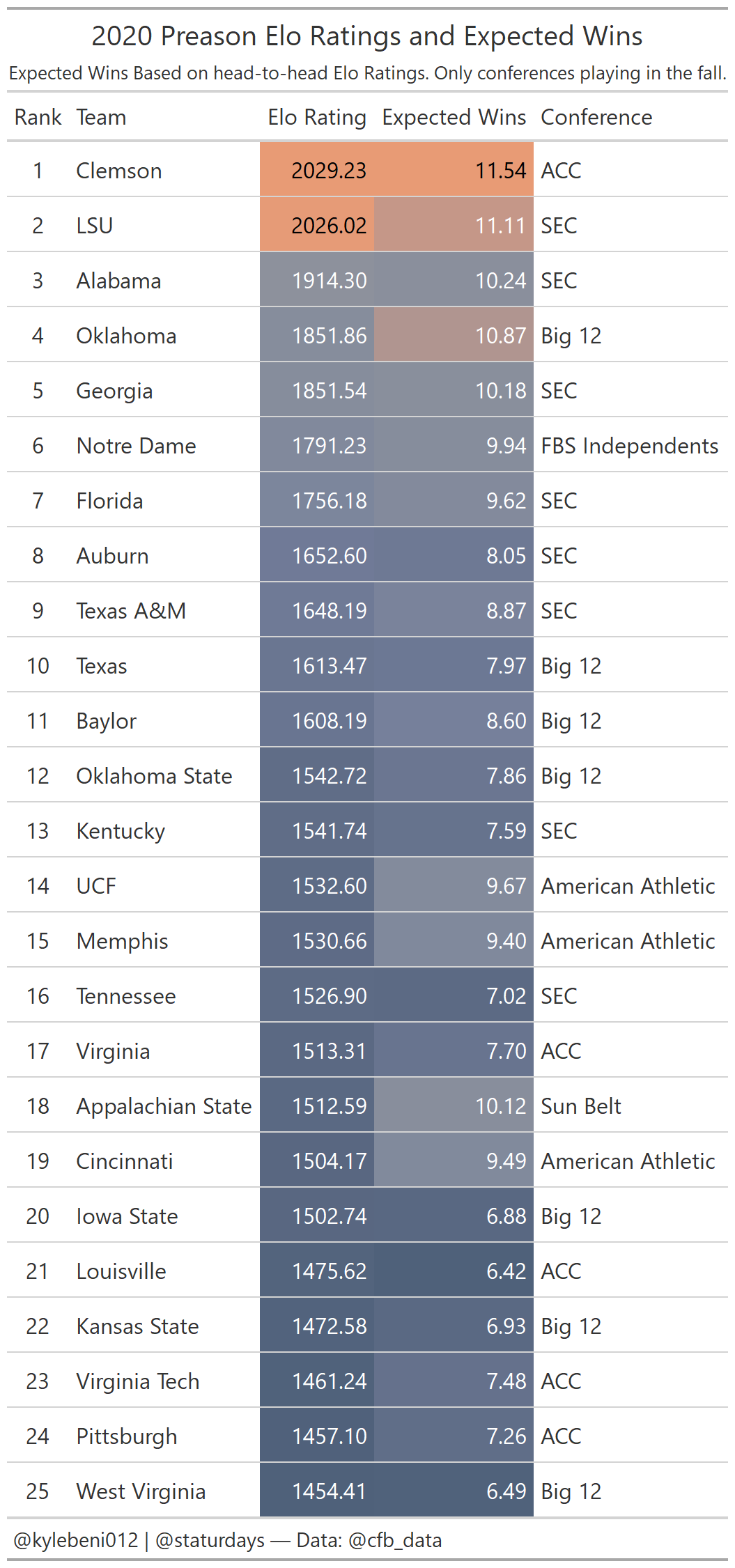
    The Top-25 for the 2020 College Football season, including teams that are in conferences that have since postponed the season, ranked based on Elo Ratings and Expected Wins.

    Unsurpisingly, Clemson and LSU sit on top of the list going in to 2020. Clemson, even after their loss to LSU, were still rated higher than LSU at the end of the 2019 season.

    The teams are ordered by their Elo, and as you go down the list, if you see a color difference between the Expected Wins column and it’s Elo Rating counterpart, it may indicate either a relatively easy schedule (light blue or orange) or a more difficult schedule (darker blue) compared to that team’s neighbors. For instance, Oklahoma has a lower Elo Rating than Alabama, but their Big-12 schedule results in 10.87 predicted wins, versus just 10.24 for the higher rated Alabama. This might tell us that Oklahoma has a slightly easier schedule, an unsurprising conclusion in this case.

    On the other hand, USC were projected to struggle with their Pac-12 schedule (or what would’ve been) with just 6.92 projected wins while comparably-rated Washington has 7.95 expected wins, more than one extra win. Oklahoma State also leads USC by nearly one win with their Big-12 schedule, and UCF in the American is projected at a whopping 9.67 wins, despite having an Elo Rating nearly 50 points lower to start the season.

    Non-Conference Strength of Schedule

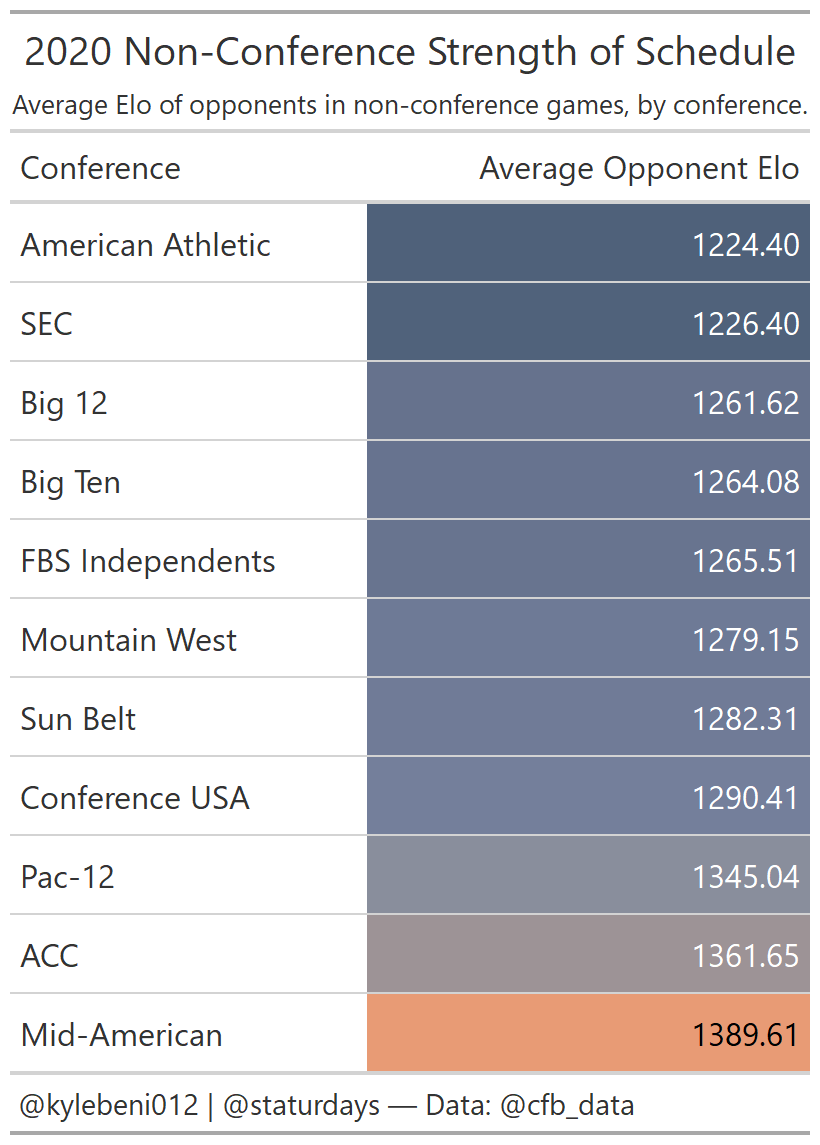
    Expected Wins are calculated simply by summing up each team’s win probabilities for all their regular season games. Once again, this was run with the old schedule, which is why you see Clemson at 11.54 Expected Wins, which is .54 more wins than games that they’ll be playing this season. As soon as the data is updated, we’ll rerun this and put out a new Expected Wins table. In the original schedule which included more out-of-conference games, the SEC had the highest average Expected Wins with 7.26 wins on average, followed by the Big 12 with 6.87, the Big Ten with 6.76, the ACC with 6.66, and the Pac-12 with 6.63. Their Elo Ratings also moved in the same order. The Mountain West was the top non-Power-5 conference in Expected Wins with 6.26. This can hint at two things: conference strength (SEC having more strong teams across the conference than the Pac-12 or ACC), and out-of-conference game difficulty (e.g. SEC scheduling easier non-conference games than the Pac-12). We can’t say for sure which is driving this value more, but both are plausible. Here’s a look at the non-conference opponent Elo ratings for each conference.

    Non-conference opponent Elo Ratings by conference. This shows us which conferences are scheduling the toughest non-conference opponents.

    So it turns out the SEC does have a fairly easy non-conference schedule, while the Pac-12 have one of the most difficult ones.

    Top Team’s Schedules and Win Probabilities

    Looking at the schedules of the top teams, the toughest matchup by far for top-ranked Clemson was (and still will be with the updated schedules) against Notre Dame. This is their only game where they do not have greater than a 90% win probability. Instead, they have a 79.7% win probability according to preseason Elo Ratings. That game was originally slated to be played away and is still an away game right now.

    LSU’s home game against Alabama shows them at a 65.5% win probability. This will likely change as the season plays out, as LSU is a big candidate to regress to the mean with Joe Burrow leaving for the NFL after a historic season in terms of QB stats. Remember, Elo doesn’t know that Joe Burrow left. Instead, Elo automatically reduced LSU’s preseason rating back down towards 1500 (by 5%) to account for any shakeup in the roster, coaching, and general year-to-year variation. LSU has three away games in the 80-percent win-probability range, with their toughest matchup coming against Florida in mid-October. Let’s look at the Top 25 with the Big Ten and Pac-12 pulled out.

    Rankings without the Big Ten and Pac-12

    The Top 25 in Elo Rating and Expected Wins for all conferences that are currently scheduled to play games in 2020.

    So the top teams move up slightly, and some less-common preseason Top-25 teams make it in this year. Outside of the top 10 or so, the teams get fairly average, with Elo Ratings near the mean of 1500. This does not bode well for the competitiveness of this season outside of the top contenders. I wouldn’t be surprised if we end the season with several undefeated teams. And with a lack of non-conference games to weigh the relative strength of each conference head-to-head, it will be a difficult year to choose who gets left out of the playoff, even with the Pac-12 and Big Ten champions out of the picture.

    A note on Elo Rating methodology

    Since we posted the initial Elo article, we’ve made some slight improvements to the calculation that resulted in a Brier score of .172, compared to our previous score of .175. We’ve eliminated the tendency to under-predict actual results. We did this by adjusting teams’ Elo Ratings based on their conference. The Power-5 stays at an initial value of 1500, but the Group of 5 schools are now initialized at an Elo of 1200, and each season they revert to 1200 as their mean. All others, including other D-I and all D-II/D-III opponents, now get initialized at a value of 500. FBS Independents like Notre Dame get lumped in with the Power-5 at 1500 as well. We used 2019 as the baseline for what conference a team should fall into, since some schools have changed conferences since the start of the Elo Ratings in 2000. We’ll continue to analyze this and tinker with it to find the optimal balance when it improves predictive power.

    View the full rankings of all 130 FBS Teams below

    The rankings and expected wins of all 130 FBS D-I college football programs based on Elo Rating for the 2020 season.

    Sign up to receive our weekly win probabilities and Elo Ratings straight to your inbox

  • Introducing College Football Elo Ratings

    Introducing College Football Elo Ratings

    In preparation for the 2020 College Football season, we did some exciting new work with something called Elo Ratings. We got them ready just in time for kickoff, only for COVID-19 to throw a wrench in the 2020 season, along with all of our lives.

    Instead of waiting around, I figured I’d use this time to introduce you to this exciting new stat and show you just how powerful it can be! And we’ll cross our fingers that we actually get to use it in 2020.

    What is an Elo?

    You mean who is Elo? Elo Ratings were created by physicist Arpad Elo, and were originally (and still) used to rank chess players. Elo Ratings are best-suited for head-to-head games. The basic premise is that at the very start of measuring Elo, you assign every team a score of 1500. As the teams play each other, you keep track of the results, and then update the ratings of each team up or down depending on the outcome of the game and how good their opponent was.

    What goes into College Football Elo Ratings?

    Honestly, not much. All we need to calculate a team’s updated Elo Ratings from week to week are:

    • their current Elo Rating
    • the actual result of the game (win, loss, or tie)
    • the expected result of the game, based on each team’s Elo going into the game (AKA pre-game win probability)
    • how much weight you give to the result of each game, called the k-factor

    These are the absolute minimum requirements needed to calculate Elo. However, we do throw in a few extra things for good measure. First is home field advantage. After testing a bunch of different values to see which made our calculation the most accurate, we came up with a home field advantage of +55 Elo Points to the home team. For two otherwise even-rated teams, this works out to be about an 8% increase in win probability. So nothing to scoff at. For teams that are already outmatched, being at home doesn’t help them all that much, maybe around 2% depending on the opponent.

    The other thing we need to do once per season is regress each team back to the mean score of 1500. This regression factor, from 0 to 1, shows how much consistency a team can hold on to from season to season. In the NFL, teams regress by one-third, meaning they retain 67% of their strength from the previous season. In other sports it may be higher or lower. In College Football, after testing a range of values, we found that .95 was the best option, meaning that from one season to the next, each team gets to keep 95% of it’s Elo Rating from last year. This is really high, and we were kind of surprised at first. But that just speaks to how strong the powerhouses are at recruiting top talent year in, year out.

    A little more info about the k-factor

    The exact calculation for a team’s new Elo Rating is to take their current Elo Rating, and add to it k-times the difference between the actual score and the expected score of the game. It looks like this.

    New Rating = Current Rating + k * (Actual Score - Expected Score)

    Now the k that we landed on is 85. This is pretty darn high. For reference, most NFL Elo Ratings use a k from 20-40, and some sports with long seasons like baseball may use a k as low as 4, meaning that each win has little significance, but the sum of many wins adds up over time. But, as we know, college football has a short 12-game regular season (even shorter this year). And when it comes to getting into the playoffs, each game is make or break. That’s why it makes some sense that each win holds a lot of weight, and especially if a team was expected to lose by a big margin and wins (or vice-versa). This allows Elo to quickly correct itself if a low-rated team comes out and gets a few big wins, or if a powerhouse blows a cupcake game.

    That said, the most a team could improve their Elo Rating in one week is 85, if they were to win a game (Actual Score = 1) that they were expected to lose with near certainty (Expected Score = 0). This would add k * 1, or 85 points, to their Elo Rating. And if they lost a game (Actual Score = 0) that they were expected to win easily (Expected Score = 1), then they would lose 85 Elo Points and their rating would go down.

    One other note: the expected score, or win probability, is a bit more complicated to calculate, but it results in a number between 0 and 1. The actual score is just the outcome of the game. A 1 equals a win, a 0 equals a loss, and a 0.5 would equal a tie, although there are currently no ties in college football.

    How accurate are your Elo Ratings?

    From 2010–2019, with our most optimized inputs, we came out with a Brier score of .175. A Brier score is the mean squared error (MSE), meaning the difference between the expected score (our predicted win probability using Elo) and the actual outcome (a 1 or 0 for a win or loss). So, lower is better. And that’s pretty low. What it amounts to is that, on average, our predictions were off by about .4. That doesn’t sound great, but keep in mind that if we give two teams a 50% chance of winning each, one of those teams is going to end up winning the game, and we will have been off by .5 in the actual vs. expected scores. A more practical validation of our model is the below graph, which shows how accurate our predictions were at each confidence level.

    Graph of Actual vs. Expected Wins for Each Win Probability Prediction

    Graph of Expected (Predicted) Win Probability on the x-axis, and actual win rate for teams with that predicted win probability on the y-axis. The relationship is linear, and for games that we predicted a win or loss with fairly high certainty (> 80% or < 10%), teams averaged about as many wins as predicted.

    When we look at each actual outcome vs. our predicted result grouped by .01, we see a pretty darn linear line, meaning that we are fairly accurate with our predictions. For instance, when we said a team had a 95% chance of winning the game, which we gave 247 teams over the course of 20 seasons, in reality they won that game 96% of the time. That’s pretty accurate. Likewise, if we predicted a 5% chance of a team winning, they actually won 6.4% of the team.

    We do notice here that we tend to underpredict win probabilities for some lower-tiered teams, meaning there are a good deal of upsets in college football, so that’s something we’d hope to correct in the future with the addition of more data; one example of this would be what fivethirtyeight does with the NFL, by adding a factor for whether the starting QB is playing, which has a significant effect on the outcome of games. Perhaps that is the cause of some of these upsets. Unfortunately right now with 130 teams and 65 games every Saturday, it’s a bit hard for us to keep up with that at the moment. Another thought is that some of these upsets come from D-II or D-III teams early on in the season that aren’t tracked by our Elo Ratings weekly, since this data only covers D-I teams. As a result, there could be a team that hasn’t had their rating updated since the game they played against a D-I opponent one year ago, and they could be a completely different team by then. If you have any ideas on how to adjust for that, let us know (a safe bet may be to regress these teams with less than 12 ratings per season closer to 1500).

    What we see at the tail ends of the spectrum is that when a team is predicted to win with high confidence (above 92% win probability) is when we tend to get the result right more often. This implies that one-sided match-ups, which occur fairly often in CFB, usually go as planned. On the other side, when we give a team below an 8% win probability, you can be fairly certain that is an accurate probability we’ve given.

    So what do we do with this information?

    Well for one thing, this is just cool to track and follow throughout the season to see how quickly teams can rise and fall. Take a look at LSU’s rise to the Championship last season. Up until the CFP Final, LSU was still the underdog in Elo Ratings.

    We can also try to use this data to inform betting decisions on games. This would be most useful when Elo is giving a team a high win probability (above 92% to be safe), and the betting odds imply otherwise. In this case, it could be a good opportunity to take that bet. We’ll be monitoring that this season and giving our predictions via our new newsletter, which you can subscribe to here.

    We have to be careful with betting purely based on Elo though, because if we think back to the list of factors going into Elo, it was very short. The data that sportsbooks use to set the odds are much more comprehensive, so the information-gap could potentially be large. That’s why it’s best to use Elo Ratings as a tool, along with context, to find the best options.

    Where do we go from here?

    We already mentioned adjusting for the starting QB being out. Once we figure out how to do that accurately every week, we’ll certainly try to implement it. Another thing that could improve the usefulness of these ratings is factoring in margin-of-victory. Many would argue that a close game against a weak opponent hints at the flaws of a top-rated team; however to Elo, a win is a win. We could correct for this by penalizing teams that come into a game with a high win probability and end up winning by a field goal, especially if it comes late in the game (vis-à-vis game control), and by rewarding teams a bit (or not penalizing them as much) for losing a game by a slim margin that they were supposed to lose by a wide margin. Lastly, we could give a team a bonus for crushing a competitor that was supposedly a 50/50 matchup. Of course, all of this has to be tested to see if it actually improves our Brier score. We can add as much data as we like to our model, but unless it actually makes our predictions significantly more accurate, what’s the point?

    Thanks for reading and we look forward to sharing more Elo Ratings with you each week to see how teams are moving up and down, as well as give projected results for each upcoming game. Remember to subscribe to our new newsletter for all the key stats right in your inbox each week.