Fans and reporters were not pleased after PSU’s loss to Michigan.
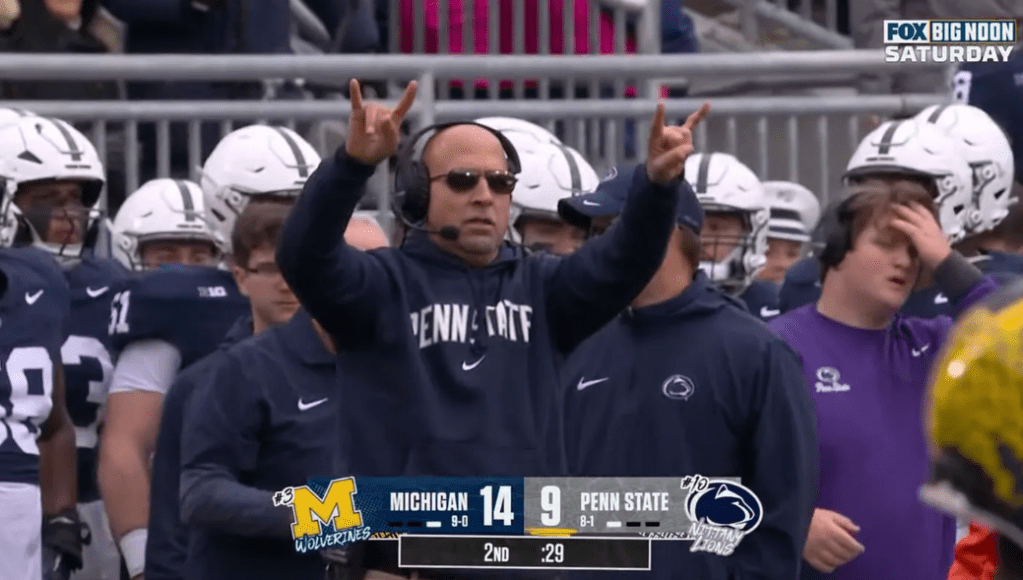
After Penn State fell to Michigan 24-15 last Saturday, a reporter questioned James Franklin on his two-point conversion attempt in a now-viral video.
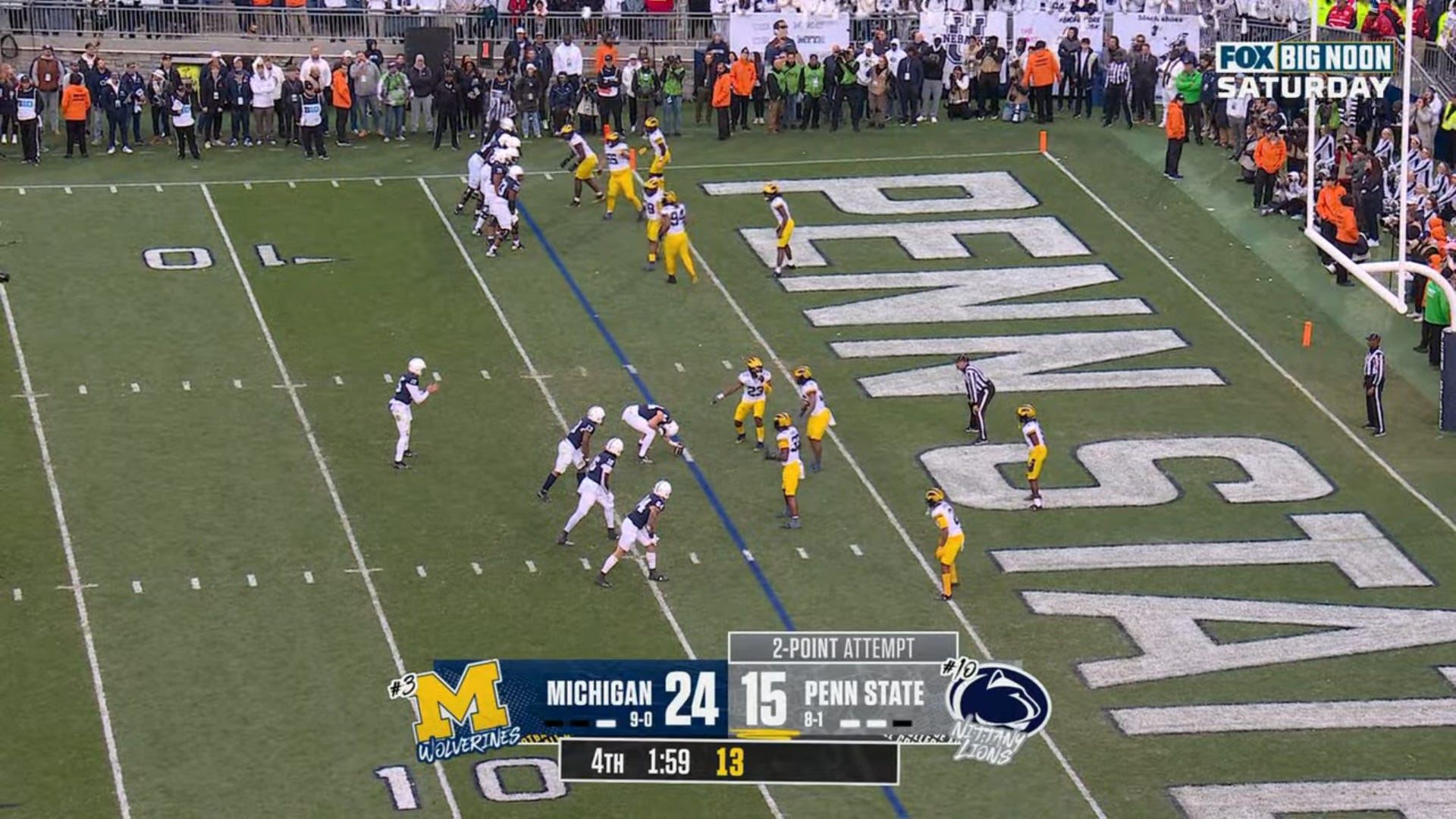
The situation was this: Penn State just scored a touchdown and was down 9, with 1:59 remaining in the game. They opted to go for it, lined up in what we can all agree was a questionable formation, and the attempt failed.
The counter-argument to the go-for-two decision boiled down to this:
“If you kick the extra point, you’re down 8 and your team is still in it. Down 9 with 1:59 left, you’re done.”
So there are a few issues with this argument:
The assumption that the game is over down 9 with 1:59 left is wrong. There’s about a 1% chance that you can win (based on NFL data) in that situation. If PSU held Michigan to a three-and-out on the next drive, they could have gotten the ball back with about a minute left.
If you’re down 8 (and you score again), you still need to go for two. So unless you think your team will magically be better at 2-point conversions next time, there’s no difference. (Penn State is 0-3 on the year, two of them in that game.)
Whether you know you’ve lost the game with 1:59 on the clock or 0:00s on the clock makes no difference.
Okay, so what does the math say?
It turns out, there may be no difference, which is kind of what I was getting at up above. It doesn’t matter. Fans very passionately want to feel like they’re in it to the last moment. Coaches prefer to know what their options are ahead of time. Do I need an onside kick? Because if so I’ll do it now rather than later.
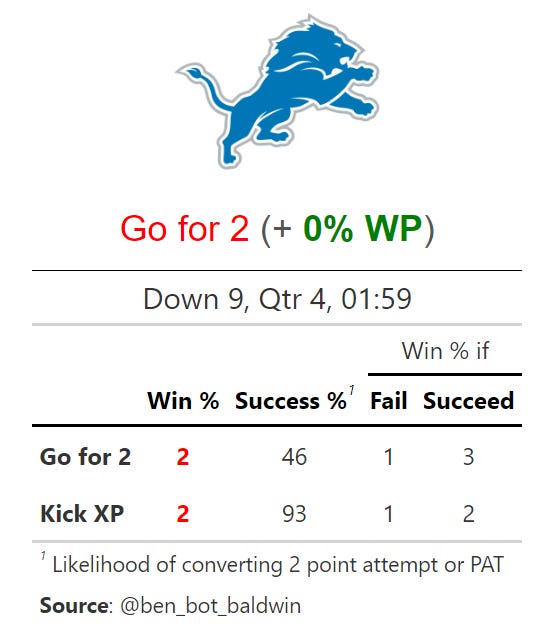
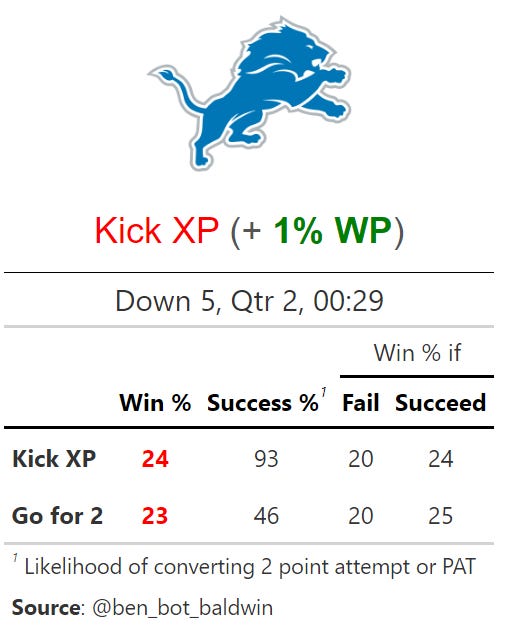
I used Ben Baldwin’s 4th-down-calculator and the 2022 Lions-Packers to simulate this game since the Packers (Michigan) were 4.5-point favorites over the (Detroit, not Nittany) Lions (Penn State).
On average, whether you make or miss either attempt, you end up with about a 2% win probability. Not great either way. But in the end, it looks like the decision was a toss-up. So the strong anger and one-sided debate are a bit surprising. But I’ll chalk it up to a frustrated fan base.
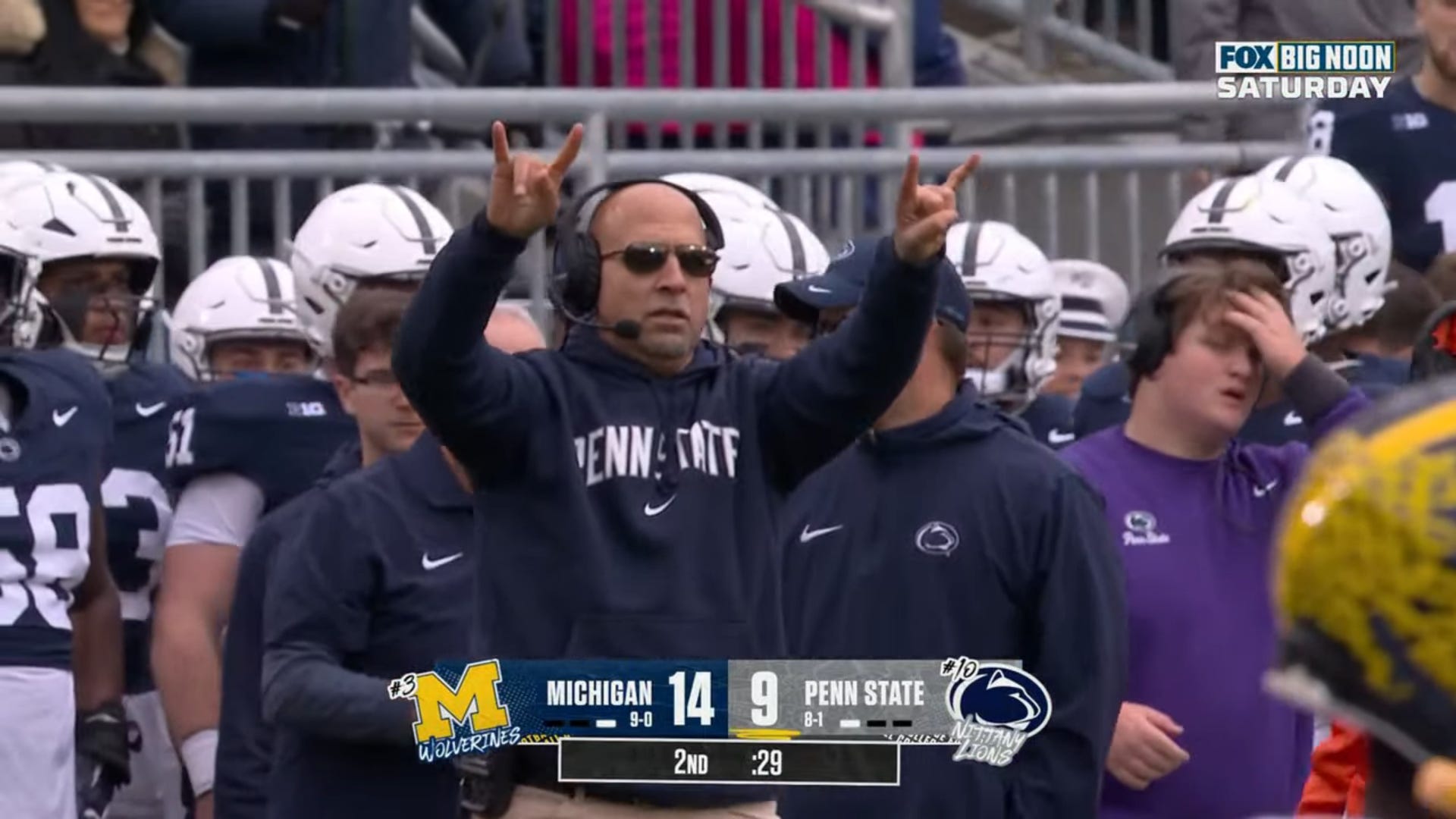
What we don’t need to argue about is Franklin’s decision to go for two in the second quarter, down 14-9. Here, there was so much time left that going for two actually hurt their win probability.
Now, this is contrary to what I just said earlier about knowing what you need ahead of time, so I think this outcome speaks to the cost of leaving free points off the board early.
On the methodology: If I were more precise, I would pick my teams based on two-point conversion rates, PAT percentages, and two-point conversion defense, but there’s just not enough data to know that when PSU has only attempted three on the year and Michigan has only defended two (4th and short or 4th and goal can sometimes be a proxy for 2PA).
After Pato O’Ward’s poor qualifying effort which had him starting 25th at Mid-Ohio, the broadcasters in the NBC booth stressed that he had to “do something different”.
And sure enough, the McLaren driver’s pit wall opted for a 3-stopper instead of the favored and eventual race-winning 2-stop strategy.
Despite these setbacks, O’Ward still finished with the 3rd fastest total time in the field, covering 80 laps just 14 seconds slower than race winner Alex Palou despite finishing 28.5s behind on the track.
Of course, qualifying better could have eaten into that chunk of time a bit, but could one-less pitstop and the 30 seconds saved have made up for his poor qualifying and seen O’Ward actually come from 25th to win?
To analyze this, we need to consider two things:
How much time would O’Ward have saved by pitting one less time? (This is the easy question to answer because it’s just the pit delta).
How much time did O’Ward gain from having fresh tires on his extra stint, or how much time would he have lost being on older tires for longer?
The net of these two things ends up being the delta between a 2-stopper and a 3-stopper.
The second question is harder to answer because we don’t know how his tires would have held up, what traffic he would have hit, and all the other unknowns that may have occurred had he 2-stopped.
The best we can do is see how the drivers around him were affected and extrapolate out to O’Ward’s race.
Pit Delta
The pit delta for O’Ward specifically can be found by looking at his pit-in and pit-out laps, and then comparing that to his normal non-pit green flag laps.
The Pit Delta also changes as the race progresses, and particularly the 3rd stop delta was quicker for O’Ward because he needed less fuel, so we will use that delta instead of the overall average. His 3rd stop was 2s quicker than his 2nd stop and 6.5s quicker than his first.
So his 3rd stop added 26.775 seconds to his race time vs. staying out and doing average-paced laps.
Green Flag Pace
O’Ward’s green flag non-pit lap times on average were 69.8 seconds. The drivers on the 2-stop strategy were averaging 70.6 seconds per lap, but we care more about the fastest of the 2-stoppers, Alex Palou and Scott Dixon.
They were both averaging 69.95. So on a typical green-flag non-pit lap, of which there were 69 for O’Ward, he was only 0.15s faster than Palou. So that equates to about 10.4s gained over those green flag laps on pace alone.
So he gained 10.4s by choosing a 3-stop over a 2-stop, but lost 26.8s in pit-road time, for a net loss of 16.2s with a 3-stop strategy. This tells us that O’Ward likely should have stuck with a 2-stop strategy.
Compared to the field, the 3-stopper made sense as he was almost a full second quicker per lap than the average 2-stopper, meaning he made up 55s on the field to counteract his 27s stop. But the fastest 2-stoppers were able to keep a similar pace to him even on longer stints.
Navigating Traffic
What likely hurt O’Ward was all the extra passes he had to make thanks to that extra stop. O’Ward started in 25th, so he had a bigger gap to make up and 24 cars to get by. He was already 6.6s behind Palou at the end of the first full green flag lap.
O’Ward had to overtake 43 cars for position in the race, 14 more than the next-closest driver. Palou and Dixon were among the lowest in the field, with just 10 and 13 overtakes, respectively. This number doesn’t cover the backmarkers, although all drivers would have to deal with them eventually.
You can see this take effect in the data too. While O’Ward had the fastest green-flag pace of anyone, he also had one of the highest standard deviations in lap time, meaning he was not able to be consistent. The difference may seem slight, but it is enough to make an impact on your race, and this accounts for the significant amount of extra time he spent behind and navigating around his competitors.
You can see from the green flag lap charts that O’Ward was much more inconsistent than Palou over the course of the race, with spikes and dips in pace.
Tire Difference
The last thing we’ll look at is the tire dropoff, which undoubtedly helped O’Ward to pump out laps almost a whole second faster than the field average throughout the race.
The reds and primary tires were similar until lap 15 of a stint, when the reds fell off sharply by about 0.5 seconds. At 25 laps, both tires were 1 second slower than at their best.
As you can see, there’s about a 1-second dropoff from lap 10 to lap 20 on the reds, and about a half-second on the primaries. The reds seemed to come back a bit near the end of the stint, but that could be drivers just pushing them to the max before pitting.
Luckily for O’Ward, he was on the primary most of the race which appears to be preferable if you want to go more than 15 laps. However, as the race went on and the traffic built up, his pace got slower and slower and his lap times more unpredictable.
When To Do An Extra Stop
This is a question that I want to do more research on, but my initial thoughts after doing this analysis are:
You have to take track position and traffic into account. If you are going to have to re-pass more than 2 or 3 cars by pitting, it’s going to cost you a significant chunk of time. 3-stopping probably makes more sense for leaders with a big gap who want to protect against tire dropoff than it does for mid-pack trying to make a big move.
Track length and cars on track matter. A short 70-second lap like Mid-Ohio with 27 cars on course appears to be the wrong place to do an extra stop. There’s too high a chance of coming out in traffic and dealing with backmarkers late in the race.
Tire dropoff matters. If tire dropoff isn’t significant, then you don’t have as much to gain on fresh tires vs. worn tires. Similarly, if the difference between reds and blacks isn’t significant, then doing shorter stints on softer tires won’t be as big of an advantage.
Cautions change everything. If more cautions had fallen later in the race, the analysis changes completely. Time lost on pit lane is mostly erased. Restarts provide easy overtaking opportunities.
Fernando Alonso and Aston Martin ended up making a crucial mistake as the rain started to fall, opting for a set of Medium compound tires as everyone else jumped on the Intermediates. It ended up costing him an extra pit stop just a lap later and the approximately 25-second delta along with it.
Had he and the team made the correct decision the first time, is it possible that we could’ve had a race for P1 in the final 20 laps?
Let’s use the best intermediate times as a reference to see what could’ve been possible in the crucial lap between Alonso and Max Verstappen’s pitstops.
The Lap Before
On lap 53, the hard was still the fastest tire, with George Russell clocking the fastest lap. So Alonso would have no data to go on to know that the inter would soon be the fastest. Valtteri Bottas and Lance Stroll would be the first to try them on, with their first full lap of data coming on Lap 53. Of course, Alonso was ahead of them so would have had less time to know the results of those laps as he’d already be well into Lap 54.
Alonso Boxes
Before Alonso’s first pitstop on lap 54, he was 9.8s behind Verstappen. At the end of his first stop, he was up to 26.1s behind, with Verstappen yet to pit, with his stop taking 24.4 seconds in total. If you’re wondering why he wasn’t 34.2s behind, it’s because Verstappen had some major moments on Alonso’s pit-in and pit-out laps that helped ease the damage of his stop tremendously. All the more reason the tire choice was crucial.
On 54, the Medium was the fast tire with Charles Leclerc clocking a 1:35.7 and the fastest Inter a 1:38.7.
Verstappen Boxes
This is where it gets interesting. While the Hard, this time of Lewis Hamilton, was yet again still the faster tire on Lap 55, the Inter was only 1.5s slower and closing the gap as people still on slicks started to slide.
Verstappen would make his one and only pit stop on lap 55 in 24.8 seconds, coming back out on the Inters. However, a major point is his in-lap, which was an astonishing 130.6 seconds, 31.5s slower than Alonso’s in-lap a lap before! This theoretically does Alonso massive favors, essentially erasing any time he lost in the pits.
Alonso Boxes Again
On the same lap, Alonso would pit a second time for Inters as well, this time in 25.9 seconds, and unerasing the advantage that Verstappen handed him that very same lap.
What Could Have Been For Aston Martin
So, if we keep his pit-out from lap 55, subtract Alonso’s second pit-in from Lap 55 and his pit-out from 56, then he makes up 20.4s on Verstappen in Lap 55 alone (mostly due to VER’s stop and slow in-lap), but crucially another 6 seconds on Lap 56 (instead of the 2.4 seconds he lost to VER in actuality on 56).
In all, Alonso left 25s on the table by pitting a second time (right around the pit delta), and could’ve ended up 2.2s ahead of Verstappen at the end of Lap 56 had he gotten Inters the first time and ran them at their best pace for two laps.
In reality, he ended up losing 10.8s to Verstappen with his double-pit. The only reason he didn’t lose more was because Max struggled mightily on his pit-in lap as well as the previous lap.
In the last 22 laps, Verstappen pulled out another 4.8s on Alonso, so Max definitely had better pace once both were on the Inters. However, at Monaco, you could easily imagine Alonso being able to hold off the Red Bull, even with its quicker pace.
It’s impossible to know for sure if Aston Martin would’ve pulled out the win, but it certainly looked promising up until that pit stop blunder.